GHRP-2, GHRP-6, and Hexarelin are synthetic six-residue growth-hormone secretagogues studied in the ghrelin-receptor system. They share a research class and a primary receptor context, but they are different sequences with uneven evidence profiles. A fair comparison therefore applies the same criteria to all three and keeps every result attached to its model, endpoint, and directly tested compound.
This page is for researchers comparing chemical identity, receptor systems, historical human challenge studies, appetite observations, pituitary-axis measurements, formulation-specific regulatory context, and Hexarelin’s separate CD36/cardiac literature. It does not select a winner or provide a personal-use, combination, bodybuilding, treatment, or diagnostic protocol.
- All three are synthetic hexapeptides associated with GHSR-1a, the ghrelin/growth-hormone-secretagogue receptor system.
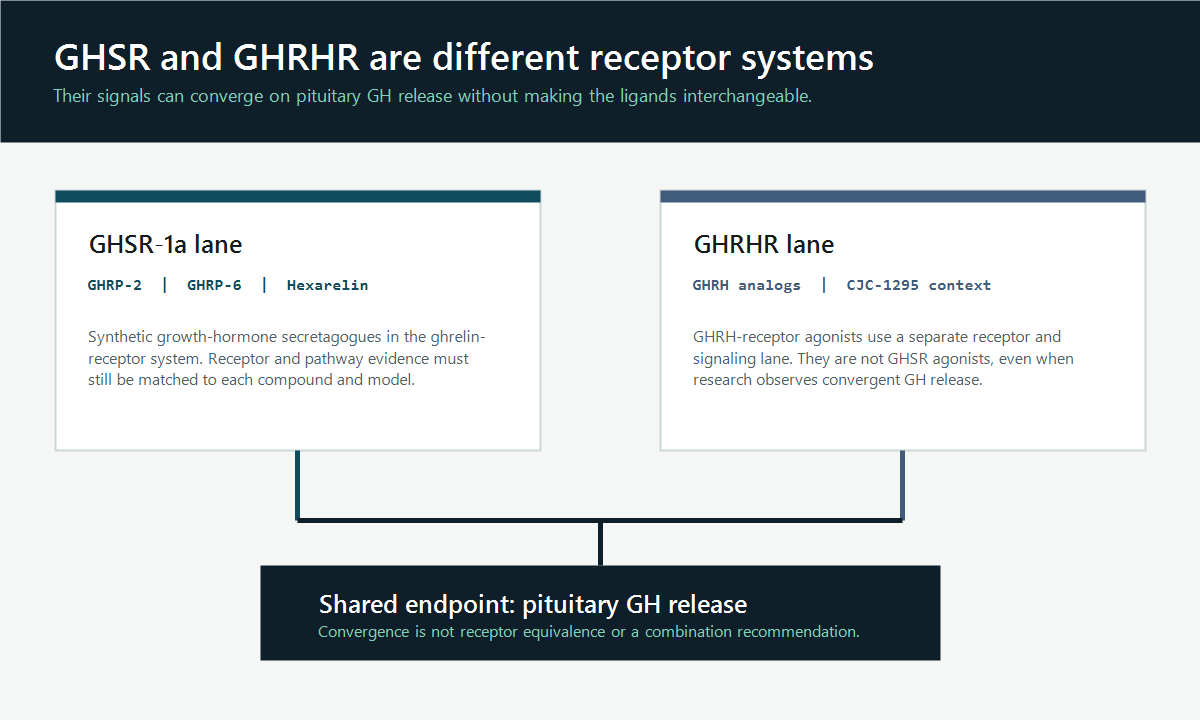
- GHSR-1a is not GHRHR. GHRH analogs such as CJC-1295 use a distinct receptor even though both pathways can converge on pituitary GH release.
- Direct GHRP-2/GHRP-6 experiments support shared receptor-mechanism context, not a human combination claim.
- Appetite evidence is asymmetric: GHRP-2 has human food-intake data, GHRP-6 has rat feeding data, and Hexarelin has a small acute subjective appetite signal in 15 healthy young men—not measured food intake or efficacy.
- The GHRP-2/Hexarelin human comparison measured GH and other pituitary-axis hormones, but it did not include GHRP-6.
- Hexarelin has a separate CD36/cardiac research lane; that does not establish an approved cardiovascular use or superiority.
- Japan’s GHRP Kaken 100 approval is for a named pralmorelin hydrochloride prescription diagnostic formulation, not a therapeutic approval and not an approval of Apex GHRP-2 reagent.
Set the Criteria Before Comparing
A comparison becomes unreliable when it begins with a verdict and searches backward for support. The defensible sequence is the opposite: define the research question, apply the same fields to each compound, identify direct sources, and leave missing cells visible. This is especially important for older secretagogue literature because studies differ in species, age, assay, challenge design, endocrine sampling window, and comparator.
The common comparison fields used here are molecular format, sequence, receptor system, direct human GH-response evidence, appetite evidence, prolactin/ACTH/cortisol measurements, CD36/cardiac evidence, repeated-exposure response, formulation-specific regulatory context, and human therapeutic efficacy and safety. A result earns direct status only when the named compound and endpoint appear in the cited experiment. Class context, formulation status, and results from another peptide stay separate.
Identity and Sequence
The three compounds are synthetic hexapeptides from the growth-hormone-releasing peptide lineage established through early structure-activity work such as Momany et al. (1981), whose most active designed analog released growth hormone from rat pituitary tissue in vitro at 10–30 ng/mL, about 1,000-fold above its enkephalin precursors. Their sequences differ at positions that can change receptor pharmacology, stability, and off-target behavior. Shared chain length does not make them interchangeable.
| Field | GHRP-2 | GHRP-6 | Hexarelin |
|---|---|---|---|
| Common synonym | Pralmorelin | Prototype GHRP-6 | Examorelin |
| Molecular format | Synthetic hexapeptide | Synthetic hexapeptide | Synthetic hexapeptide |
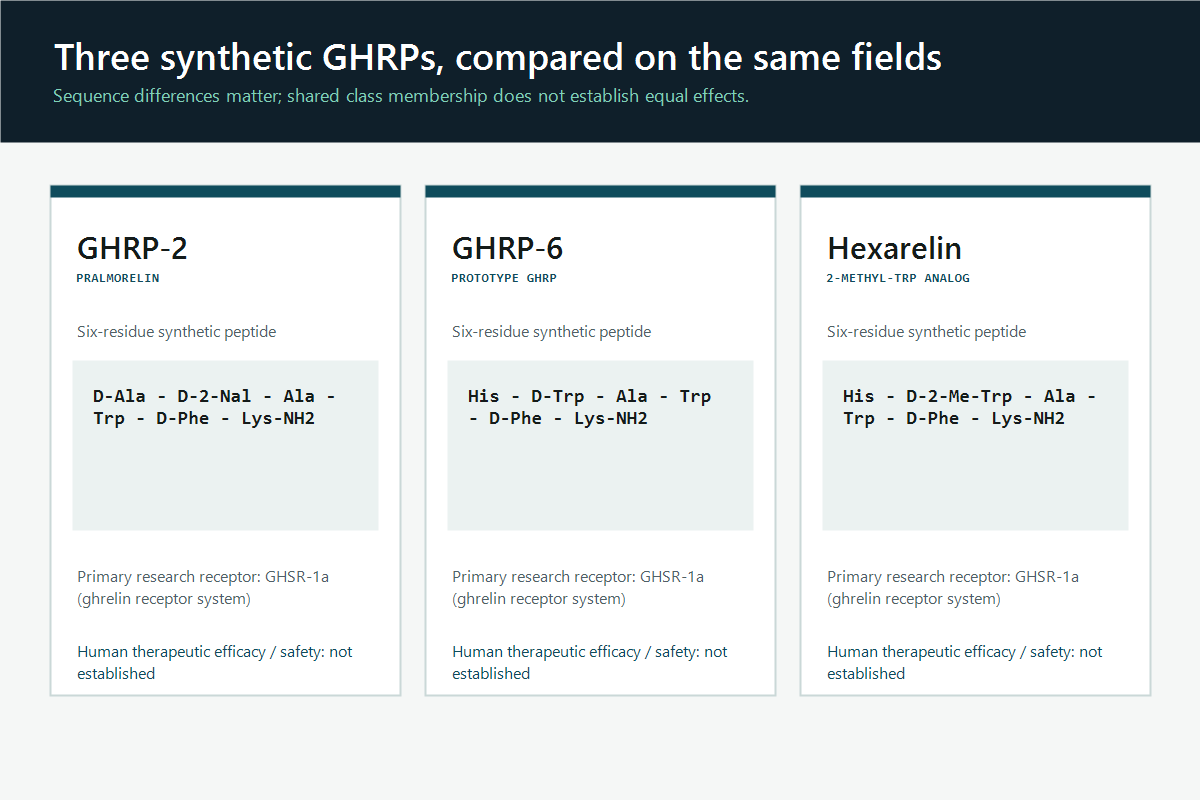
| Sequence | D-Ala-D-2-Nal-Ala-Trp-D-Phe-Lys-NH2 | His-D-Trp-Ala-Trp-D-Phe-Lys-NH2 | His-D-2-Me-Trp-Ala-Trp-D-Phe-Lys-NH2 |
| Primary research receptor | GHSR-1a | GHSR-1a | GHSR-1a |
| Distinct evidence emphasis | Human GH challenge, appetite, diagnostic-research history | Prototype GH and appetite research | GH challenge, repeated exposure, CD36/cardiac research |
| Named pharmaceutical-formulation context | Japan: GHRP Kaken 100, a distinct pralmorelin hydrochloride prescription formulation approved as an in-vivo diagnostic | None established in the selected PMDA sources | None established in the selected PMDA sources |
| Approved therapeutic efficacy/safety | Not established here | Not established here | Not established here |
GHSR Versus GHRHR: Different Receptor Systems
The receptor distinction is the most important correction in this comparison. Molecular cloning identified the growth-hormone-secretagogue receptor in swine and human pituitary and hypothalamic tissue (Howard et al., 1996), and ghrelin—a 28-residue peptide octanoylated at serine 3, purified from rat stomach—was later identified as its endogenous ligand (Kojima et al., 1999). Both are receptor- and ligand-characterization papers and report no quantitative endpoint for the three peptides compared here. GHRP-2, GHRP-6, and Hexarelin are synthetic ligands in this GHSR-1a research lane.
GHRH analogs use the growth-hormone-releasing-hormone receptor, GHRHR. A transfected-cell experiment found that GHRP-2 did not signal through the human GHRH receptor: in rat GC pituitary cells carrying the human GHRHR, GHRH raised intracellular cAMP up to 20-fold, while GHRP-2 left cAMP unchanged at every concentration tested (Chen et al., 1998). Separate pathways can converge on pituitary GH release, and research can observe interaction between them, but downstream convergence does not merge receptor identities.
Direct GHRP-2/GHRP-6 work provides another boundary. Cheng et al. (1997) reported a shared receptor/mechanism in cultured rat pituitary cells and no additive response when both were present at maximally effective assay conditions; that published abstract records the comparison qualitatively and reports no quantitative endpoint for relative potency. That is mechanistic evidence in a rat-cell model. It is not a human combination experiment and does not support a stacking recommendation.
For deeper context on the separate axis, see the CJC-1295 research guide and the growth-hormone-axis research hub. Those pages are navigation aids, not evidence that a GHRH analog and a GHRP are interchangeable.
Evidence by Model
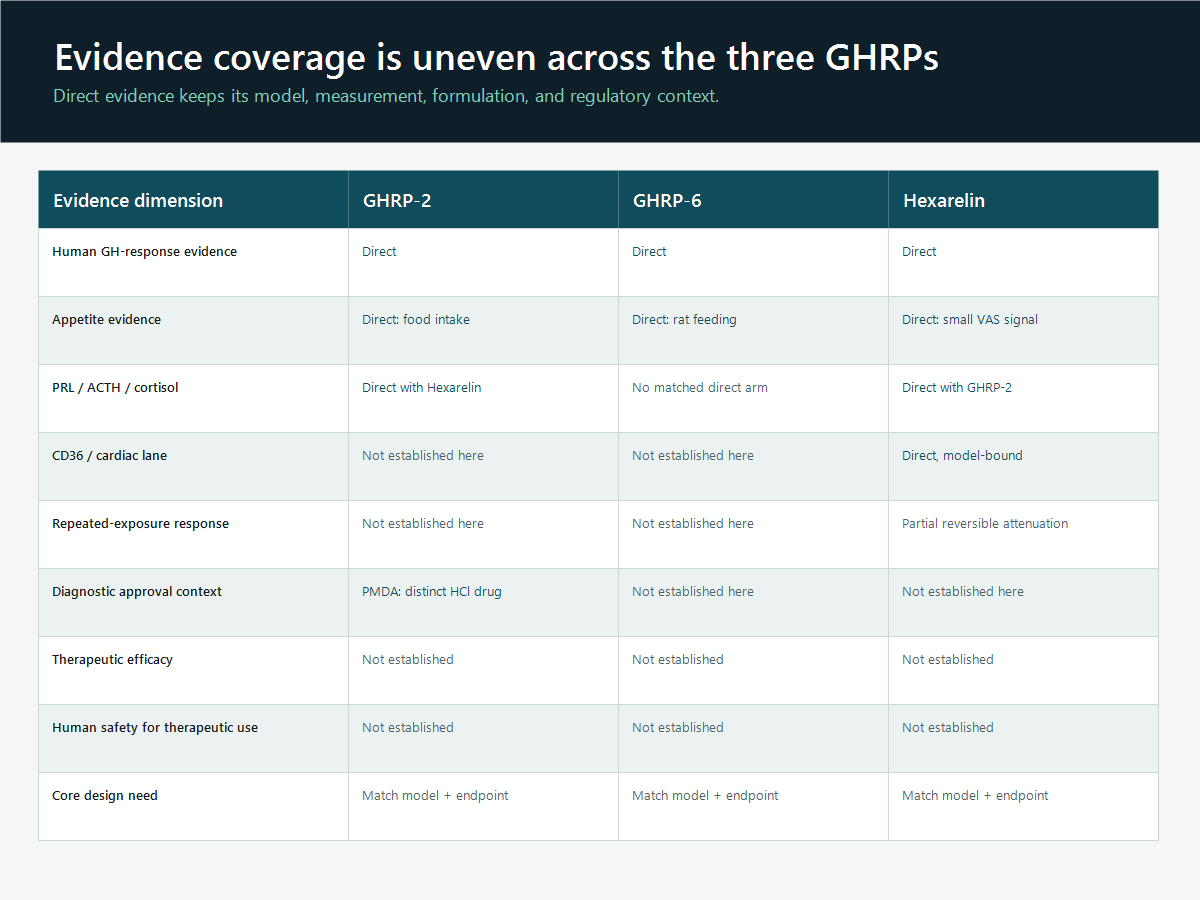
All three have historical human GH-response records, but there is no single study in the selected source set that tests all three under one modern, matched design. The most defensible comparison therefore preserves pairwise and single-compound results instead of normalizing them into a universal ordering.
| Evidence dimension | GHRP-2 | GHRP-6 | Hexarelin |
|---|---|---|---|
| Human GH-response evidence | Direct historical challenge studies | Direct historical challenge studies | Direct historical challenge studies |
| Appetite evidence | Direct human food-intake evidence | Direct rat central feeding evidence | Direct small subjective VAS appetite signal in 15 healthy young men; food intake not measured |
| PRL/ACTH/cortisol comparison | Direct comparison with Hexarelin | No matched arm in that paper | Direct comparison with GHRP-2 |
| CD36/cardiac lane | Not established to the same depth here | Not established to the same depth here | Direct preclinical and limited acute human physiology evidence |
| Repeated-exposure response | Not established in selected sources | Not established in selected sources | Partial, reversible attenuation in one small historical study |
| Diagnostic approval context | PMDA: distinct pralmorelin hydrochloride prescription formulation approved as an in-vivo diagnostic | Not established in the selected official sources | Not established in the selected official sources |
| Approved human therapeutic efficacy/safety | Not established | Not established | Not established |
Criterion-by-Criterion Analysis
Human GH-response evidence
Historical human challenge studies document GH responses for each compound. For GHRP-6, Bowers et al. (1990) studied 18 normal men, in whom mean peak serum GH rose from 1.2 µg/L after placebo to 68.7 µg/L after 1.0 µg/kg intravenous GHRP-6, with submaximal doses acting synergistically with GHRH. For Hexarelin, Imbimbo et al. (1994) gave 12 healthy men intravenous boluses of 0.5–2 µg/kg, with mean peak GH of 3.9 ng/mL on placebo versus 52.3 ng/mL at 1 µg/kg. These records establish acute physiological responses under their tested conditions, not approved therapeutic efficacy, long-term safety, or comparative suitability.
A small human comparison of GHRP-2 and Hexarelin in 6 young adults aged 22–27 reported similarly strong GH responses to 1 and 2 µg/kg intravenously, each higher than the response to 1 µg/kg GHRH (p < 0.05) (Arvat et al., 1997). There was no GHRP-6 arm. The result therefore supports a pairwise observation under specific conditions, not a three-way ordering.
Appetite evidence
Laferrere et al. (2005) infused 7 lean healthy men with GHRP-2 at 1 µg/kg/h and measured 35.9% higher intake at a subsequent ad libitum meal than on saline (p = 0.008). Lawrence et al. (2002) gave rats intracerebroventricular GHRP-6, which stimulated feeding and activated arcuate, paraventricular, and brainstem appetite centers and was blocked by a Y1 receptor antagonist; that rat report gives no quantitative endpoint for intake. Korbonits et al. (1999) studied 15 healthy young men (n = 15), quantified Hexarelin’s ACTH release (AUC 3,444 ng/L × 125 min), and reported only a small acute increment in subjective appetite measured by visual analogue scale. These are direct but different evidence types. The Hexarelin result did not measure food intake and does not establish a feeding effect, therapeutic efficacy, or a matched appetite magnitude across compounds.
Prolactin, ACTH, and cortisol
The Arvat comparison also measured prolactin, ACTH, and cortisol and reported similar increases for GHRP-2 and Hexarelin under its conditions. This helps distinguish broader pituitary-axis observations from GH alone. It does not establish the corresponding profile for GHRP-6, because GHRP-6 was not tested in that study. Nor can a brief challenge establish the long-term clinical significance of those hormone changes.
What direct GHRP-2/GHRP-6 comparisons can show
Pairwise preclinical comparisons help test whether two ligands share a signaling context, but their conclusions are assay-specific. Wu et al. (1996) compared GHRP-2 and GHRP-6 in ovine and rat pituitary cells: in ovine somatotrophs GHRP-2 raised intracellular cAMP dose-dependently and GHRP-6 released GH without raising cAMP, while in rat cells GHRP-2 raised no cAMP at all. That abstract likewise reports no quantitative endpoint for either peptide. Cheng and colleagues then interrogated their shared receptor mechanism in cultured rat pituitary cells. Together these papers support a common GHSR-related lane while still showing why a universal potency table is inappropriate: assay conditions, receptor expression, ligand exposure, and endpoint timing shape the observed response.
They also do not answer every selectivity question. Selectivity can mean receptor binding, intracellular signaling bias, GH versus other pituitary-axis responses, or separation from nonpituitary targets. Raun et al. (1998) introduced Ipamorelin as a more selective secretagogue comparator in animal research: in anaesthetized rats its maximal GH response was 1,545 ng/mL against 1,167 ng/mL for GHRP-6, and in conscious swine it did not raise ACTH or cortisol where GHRP-6 and GHRP-2 did. That record still does not turn the present page into a four-compound ranking. Every selectivity claim needs the exact endpoint and comparator that produced it.
Hexarelin’s CD36 and cardiac research lane
Hexarelin has a distinct literature beyond pituitary GHSR signaling. Locatelli et al. (1999) gave hypophysectomized rats 80 µg/kg subcutaneous Hexarelin for 7 days, which prevented the ischemia-reperfusion damage hypophysectomy caused, as subcutaneous GH at 400 µg/kg did. Broglio et al. (2001) gave 2.0 µg/kg intravenous Hexarelin to 7 normal adults, 7 GH-deficient patients, and 12 patients with dilated cardiomyopathy; left-ventricular ejection fraction rose in the first two groups (p < 0.05) but not the third. These studies generate a cardiac research lane; they do not establish a cardiovascular treatment or chronic safety profile.
Mechanistic work connected this lane to CD36. Bodart et al. (2002) photolabelled rat cardiac membranes, identified an 84 kDa binding protein as CD36, and found that Hexarelin raised coronary perfusion pressure dose-dependently in perfused hearts but not in CD36-null mice. Demers et al. (2004) mapped the Hexarelin site to an 8 kDa CD36 fragment spanning residues Asn132–Glu177. A biochemical binding-site result is not the same as pituitary GHSR signaling, and neither result proves a clinical cardiac outcome.
Repeated-exposure evidence
One historical study gave twice-daily subcutaneous Hexarelin to 12 healthy elderly adults for 16 weeks: the mean GH area under the curve fell from 19.1 to 10.5 µg/L per hour (p < 0.01), then returned to 19.4 µg/L per hour four weeks after stopping (Rahim et al., 1998). Its small sample and specific design prevent a general conclusion about desensitization, long-term safety, or how another GHRP would behave. The study is an observation to reproduce, not a schedule.
A Research-Design Framework
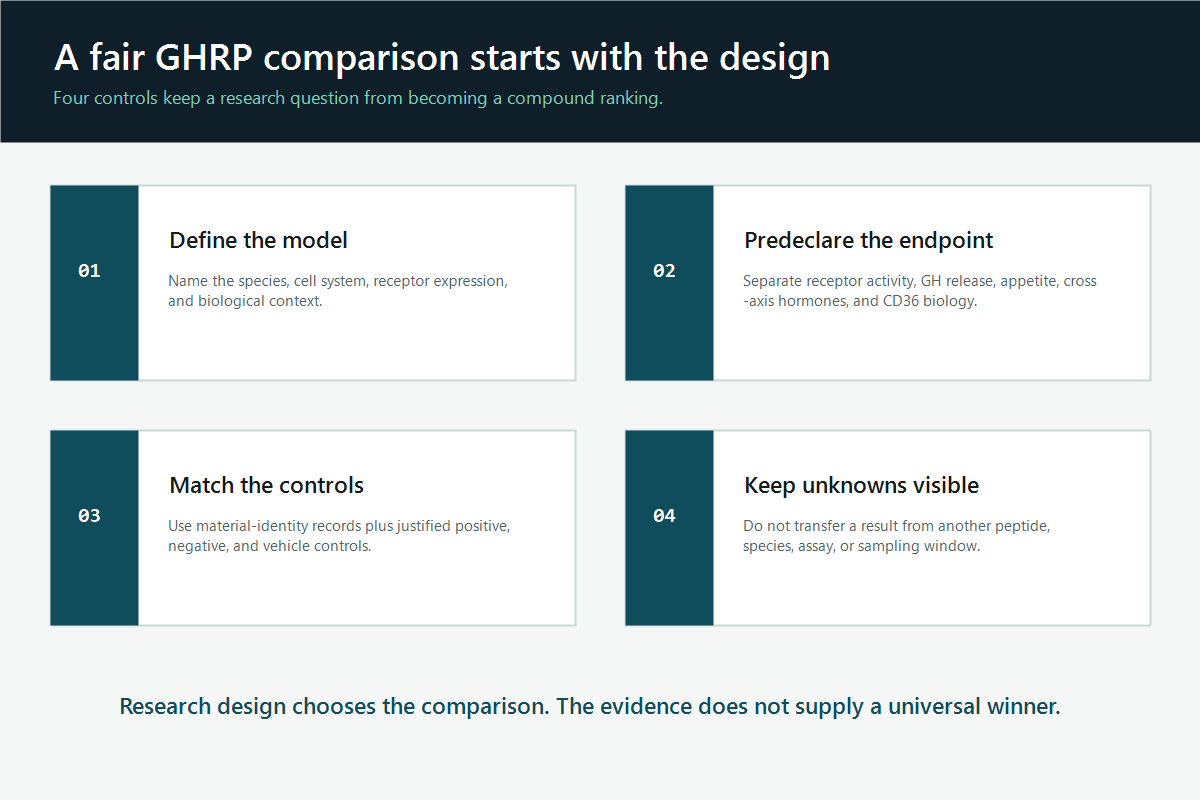
Selection for a legitimate experiment should follow the hypothesis, not a generalized compound ranking. A pituitary-receptor study, appetite-circuit model, CD36 binding experiment, and assay-development project need different controls and endpoints. At minimum, a protocol should define the model and species, receptor or pathway under test, analytical identity of the material, exposure confirmation, sampling window, positive and negative controls, and predeclared endpoint.
Cross-compound work should keep concentrations and assay conditions analytically justified, but this article does not supply them. It should also distinguish GHSR activity from GHRHR activity, GH release from non-GH endpoints, acute challenge from repeated exposure, and biochemical binding from organism-level physiology. An apparent difference has little meaning if the materials, assays, or sampling designs are not comparable.
The unresolved human questions are substantial: therapeutic efficacy, long-term safety, immunogenicity, interaction risk, formulation equivalence, and the clinical significance of cross-axis hormone changes. Historical challenge and diagnostic-research papers do not resolve those questions for current research materials.
Historical terminology needs similar discipline. GHRP-2 appeared in GH-provocation and diagnostic-research contexts, including Chihara et al. (2007), where a 100 µg intravenous GHRP-2 test in 77 healthy subjects and 58 GH-deficient patients gave mean peak GH of 84.6 µg/L versus 1.36 µg/L (p < 0.001) and supported a 15 µg/L diagnostic cut-off. Japan’s PMDA currently lists GHRP Kaken 100 Injection, a prescription pharmaceutical formulation of pralmorelin hydrochloride, for diagnosis of growth-hormone secretion deficiency. The PMDA approved-drug list records it as an in-vivo diagnostic approved October 22, 2004. This is diagnostic—not therapeutic—approval for that named hydrochloride pharmaceutical formulation; it does not transfer to Apex’s GHRP-2 research reagent. Older authors also discussed potential therapeutic directions, but an author’s proposed application is not current regulatory approval, a demonstrated benefit, or permission to transfer a study material’s performance to a commercial research vial.
Research-Material Context
Apex Laboratory supplies research-grade chemical reagents for in-vitro and preclinical research. The three catalog links below receive equal treatment and remain separate from the scientific comparison. The article does not repeat price, stock, variant, purity, or batch information; researchers should examine the current live listing and current analytical documentation for the specific material.
GHRP-2
Catalog destination for the current GHRP-2 research reagent. Literature claims remain tied to their cited test articles.
View the current product pageGHRP-6
Catalog destination for the current GHRP-6 research reagent. No evidence from another peptide is transferred to this material.
View the current product pageHexarelin
Catalog destination for the current Hexarelin research reagent. CD36 and cardiac literature remains model-bound.
View the current product pageFor an adjacent criteria-first comparison involving a different secretagogue profile, see Ipamorelin vs CJC-1295. That page also requires the same GHSR/GHRHR separation and should not be used to fill evidence gaps in this three-way comparison.
Frequently Asked Questions
Do GHRP-2, GHRP-6, and Hexarelin use the same receptor?
All three are studied primarily as GHSR-1a agonists. That shared receptor context does not make their sequences or evidence profiles identical.
Are GHSR and GHRHR the same receptor?
No. GHSR is the ghrelin/growth-hormone-secretagogue receptor system. GHRHR is the receptor used by GHRH and GHRH analogs. Their signals can converge on GH release without becoming one pathway.
Which compound is best?
The evidence does not support a universal winner. The scientifically useful choice depends on a defined model, endpoint, control set, and source-matched evidence.
Does GHRP-6 have the same cortisol and prolactin profile as GHRP-2?
The cited direct human comparison tested GHRP-2 and Hexarelin, not GHRP-6. Transferring that result to GHRP-6 would be unsupported.
Does Japan’s GHRP Kaken 100 approval apply to Apex GHRP-2?
No. PMDA’s diagnostic approval applies to the named pralmorelin hydrochloride prescription pharmaceutical formulation. It is not a therapeutic approval and does not make Apex’s GHRP-2 research reagent an approved diagnostic or medicine.
Does Hexarelin’s cardiac literature establish a human treatment?
No. The selected literature includes preclinical studies, biochemical CD36 work, and limited acute human physiology. It does not establish approved therapeutic efficacy or long-term safety.
Can the compounds be combined because they share GHSR?
The cited rat-pituitary-cell study is mechanistic evidence, not a human combination study. This guide provides no combination recommendation.