Sermorelin and CJC-1295 are distinct GHRH analogs built around the active GHRH(1-29) region. Sermorelin is C-terminally amidated human GHRH(1-29), whereas peer-reviewed CJC-1295 is a tetrasubstituted, DAC-bearing analog designed for albumin binding. The verified source set contains no direct head-to-head trial, so it does not support a universal claim that one is stronger, longer acting, safer, or better suited to research.
A useful Sermorelin-versus-CJC-1295 comparison has to solve a naming problem before it compares pharmacology. Sermorelin has a defined 29-residue identity and a historical finished-drug record under the Geref name. In the foundational papers, CJC-1295 includes a Drug Affinity Complex, or DAC. The catalog phrase “CJC-1295 no DAC” usually points to Modified GRF 1-29, which is a different material and cannot inherit the DAC construct’s study results.
- Sermorelin is human GHRH(1-29)-NH2; Sermorelin acetate is its acetate material form.
- The peer-reviewed CJC-1295 record describes a substituted GHRH(1-29) analog with a DAC group designed for covalent albumin binding.
- “CJC-1295 no DAC” is a commercial search label for Modified GRF 1-29, not the construct tested in the cited CJC-1295 human studies.
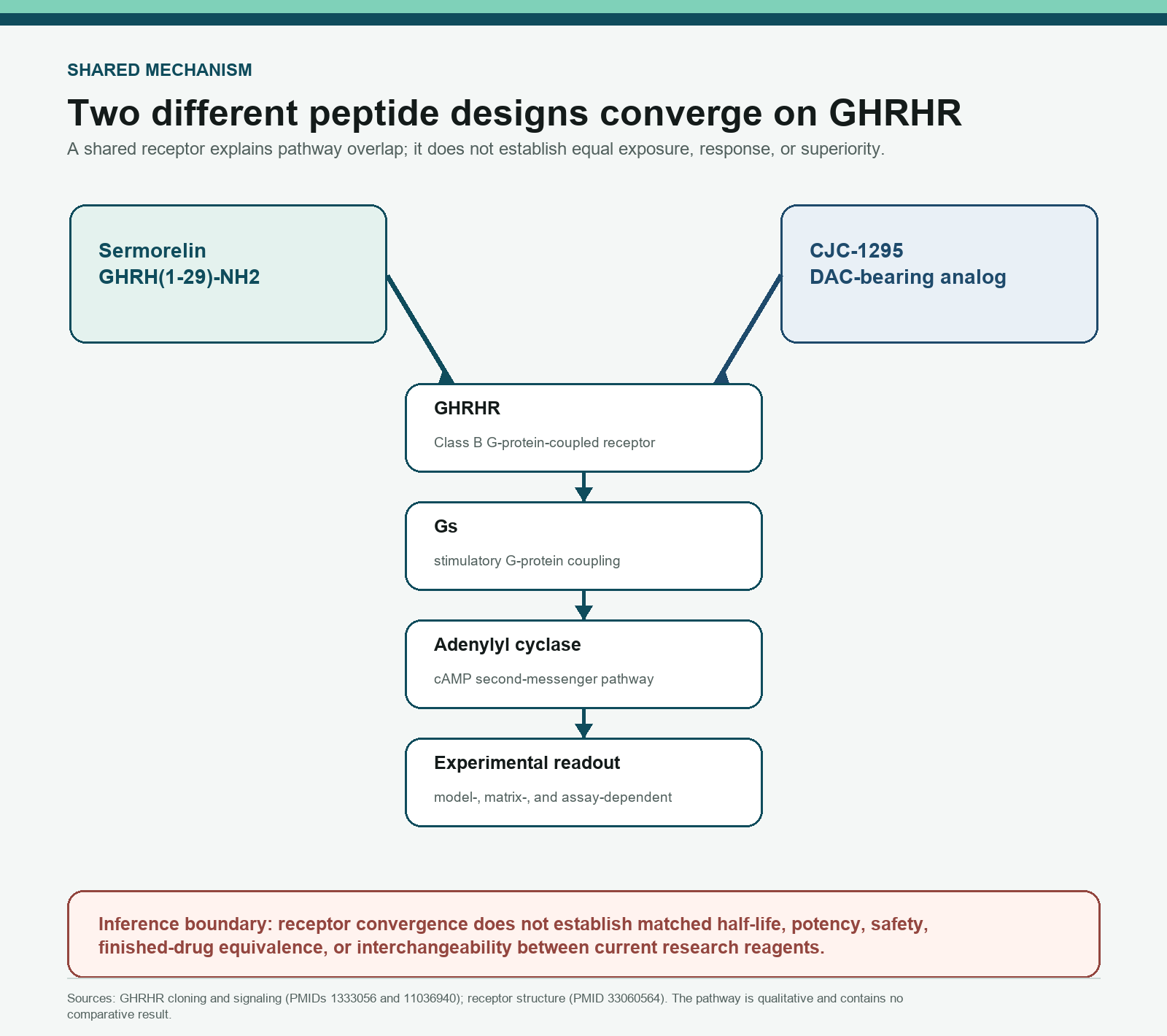
- Both analogs are studied through GHRHR and the Gs-cAMP pathway, but a shared receptor does not establish equivalent exposure or response.
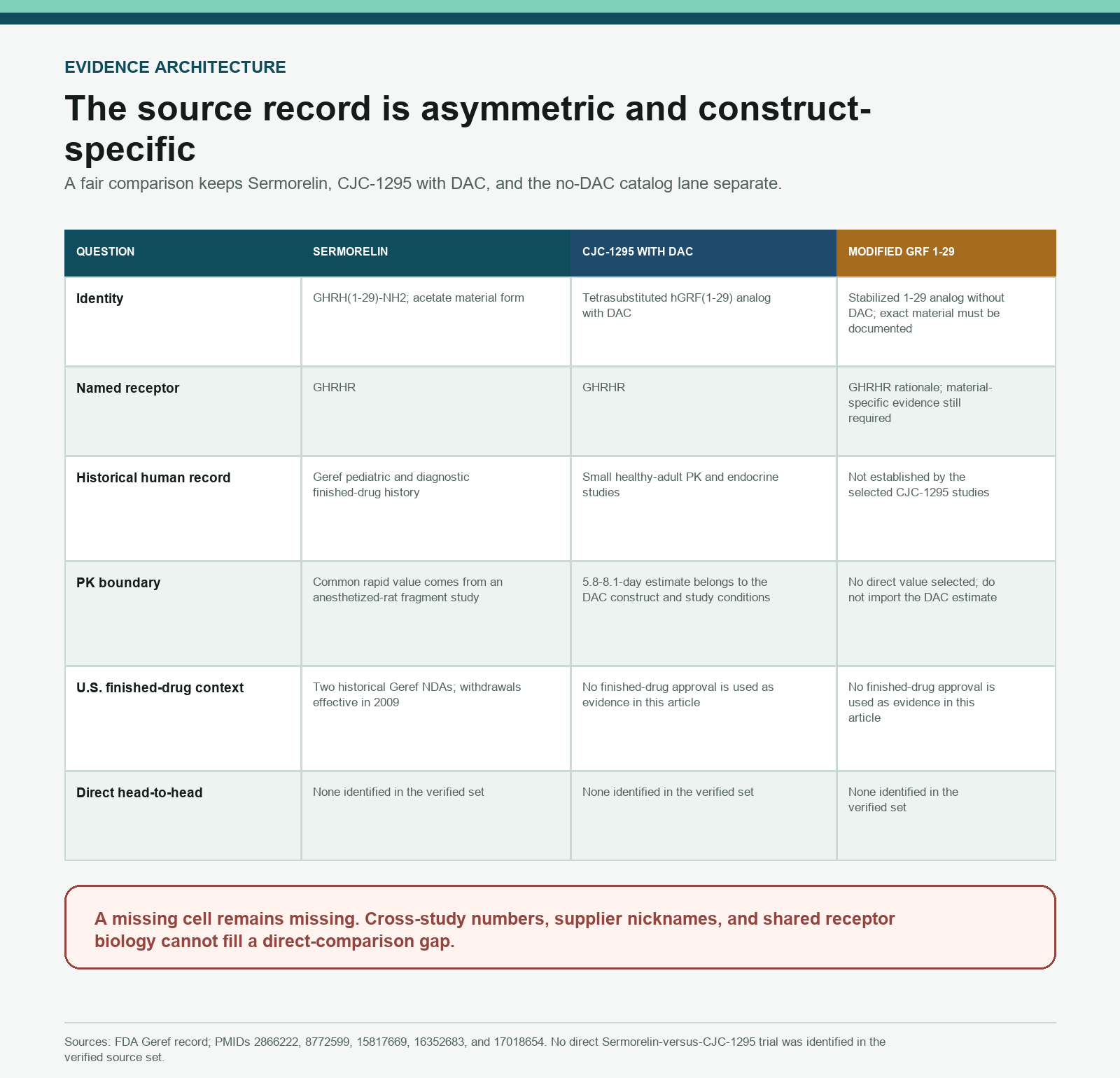
- The often-repeated rapid Sermorelin value comes from an anesthetized-rat experiment; the 5.8-8.1-day estimate comes from a historical CJC-1295-with-DAC study in healthy adults.
- No direct Sermorelin-versus-CJC-1295 trial was identified in the verified source set, so cross-study numbers cannot support a universal winner.
Sermorelin vs CJC-1295 at a Glance
| Comparison point | Sermorelin | CJC-1295 in the cited literature |
|---|---|---|
| Core identity | C-terminally amidated human GHRH residues 1-29 | Tetrasubstituted hGRF(1-29) analog carrying a DAC group |
| Common material wording | Sermorelin; Sermorelin acetate for the acetate material form | CJC-1295 with DAC; the selected papers do not describe Modified GRF 1-29 |
| Named receptor | GHRHR | GHRHR |
| Persistence strategy represented in the identity | Short active fragment with C-terminal amide | Substitutions plus a reactive DAC group designed for albumin binding |
| Historical human evidence emphasized here | Geref finished-drug study and regulatory history | Small healthy-adult pharmacokinetic and endocrine studies of the DAC construct |
| U.S. finished-drug context | Historical Geref NDAs approved in 1990 and 1997; withdrawals effective in 2009 | No finished-drug approval is used as evidence in this comparison |
| Direct head-to-head evidence | None identified in this article’s verified source set | |
| Current Apex context | Research-use-only reagent; not historical Geref | Research-use-only material; literature transfer requires exact construct matching |
The table compares source-backed fields, not therapeutic value. It does not turn a historical pharmaceutical record into support for a current vial, and it does not treat shared receptor biology as proof of equal potency. The sources reviewed for this refresh contain no matched head-to-head experiment.
How Do Sermorelin and CJC-1295 Identities Differ?
Human growth hormone-releasing factor was isolated and characterized in 1982, establishing the 44-residue parent sequence from which shorter research analogs were developed.[1][2] Both 1982 papers characterize structure and report no quantitative endpoint for either analog. Sermorelin contains that N-terminal 29-residue region plus a C-terminal amide, and comparative work in normal subjects found GHRH(1-29)NH2 equipotent to the longer GHRH(1-40) fragment, with 10-200 µg per subject lengthening the duration of stimulated GH release rather than raising the peak in proportion to dose (Grossman 1984, PMID 6236914). FDA substance records distinguish Sermorelin from the corresponding Sermorelin acetate material form.
CJC-1295 takes a different design route. The foundational characterization describes a tetrasubstituted hGRF(1-29) analog with a reactive DAC group engineered to bind albumin covalently.[8] That albumin-binding component is part of the studied construct, not a detachable marketing phrase. When a paper reports a result for CJC-1295, the material definition must be checked before the result is assigned to another label.
Verified reagent identity
| Identity field | Sermorelin | Modified GRF 1-29 (“CJC-1295 no DAC”) | CJC-1295 with DAC |
|---|---|---|---|
| CAS | 86168-78-7 | 863288-34-0 | 446262-90-4 |
| PubChem CID | 16132413 | 56841945 | 91971820 |
| Molecular formula | C149H246N44O42S | C152H252N44O42 | C165H269N47O46 |
| Molecular weight | 3,357.9 g/mol | 3,367.9 g/mol | 3,647.2 g/mol |
| Backbone | Native GHRH(1-29), C-terminal amide, native Tyr1-Ala2 N-terminus | Tetrasubstituted GHRH(1-29): D-Ala2, Gln8, Ala15, Leu27; C-terminal argininamide | Same tetrasubstituted backbone plus a C-terminal lysine carrying an N-epsilon-3-maleimidopropionamide group (the DAC) |
| Sequence | Tyr-Ala-Asp-Ala-Ile-Phe-Thr-Asn-Ser-Tyr-Arg-Lys-Val-Leu-Gly-Gln-Leu-Ser-Ala-Arg-Lys-Leu-Leu-Gln-Asp-Ile-Met-Ser-Arg-NH2 | Same 29-residue backbone, read positionally, with the four substitutions above | |
Formula and mass values resolve from the PubChem CID records above, cross-checked for Sermorelin against the FDA substance records cited below. The 279.3 g/mol gap between the two CJC-1295 forms is the Drug Affinity Complex itself, which is what a mass-spectrometric identity check detects. Apex lists all three as lyophilized research reagents. Read the applicable report for each form and configuration, including its declared identity, lot, methods, results and acceptance criteria.
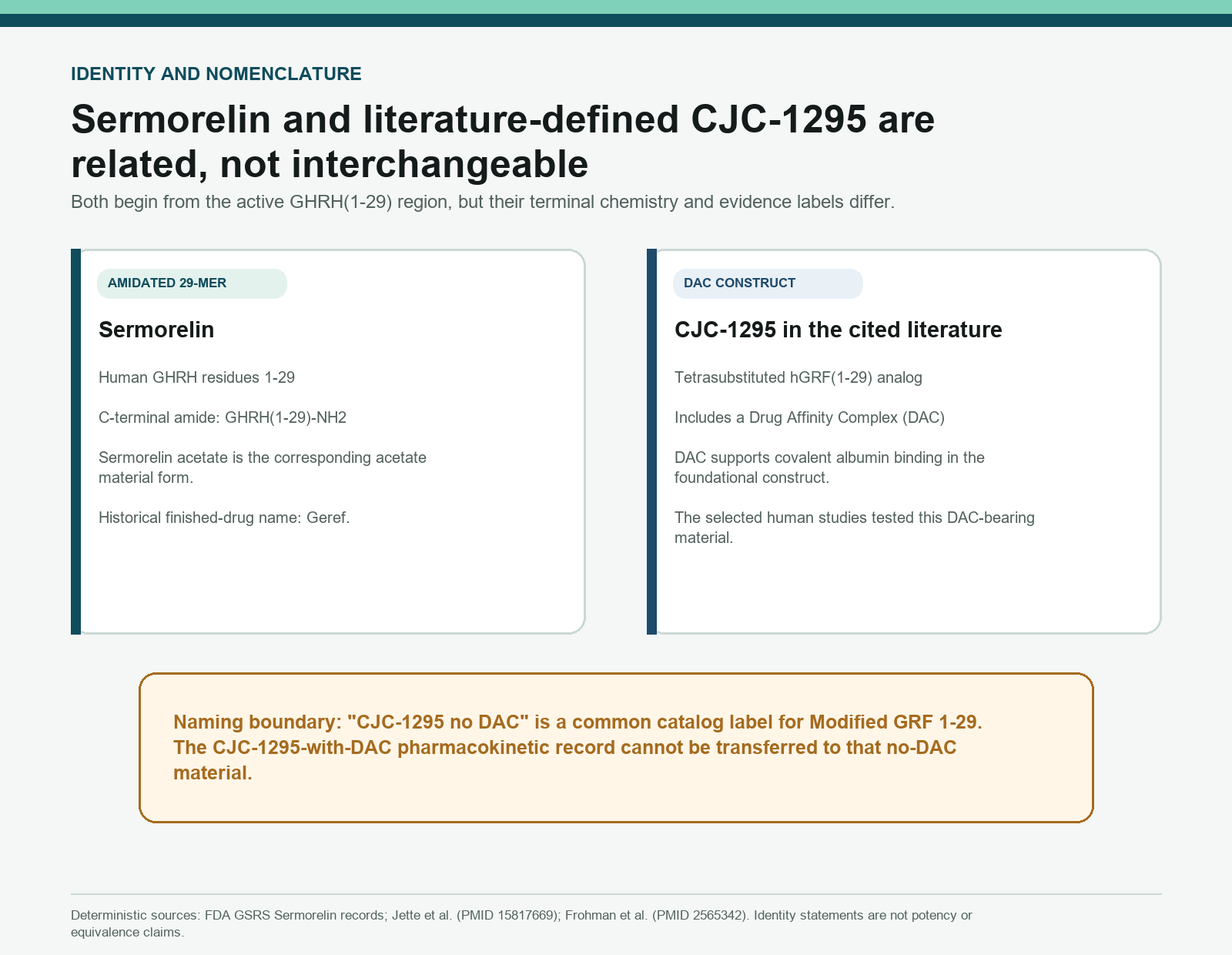
This distinction changes more than a product name. It determines the appropriate reference standard, expected analyte, mass-spectrometric target, chromatographic method, stability question, and literature set. A supplier nickname cannot establish those properties. The current lot must be evaluated through its own identity and purity documentation.
What Mechanism Do Sermorelin and CJC-1295 Share?
Both analogs are studied through the growth hormone-releasing hormone receptor. Molecular cloning identified GHRHR as a pituitary-enriched receptor that binds GHRH and couples receptor activation to intracellular cAMP signaling.[3] A later review described regulation of the somatotroph through GHRH and its receptor, and a cryo-electron-microscopy study resolved the human receptor bound to its endogenous ligand and the stimulatory G protein at 2.6 angstrom resolution.[4][5] All three receptor papers are characterization sources: each reports no quantitative endpoint for Sermorelin or CJC-1295, because none of them tested either analog.
The shared pathway can support a common mechanistic frame: ligand engagement, Gs coupling, adenylyl cyclase, cAMP, and a model-dependent cellular readout. It cannot support a claim that the ligands produce the same exposure or response. Sequence substitutions, terminal chemistry, protein binding, degradation, matrix, assay, species, tissue, and receptor expression can all alter what an experiment measures.
Why Does DPP-IV Set the Duration Difference?
The N-terminus is the control point that separates these two designs. Plasma-degradation work identified dipeptidyl peptidase IV as the primary route of human GHRH cleavage, at the bond between residues 2 and 3; GRH(1-29)-NH2 was rapidly cleaved alongside the native forms, conversion to the 3-44 metabolite was blocked by the DPP-IV competitive inhibitor diprotin A, and a D-amino-acid substitution at position 1 or 2 prevented hydrolysis altogether.[6] That study locates the cleavage site and reports no quantitative endpoint of its own.
An in-vitro series with porcine-kidney DPP-IV put numbers on the same substitution. Across a [X2,Ala15,Leu27]bGRF(1-29)NH2 panel incubated in PBS at pH 7.4, relative cleavage rates fell from 100% for Ala2 to 4% for Ser2, 2.5% for Thr2, 0.53% for Val2 and 0% for Ile2 (Martin 1993, PMID 8102071). A narrative review of DPP-IV/CD26 places GHRH in the same substrate class as GLP-1 and peptide YY and reports no quantitative finding specific to either analog (Mentlein 1999, PMID 10588446).
That is the design logic behind the two labels. Sermorelin keeps the native Tyr1-Ala2 N-terminus and its substrate profile; both CJC-1295 forms carry the position-2 substitution the porcine-kidney panel shows can slow cleavage by more than two orders of magnitude in vitro, and the with-DAC form adds albumin binding on top of that. None of these experiments ran the two analogs side by side.
What Does the Sermorelin Evidence Show?
The Sermorelin evidence record answers several different questions. A frequently repeated rapid-elimination figure traces to a 1985 experiment on hGRF(1-29)-NH2 in anesthetized rats. After a 10 µg intravenous dose the plasma disappearance curve was biphasic, with a distribution-phase half-life of 1.9 plus or minus 0.2 minutes and an elimination-phase half-life of 10.4 plus or minus 0.2 minutes; subcutaneous injection produced only 4% of the circulating exposure obtained intravenously.[7]
Those are rat values measured under anesthesia, and they are reported here as rat values. This article’s verified source set contains no primary human pharmacokinetic study of Sermorelin: a 2003 PEGylation review states a plasma half-life of about 10-20 min in humans and attributes it to renal ultrafiltration plus N-terminal enzymatic degradation, but states it as a review assertion with no human dataset attached (Esposito 2003, PMID 14499707). No validated human Sermorelin half-life has been published in this set, so the figure is carried with that qualification rather than deleted or promoted to a human number.
The Geref record is a separate finished-drug evidence lane. A multicenter study treated 110 previously untreated prepubertal children who had growth-hormone deficiency with 30 µg/kg of GHRH-(1-29) subcutaneously at bedtime for up to one year; among the 86 patients eligible for efficacy analysis, mean height velocity rose from 4.1 cm/yr at baseline to 8.0 cm/yr at 6 months and 7.2 cm/yr at 12 months, and 74% were rated good responders at the 6-month mark.[11] That historical study describes a regulated product in a defined pediatric population. It cannot establish purity, sterility, activity, safety, or equivalence for a present-day research-use-only reagent.
What Does the CJC-1295 Evidence Show?
The direct CJC-1295 record used here belongs to the DAC-bearing construct. Jette and colleagues synthesized three maleimido derivatives of hGRF(1-29), bioconjugated them to human serum albumin, and selected one for development: in normal male Sprague-Dawley rats, CJC-1295 produced a 4-fold larger growth-hormone area under the curve over a 2-hour window than unmodified hGRF(1-29), was still present in plasma beyond 72 hours, and appeared as an albumin-associated immunoreactive band from 15 minutes after injection onward.[8] The study supports construct identity, albumin binding, receptor activity, and preclinical persistence in rats. It is not a human outcome comparison with Sermorelin.
A later historical study ran two randomized, placebo-controlled, double-blind ascending-dose trials of 28 and 49 days in healthy adults aged 21 to 61 years. A single subcutaneous injection of the DAC construct raised mean plasma GH 2- to 10-fold for 6 days or more and mean IGF-I 1.5- to 3-fold for 9 to 11 days; the estimated half-life was 5.8-8.1 days, and after repeated dosing IGF-I stayed above baseline for up to 28 days, with 30 and 60 µg/kg identified as the better-tolerated doses.[9] Those values belong to the tested material, participants, assays, and sampling framework. They cannot be assigned to a no-DAC analog, a current vial, or a different experimental model without direct evidence.
A separate small study sampled GH every 20 minutes across a 12-hour overnight window in healthy men aged 20 to 40, before and one week after 60 or 90 µg/kg of the DAC construct. Pulse frequency and pulse magnitude were unchanged, while trough GH rose 7.5-fold (P<0.0001), mean GH rose 46% (P<0.01) and IGF-I rose 45% (P<0.001).[10] The precise conclusion is continued pulsatility during sustained GHRHR stimulation in that study. It is not evidence for Modified GRF 1-29, and it does not compare CJC-1295 directly with Sermorelin.
Why Does “CJC-1295 No DAC” Remain a Separate Evidence Lane?
“CJC-1295 no DAC” is useful for search and catalog navigation because researchers encounter that wording. When molecular identity matters, the clearer label is Modified GRF 1-29. Removing the DAC group removes the albumin-binding component that defines the foundational CJC-1295 construct. The result is not a second presentation that automatically inherits the same pharmacokinetics; it is a separate analyte requiring its own source record.
The selected CJC-1295 human papers do not provide an equivalent no-DAC pharmacokinetic data set. This article therefore does not publish the popular approximate 30-minute no-DAC half-life as an established value. Repetition across supplier pages is not a substitute for a direct, construct-matched source. The dedicated CJC-1295 with DAC versus Modified GRF 1-29 guide examines that nomenclature problem in greater depth.
A CJC-1295 result moves into the no-DAC lane only when the source explicitly identifies and tests the no-DAC material. None of the selected CJC-1295 human pharmacokinetic or pulsatility papers meets that condition.
Can Sermorelin and CJC-1295 Half-Life Be Compared?
Not as a clean ratio from the sources assembled here. The Sermorelin-associated rapid value comes from hGRF(1-29)-NH2 in anesthetized rats. The multi-day CJC-1295 estimate comes from a DAC-bearing construct in healthy adults. Those studies differ in material, species, setting, methods, sampling, and endpoints. Placing the two numbers side by side without those qualifiers creates an apparent precision that the evidence does not justify.
A valid head-to-head pharmacokinetic design would require construct-confirmed materials, matched model or population, route and formulation controls, dose normalization, sampling schedule, assay specificity, and a prespecified distinction between intact active peptide and immunoreactive signal. Even then, the conclusion would belong to the tested conditions. No such direct Sermorelin-versus-CJC-1295 experiment was identified in this article’s verified set, so the difference between the two numbers is evidence architecture, not a universal recommendation.
Additional Reported Findings
The sources below sit outside the direct Sermorelin-versus-CJC-1295 argument but report measured results that belong to this evidence record. Each row keeps its own model, species or population, endpoint and source, so no figure travels without its conditions.
| Compound and model | Species or population | Endpoint | Reported result | Source |
|---|---|---|---|---|
| GHRH(1-29)NH2, acute intravenous provocation | Human; 40 children and young adults with growth-hormone deficiency | Peak serum GH after a 200 µg bolus | GH reached normal or near-normal levels in 13 of 17 patients with structural lesions and 8 of 14 with idiopathic deficiency or panhypopituitarism | PMID 2863206 |
| GHRH(1-29)NH2, twice-daily subcutaneous | Human; 18 prepubertal growth-hormone-deficient children (n=18) | Height velocity during the first 6 months of treatment | Height velocity rose in 12 of 18; 8 gained more than 2 cm/yr (range 2.7-11.2 cm/yr); anti-GHRH antibodies appeared in 14 patients without measurable effect on growth | PMID 2879138 |
| GHRH, continuous versus pulsatile administration | Female rats | Pituitary GH mRNA, GH stores, somatic growth | Continuous infusion altered none of the three; 8 and 16 µg/kg every 3 h raised weight gain by as much as 60%; 1.5-hour pulsing doubled GH mRNA | PMID 10780945 |
| Endogenous GH secretion, narrative review | Human | Basal versus pulsatile GH output | Basal release runs at 8-12% of normal total GH output; sex steroids and puberty raise secretory-burst mass 1.8- to 3.5-fold | PMID 11527085 |
| Combined GHRP-2, GHRP-6 and sermorelin protocol, retrospective chart review | Human; 14 hypogonadal men also receiving testosterone therapy | Serum IGF-1 after a mean of 134 days | Mean IGF-1 rose from 159.5 to 239.0 ng/mL (p<.0001); three secretagogues plus testosterone were given together, so the change cannot be attributed to sermorelin | PMID 28830317 |
The rat pattern experiment and the human pulsatility review both describe intermittent GH exposure as the more effective signal in their own models, which is why a longer exposure window is a design trade-off rather than an improvement by default.
How Does Regulatory Context Differ?
Sermorelin has a specific U.S. finished-drug history under the Geref trade name. FDA records show NDA 19-863 approved on December 28, 1990, for a diagnostic use and NDA 20-443 approved on September 26, 1997, for a pediatric indication. The manufacturer notified FDA of commercial discontinuation in 2008, and withdrawal of the applications became effective June 18, 2009. In 2013, FDA determined that the Geref products had not been withdrawn for reasons of safety or effectiveness.
That history is frequently compressed into “Sermorelin was FDA approved,” but the full statement matters. The approvals belonged to particular finished drug products, indications, and applications that were later discontinued and withdrawn. The 2013 determination explains the reason for withdrawal; it did not reactivate the NDAs or approve a modern research reagent.
The CJC-1295 side of this article is supported by research literature, not by a finished-drug approval used here as evidence. Same-family receptor biology does not transfer the Geref record to CJC-1295. It also does not transfer an approved-product status, formulation, clinical evidence, or quality system to any current Apex material. The research-grade versus pharmaceutical-grade guide explains why molecular overlap and regulatory equivalence are different questions.
Stated per compound, and current as of this review date: Sermorelin has no marketed FDA-approved product today, and the research-grade reagent described here has never been reviewed or approved by any regulator in any jurisdiction. CJC-1295 with DAC holds no FDA, EMA, NMPA, MHRA, PMDA or other regulatory approval anywhere globally, and no approved medicine has ever contained it. Modified GRF 1-29, sold under the “CJC-1295 no DAC” label, carries the same status: no approval in any jurisdiction, and no finished-drug application on which an approval could rest. Neither the 1990 nor the 1997 Geref approval extends to any of the three research materials described on this page.
How Should a Sermorelin-vs-CJC-1295 Comparison Be Interpreted?
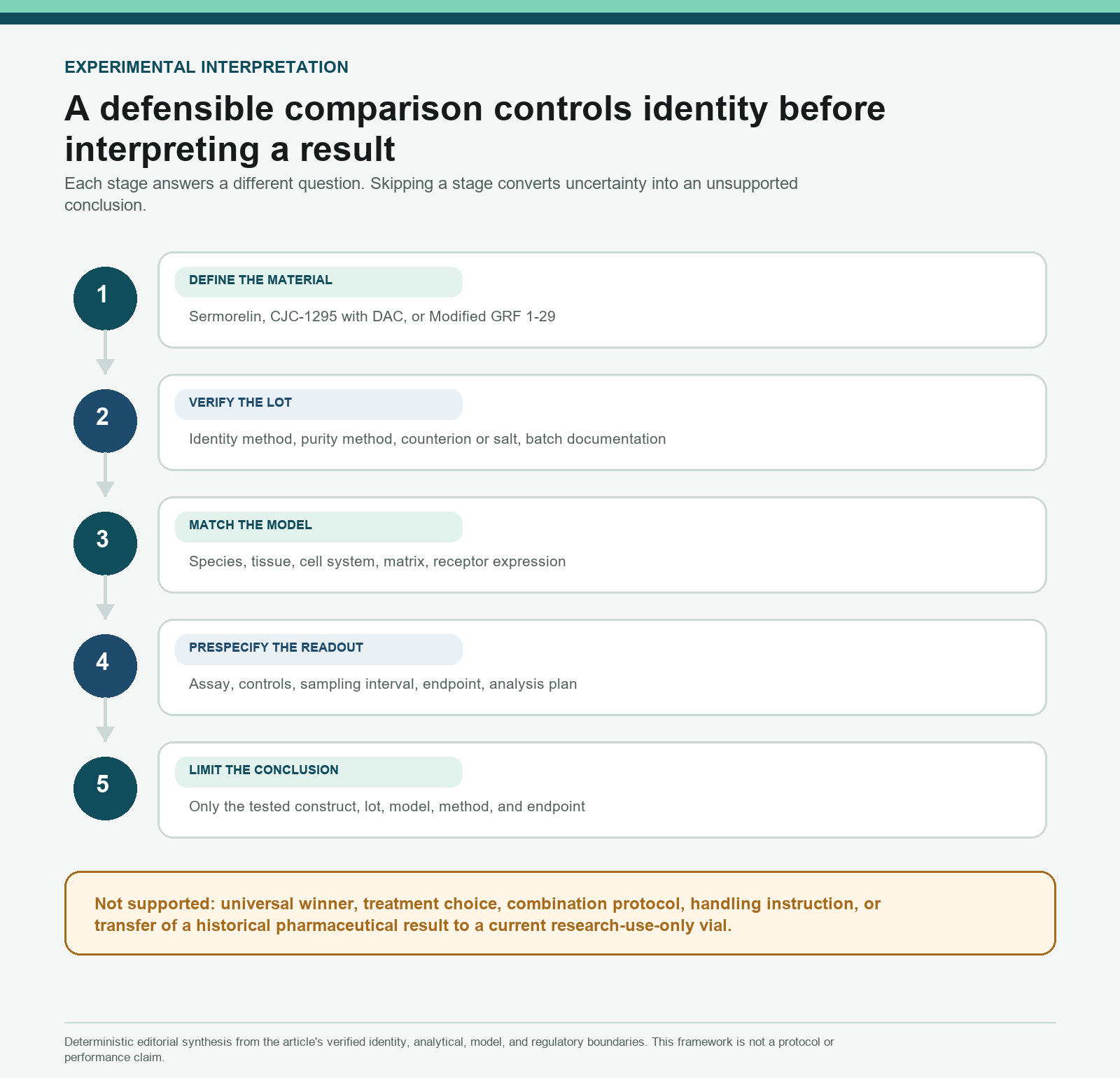
The comparison should begin with identity, not a desired result. Record whether the material is Sermorelin, CJC-1295 with DAC, or Modified GRF 1-29. Then attach the lot’s identity method, purity method, counterion or salt information, and batch documentation. HPLC can describe chromatographic purity under a defined method, while mass spectrometry can support analyte identity; neither method alone establishes every attribute of a lot. See the guides to HPLC peptide purity testing, mass-spectrometry verification, and reading a peptide Certificate of Analysis.
Next, define the model, matrix, assay, controls, sampling interval, and endpoint. A receptor assay, a rat disposition experiment, a historical finished-drug study, and a current lot document answer different questions; they inform one another but cannot be collapsed into one score.
Qualified laboratories with an independently defined study can review the current Sermorelin acetate research-reagent record and the construct-specific CJC destinations below. Product availability, specifications, and lot documents should be rechecked at deployment and again at the time of evaluation.
Sermorelin acetate
Current research-reagent destination for the amidated GHRH(1-29) material. It is not historical Geref.
View the current Sermorelin recordCJC-1295 construct records
Review the CJC-1295 with DAC record separately from the Modified GRF 1-29 / no-DAC record. The pages do not make the materials interchangeable.
For broader cluster context, see the growth hormone axis research hub. The Sermorelin research guide owns the single-entity and Geref history, while this page owns the direct comparison and its evidence boundaries.
Frequently Asked Questions About Sermorelin vs CJC-1295
What is the main difference between Sermorelin and CJC-1295?
Sermorelin is C-terminally amidated human GHRH(1-29). The peer-reviewed CJC-1295 record describes a substituted hGRF(1-29) analog with a Drug Affinity Complex designed for covalent albumin binding.
Are Sermorelin and CJC-1295 the same compound?
No. They share a GHRH(1-29) lineage and GHRHR mechanism, but their terminal chemistry, construct definitions, and evidence records differ.
Does CJC-1295 mean the version with DAC?
In the foundational and human papers cited here, CJC-1295 is the DAC-bearing construct. The supplier phrase “CJC-1295 no DAC” commonly refers to Modified GRF 1-29 and requires a separate evidence lane.
Which has the longer half-life, Sermorelin or CJC-1295?
The selected sources do not support a clean head-to-head ratio. The rapid Sermorelin-associated result comes from an anesthetized-rat fragment study, while the 5.8-8.1-day estimate belongs to CJC-1295 with DAC in a historical healthy-adult study.
Do Sermorelin and CJC-1295 act through the same receptor?
Both are studied through GHRHR and its Gs-cAMP signaling pathway. Shared receptor biology does not establish equal exposure, response, safety, or interchangeability.
Was Sermorelin FDA approved?
Historical Geref finished drugs had separate U.S. approvals in 1990 and 1997. The products were discontinued and both applications were withdrawn effective in 2009; that history does not approve a current research-use-only reagent.
Is there a direct Sermorelin-versus-CJC-1295 trial?
No direct head-to-head trial was identified in the verified source set used for this refresh. Cross-study comparisons should therefore remain qualified by construct, model, method, and endpoint.
What are the molecular weights of Sermorelin and CJC-1295?
Sermorelin is 3,357.9 g/mol (CAS 86168-78-7, PubChem CID 16132413). Modified GRF 1-29, labeled CJC-1295 no DAC, is 3,367.9 g/mol (CAS 863288-34-0). CJC-1295 with DAC is 3,647.2 g/mol (CAS 446262-90-4), and the 279.3 g/mol difference between the two CJC-1295 forms is the Drug Affinity Complex.
Is CJC-1295 approved by any regulator?
No. CJC-1295 with DAC and Modified GRF 1-29 hold no FDA, EMA, NMPA or other regulatory approval anywhere globally, and neither has ever been part of an approved finished drug product.
References and Primary Records
- Rivier J, et al. Characterization of a growth hormone-releasing factor from a human pancreatic islet tumour. Nature. 1982;300(5889):276-8. PMID: PMID 6292724.
- Guillemin R, et al. Growth hormone-releasing factor from a human pancreatic tumor that caused acromegaly. Science. 1982;218(4572):585-7. PMID: PMID 6812220.
- Mayo KE. Molecular cloning and expression of a pituitary-specific receptor for growth hormone-releasing hormone. Mol Endocrinol. 1992;6(10):1734-44. PMID: PMID 1333056.
- Mayo KE, et al. Regulation of the pituitary somatotroph cell by GHRH and its receptor. Recent Prog Horm Res. 2000;55:237-66; discussion 266-7. PMID: PMID 11036940.
- Zhou F, et al. Structural basis for activation of the growth hormone-releasing hormone receptor. Nat Commun. 2020;11(1):5205. PMID: PMID 33060564.
- Frohman LA, et al. Dipeptidylpeptidase IV and trypsin-like enzymatic degradation of human growth hormone-releasing hormone in plasma. J Clin Invest. 1989;83(5):1533-40. PMID: PMID 2565342.
- Rafferty B, et al. Growth hormone-releasing factor analogue (hGRF1-29NH2): immunoreactive-GRF plasma levels after intravenous and subcutaneous administration. J Endocrinol. 1985;107(3):R5-8. PMID: PMID 2866222.
- Jetté L, et al. Human growth hormone-releasing factor (hGRF)1-29-albumin bioconjugates activate the GRF receptor on the anterior pituitary in rats: identification of CJC-1295 as a long-lasting GRF analog. Endocrinology. 2005;146(7):3052-8. PMID: PMID 15817669.
- Teichman SL, et al. Prolonged stimulation of growth hormone (GH) and insulin-like growth factor I secretion by CJC-1295, a long-acting analog of GH-releasing hormone, in healthy adults. J Clin Endocrinol Metab. 2006;91(3):799-805. PMID: PMID 16352683.
- Ionescu M, et al. Pulsatile secretion of growth hormone (GH) persists during continuous stimulation by CJC-1295, a long-acting GH-releasing hormone analog. J Clin Endocrinol Metab. 2006;91(12):4792-7. PMID: PMID 17018654.
- Thorner M, et al. Once daily subcutaneous growth hormone-releasing hormone therapy accelerates growth in growth hormone-deficient children during the first year of therapy. Geref International Study Group. J Clin Endocrinol Metab. 1996;81(3):1189-96. PMID: PMID 8772599.
- FDA Global Substance Registration System. Sermorelin substance record and Sermorelin acetate record.
- U.S. Food and Drug Administration. Determination that Geref products were not withdrawn for reasons of safety or effectiveness. Federal Register. March 4, 2013.