LL-37 occupies an unusual place in peptide research. It can interact directly with model membranes, signal through several receptor-linked pathways, bind nucleic acids, and change inflammatory responses. Those findings do not form one universal mechanism, and they do not automatically establish an antimicrobial treatment, wound-healing product, or personal-use protocol.
This guide follows the material actually tested: the endogenous CAMP–hCAP18–LL-37 pathway, then biophysical, cell, animal, human-tissue, and interventional evidence, then the controls needed before a synthetic reagent result can be interpreted. It is educational and gives no dosing, administration, or treatment instruction.
- LL-37 is produced endogenously from hCAP18, but that biosynthetic pathway is not a specification for a synthetic vial.
- Membrane disruption, chemotaxis, P2X7-linked signaling, TLR-response modulation, and nucleic-acid binding were measured in different experimental systems.
- Salt, serum proteins, peptide concentration, membrane composition, and cell type can change the observed result.
- A 34-person topical proof-of-concept trial reported a signal; a later 148-person phase IIb trial found no significant healing benefit in the full cohort.
- The clinical studies used investigational topical formulations. They do not validate a research-use-only reagent or establish a personal-use protocol.
- Identity evidence, purity evidence, contamination controls, matrix conditions, and matched biological controls belong in the same experimental record.
What Is LL-37?
LL-37 is the mature C-terminal peptide associated with the sole human cathelicidin precursor, hCAP18. Early human work described the cysteine-free peptide that was initially called FALL-39, while later studies characterized LL-37 in neutrophils and epithelial tissues (Agerberth et al., 1995; Turner et al., 1998). Agerberth and colleagues cloned a 170-residue precursor and measured 30% helix formation for synthetic 39-residue FALL-39 in the medium where it inhibited Escherichia coli. A broad review of the human cathelicidin system is available in Dürr et al. (2006), which is a narrative structure-function synthesis and reports no quantitative endpoint of its own.
The sequence represented in the FDA substance-registration record is LLGDFFRKSKEKIGKEFKRIVQRIKDFLRNLVPRTES. The name comes from its first two leucines and its 37 residues. A substance record or UNII helps identify a chemical entity; the FDA record itself states that UNII availability does not imply regulatory review or approval.
LL-37 reagent identity
These values identify the chemical entity; a certificate of analysis answers lot-level questions.
| Field | Value |
|---|---|
| CAS number | 154947-66-7 |
| Molecular formula | C205H340N60O53 |
| Average molecular weight | 4493.33 g/mol (free base; a salt form such as acetate raises weighed mass) |
| Sequence, one-letter | LLGDFFRKSKEKIGKEFKRIVQRIKDFLRNLVPRTES — 37 residues, cysteine-free |
| Precursor and gene | hCAP18, from the single human CAMP gene |
| PubChem CID | 16198951 |
| Context | What it is | What the evidence can establish | What it cannot establish automatically |
|---|---|---|---|
| Endogenous LL-37 | Peptide released from hCAP18 in a biological system | Expression, processing, localization, and system-specific function | Specifications or performance of a synthetic lot |
| Synthetic research reagent | A manufactured peptide material intended for laboratory research | Results for the characterized lot, method, concentration, and model tested | Clinical safety, efficacy, sterility, or therapeutic equivalence |
| Investigational formulated drug | A defined formulation manufactured for a clinical protocol | Results from that protocol, population, route, formulation, and endpoint | Results for an RUO vial or another formulation |
From CAMP to hCAP18 to LL-37
The human CAMP gene encodes the cathelicidin precursor hCAP18. The mature LL-37 region sits at the C-terminus of that larger precursor. In neutrophil experiments, Sørensen et al. (2001) found that proteinase 3 cleaved extracellular hCAP18 after exocytosis to release LL-37. That result defines a physiological processing route in the studied system; it does not mean every cell or tissue uses an identical release context.
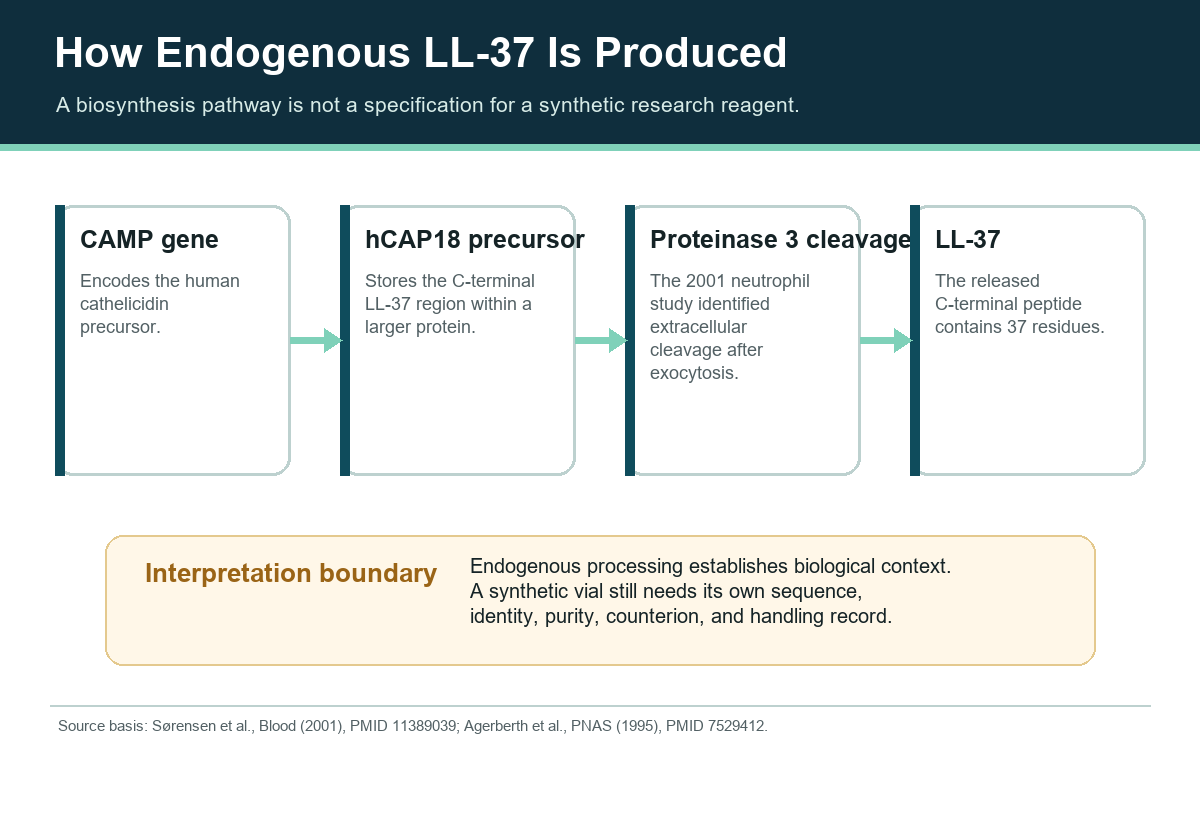
That distinction matters because the word “LL-37” can refer to an endogenous peptide detected in tissue, a synthetic sequence used in a cell assay, or a formulated investigational product. Source conclusions stay attached to the tested category: endogenous expression does not verify a commercial vial.
Membrane Interaction Is Conditional, Not a Universal Mode
LL-37 is cationic and can adopt an amphipathic helical conformation in membrane-like environments. Biophysical work reported surface-oriented peptide behavior and bilayer disruption under defined experimental conditions (Henzler Wildman et al., 2003). NMR research later described LL-37 and the shorter KR-12 region in lipid micelles (Wang et al., 2008).
These studies help explain why membrane composition and assay conditions matter. They do not establish that one pore model explains every organism, cell type, or concentration. Ionic strength, serum proteins, peptide aggregation, lipid composition, incubation time, and the readout can shift an apparent antimicrobial or cytotoxic effect. The earliest neutrophil study itself reported that activity varied with assay conditions: minimum inhibitory concentrations below 10 µg/mL against Pseudomonas aeruginosa, Escherichia coli, Staphylococcus aureus and vancomycin-resistant enterococci in vitro, retained in media containing 100 mM sodium chloride, while methicillin-resistant S. aureus and Candida albicans resisted at that concentration but stayed susceptible in low salt (PMID 9736536).
Antimicrobial, biofilm, and viral-model findings
LL-37 has shown direct activity in several laboratory systems, but each finding belongs to its model. Overhage et al. (2008) reported inhibition of Pseudomonas aeruginosa biofilm formation in vitro at 0.5 µg/mL, far below the 64 µg/mL growth-inhibitory concentration measured in the same system. Barlow et al. (2011) combined influenza experiments with a mouse host-defense model, reporting reduced disease severity and viral replication in infected mice on a par with zanamivir, though that abstract reports no quantitative endpoint for the comparison. Neither paper establishes that an RUO product treats an infection, and neither supplies a human dosing instruction.
LL-37 Immune-Signaling Research
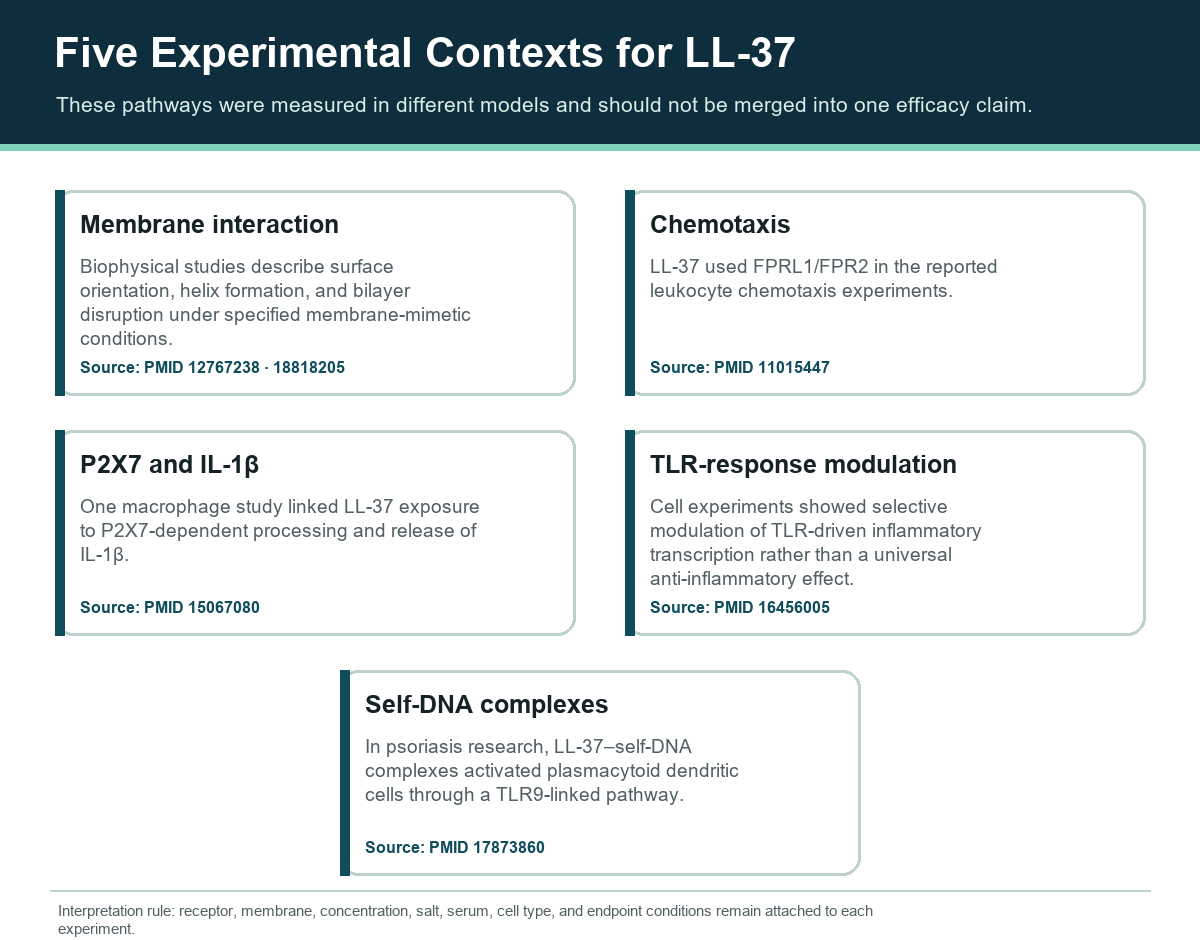
Describing LL-37 only as a membrane-disrupting peptide misses much of the literature. In human leukocyte experiments, LL-37 used the formyl-peptide-receptor-like receptor FPRL1, now generally called FPR2, to drive chemotaxis (De et al. (2000)). In macrophage work, Elssner et al. (2004) linked LL-37 exposure to P2X7-dependent processing and release of IL-1β.
Those are not interchangeable pathways. Another cell study found selective modulation of TLR-driven inflammatory transcription rather than a simple, universal “anti-inflammatory” switch: at 1 µg/mL or below, LL-37 suppressed LPS-induced TNF-α release from human monocytic cells and reduced nuclear translocation of the NF-κB subunits p50 and p65 by at least 50% in vitro (Mookherjee et al., 2006). In psoriasis research, LL-37–self-DNA complexes activated plasmacytoid dendritic cells through a TLR9-linked pathway (Lande et al., 2007). More recent biophysical work reported concentration-dependent dsDNA compaction and changes in neutrophil-extracellular-trap structure: complete complexation at a 1:1.7 DNA-to-peptide mass ratio, disc-like complexes about 150 nm across, and a significant reduction in projected NET area at high peptide concentrations, measured in vitro with phage λ DNA (Zielke et al., 2026).
Vitamin D and CAMP transcription
The vitamin D axis concerns expression of the endogenous precursor system, not proof that an external LL-37 reagent has a given effect. Gombart et al. (2005) identified the human CAMP gene as a direct vitamin D receptor target in the tested myeloid-cell system. Liu et al. (2006) connected TLR activation with a vitamin-D-mediated antimicrobial response. These transcriptional findings do not support supplement advice or a synthetic-peptide protocol.
What Level of Evidence Exists?
LL-37 evidence spans biophysics, cell models, animal models, human tissue, and clinical investigation. That breadth is easy to overstate. A membrane observation can clarify mechanism without predicting a clinical endpoint, a tissue association can establish localization without proving causality, and a trial can test one formulation without validating another material sold under the same peptide name.
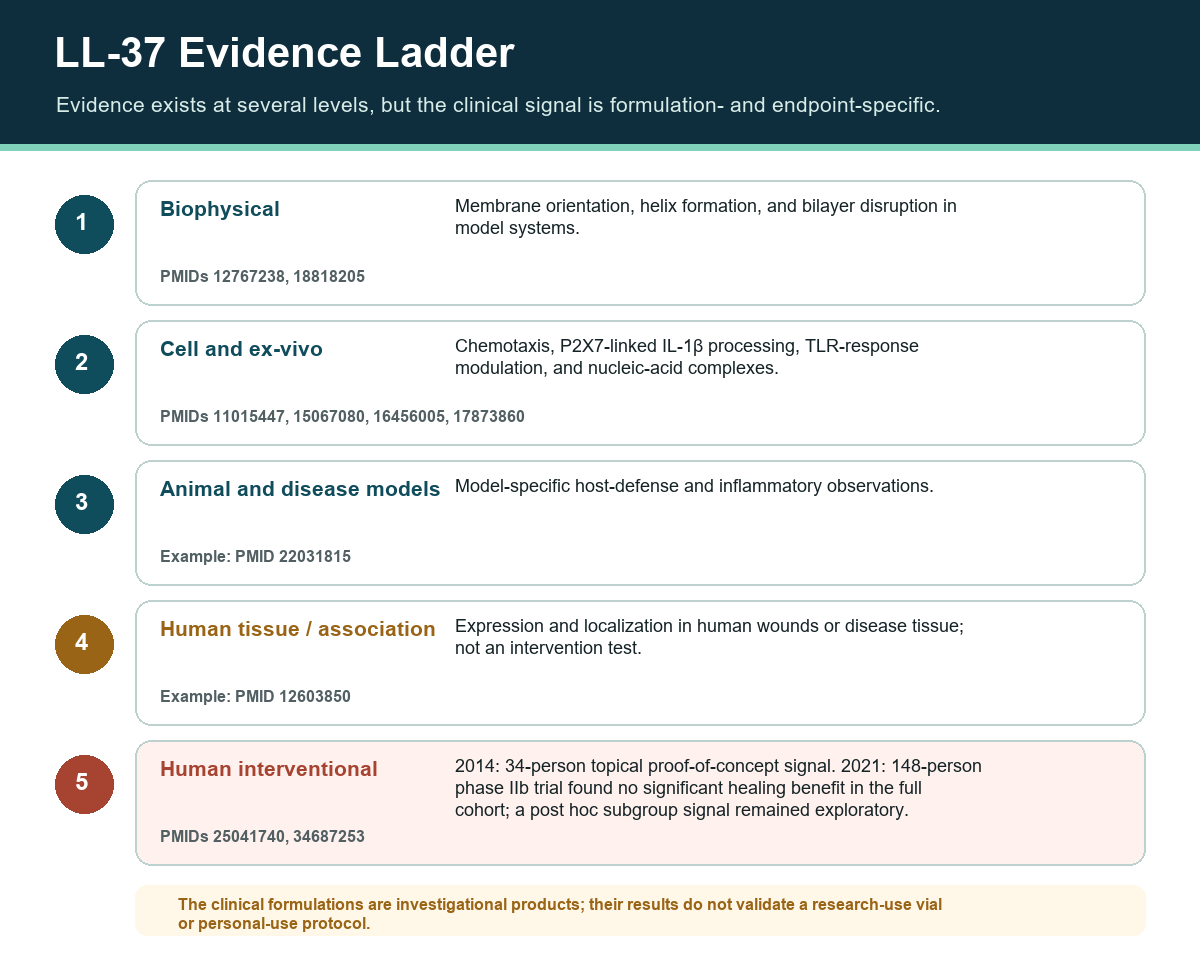
Human-tissue work provides an important intermediate layer. Heilborn et al. (2003) examined LL-37 expression in human skin wounds and chronic-ulcer epithelium, where hCAP18 peaked 48 hours after injury and fell back to pre-injury levels as wounds closed, and where antibodies against LL-37 inhibited re-epithelialization in a concentration-dependent way in organ-cultured human skin. Koczulla et al. (2003) combined endothelial experiments with an in-vivo model to investigate angiogenic activity. These papers helped motivate wound-focused development, but they are not substitutes for controlled clinical outcomes.
Additional reported findings
The remaining sources support mechanism rather than magnitude, including one endotoxin source restored from the earlier version of this guide.
| Finding and model (species) | Reported result | Source |
|---|---|---|
| hCAP18 processing — exocytosed neutrophil material (human, in vitro) | Proteinase 3 alone liberated LL-37; no quantitative endpoint reported | PMID 11389039 |
| Membrane structure — oriented bilayers and lipid micelles (in vitro NMR) | Surface-parallel helix supporting a toroidal pore, not a barrel-stave mechanism; helix-bend-helix over residues 2–31; no quantitative endpoint reported | PMID 12767238; PMID 18818205 |
| Leukocyte signaling — blood leukocytes and LPS-primed monocytes (human, in vitro) | Migration via FPRL1/FPR2 and P2X7-dependent IL-1β release; no quantitative endpoint reported | PMID 11015447; PMID 15067080 |
| Endotoxin neutralization — macrophage assays and LPS lethality (mouse, in vivo and in vitro) | hCAP18 C-terminal fragment bound LPS, blocked LPS-induced nitric oxide and tissue factor, and protected mice; no quantitative endpoint reported | PMID 7890387 |
| Vitamin D axis — myeloid, keratinocyte and colon lines, macrophages (human, in vitro) | A promoter VDRE drove CAMP induction, also reached through TLR activation; no quantitative endpoint reported | PMID 15985530; PMID 16497887 |
| Self-DNA sensing — plasmacytoid dendritic cells, psoriatic skin (human) | LL-37–self-DNA complexes triggered TLR9-dependent interferon that self-DNA alone did not; no quantitative endpoint reported | PMID 17873860 |
| Neovascularization — chorioallantoic membrane (chick), hind-limb ischemia (rabbit), wounds (CRAMP-null mouse) | Vessel formation via FPRL1; less wound vascularization in CRAMP-deficient mice; no quantitative endpoint reported | PMID 12782669 |
What Did the Human Topical Trials Find?
A small randomized proof-of-concept study enrolled 34 people with hard-to-heal venous leg ulcers. After a 3-week placebo run-in it tested twice-weekly topical LL-37 at 0.5, 1.6 and 3.2 mg/mL against placebo across a 4-week randomized phase. Healing-rate constants were about six-fold higher than placebo at 0.5 mg/mL (p = 0.003) and three-fold higher at 1.6 mg/mL (p = 0.088), and mean ulcer area fell 68% and 50% in those two groups, while 3.2 mg/mL did not outperform placebo (Grönberg et al., 2014). The non-monotonic pattern and small sample made confirmation important.
The later HEAL LL-37 phase IIb study enrolled 148 participants — mean age 67.6 years, median ulcer duration 20.3 months, mean wound area 11.6 cm² at randomization — and compared topical LL-37 at 0.5 and 1.6 mg/mL with placebo alongside compression therapy. In the full study population, the trial did not identify a statistically significant improvement in healing for LL-37 over placebo. A post hoc analysis suggested a possible signal among participants whose target wound covered at least 10 cm² at randomization, but the authors correctly treated that subgroup finding as a reason for a dedicated, adequately powered study—not as confirmation (Mahlapuu et al., 2021).
What the Evidence Does Not Establish
The source set does not support a simple “LL-37 kills pathogens and heals wounds” conclusion. Direct antimicrobial activity is condition-sensitive. Immune effects can be pro- or anti-inflammatory depending on the system. Nucleic-acid complex formation can change immune sensing. The human topical program produced a positive small-study signal followed by a larger trial that missed its full-cohort efficacy comparison.
It also does not support transferring results among materials by name alone: terminal chemistry, counterion, impurity profile, aggregation state, concentration accuracy, contamination controls, vehicle, container, and stability all differ between a synthetic lot and a formulated clinical product.
LL-37 is a multifunctional human host-defense peptide with substantial mechanistic research and limited, mixed clinical investigation. Every claim should identify the material, model, formulation, concentration, and endpoint that produced it.
Controls for an LL-37 Reagent Study
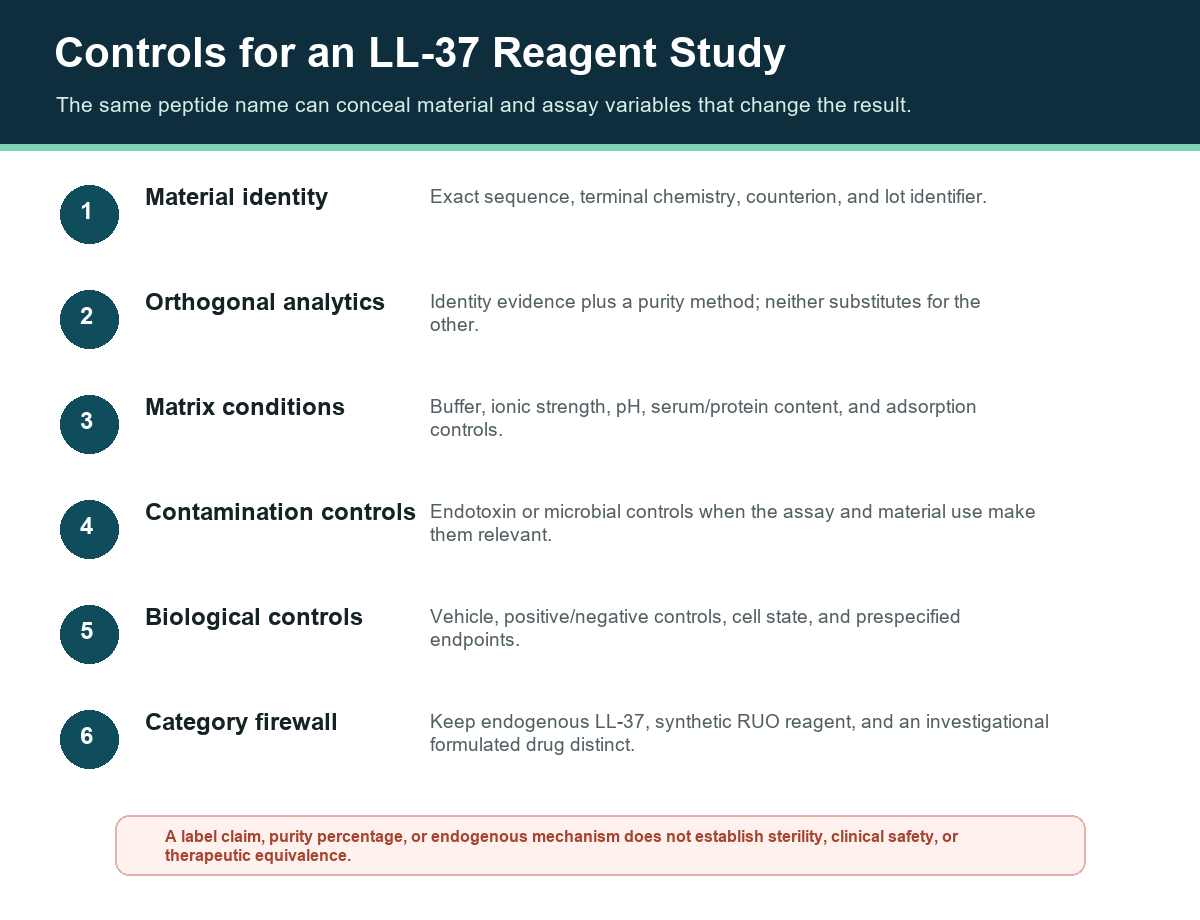
A defensible experiment begins with identity. The exact sequence and terminal chemistry should be documented, and the counterion should be known when it affects mass or concentration calculations. A mass-spectrometry result and an HPLC chromatogram answer different questions; one should not be presented as a substitute for the other. The mass-spectrometry explainer, HPLC purity guide, and COA-reading guide explain those evidence boundaries.
Matrix controls are equally important. LL-37 can interact with salts, serum proteins, plastics, lipids, and nucleic acids. The buffer, ionic strength, pH, protein content, incubation time, vessel material, and concentration calculation belong in the method record. For immune or host-defense assays, endotoxin and microbial controls should be selected for the actual assay rather than assumed from a general purity percentage.
Research-Material Context
Apex Laboratory lists LL-37 as a chemical reagent for laboratory research. Product-specific facts — current vial amount, lot documentation, availability, shipping — belong on the live product page, so a dated article cannot contradict the transactional record.
Looking for the current LL-37 research-reagent record?
Review the live listing for current product specifications and available documentation. The listing is for research use only and is not a drug, treatment, or clinical formulation.
View the LL-37 research-reagent pageFor cluster context, the tissue-repair research hub maps adjacent research topics, while the KPV research guide covers a distinct peptide and evidence base. Those internal links indicate topical relationships, not therapeutic combinations or equivalence.
Frequently Asked Questions
What is LL-37?
LL-37 is the 37-residue C-terminal peptide released from the human cathelicidin precursor hCAP18. It is studied in host-defense, membrane, immune-signaling, wound, and nucleic-acid contexts.
Is LL-37 the only human cathelicidin?
Humans have one cathelicidin precursor gene, CAMP, which encodes hCAP18 and its C-terminal LL-37 region. That statement does not mean LL-37 is the only human antimicrobial or host-defense peptide; defensins and other peptide families also exist.
How is endogenous LL-37 produced?
In the neutrophil system studied by Sørensen and colleagues, extracellular proteinase 3 cleavage of exocytosed hCAP18 released LL-37. Processing and localization can vary by biological context.
Does LL-37 have human clinical-trial evidence?
Yes, defined topical investigational formulations have been tested in venous-leg-ulcer trials. A 34-person proof-of-concept study reported a signal, while a later 148-person phase IIb study found no significant healing benefit in the full cohort. Those results do not validate an RUO reagent.
Is a synthetic LL-37 research vial equivalent to endogenous LL-37 or a clinical formulation?
No equivalence should be assumed. Endogenous processing, a synthetic research material, and an investigational formulated drug have different identity, manufacturing, formulation, and evidence records.
What documentation matters most for an LL-37 reagent study?
Record the exact sequence and terminal chemistry, counterion, lot identifier, identity evidence, purity method, concentration basis, relevant contamination controls, matrix conditions, and biological controls. Keep raw evidence traceable to the lot used.
Is LL-37 FDA-approved?
The Apex research reagent is not an FDA-approved drug. An FDA substance-registration record or UNII is not approval, and FDA separately flags compounded cathelicidin LL-37 as a substance that may present significant safety risks.
Selected Primary Sources
- Agerberth B, et al. FALL-39, a putative human peptide antibiotic, is cysteine-free and expressed in bone marrow and testis. Proc Natl Acad Sci U S A. 1995;92(1):195-9. PMID: Agerberth B et al. (1995). FALL-39, a putative human peptide antibiotic. PMID 7529412..
- Turner J, et al. Activities of LL-37, a cathelin-associated antimicrobial peptide of human neutrophils. Antimicrob Agents Chemother. 1998;42(9):2206-14. PMID: Turner J et al. (1998). Activities of LL-37 in human neutrophil research. PMID 9736536..
- Sørensen OE, et al. Human cathelicidin, hCAP-18, is processed to the antimicrobial peptide LL-37 by extracellular cleavage with proteinase 3. Blood. 2001;97(12):3951-9. PMID: Sørensen OE et al. (2001). hCAP18 processing by proteinase 3. PMID 11389039..
- Henzler Wildman KA, et al. Mechanism of lipid bilayer disruption by the human antimicrobial peptide, LL-37. Biochemistry. 2003;42(21):6545-58. PMID: Henzler Wildman KA et al. (2003). LL-37 lipid-bilayer disruption. PMID 12767238..
- Wang G. Structures of human host defense cathelicidin LL-37 and its smallest antimicrobial peptide KR-12 in lipid micelles. J Biol Chem. 2008;283(47):32637-43. PMID: Wang G et al. (2008). LL-37 and KR-12 structures in lipid micelles. PMID 18818205..
- De Yang, et al. LL-37, the neutrophil granule- and epithelial cell-derived cathelicidin, utilizes formyl peptide receptor-like 1 (FPRL1) as a receptor to chemoattract human peripheral blood neutrophils, monocytes, and T cells. J Exp Med. 2000;192(7):1069-74. PMID: De Y et al. (2000). FPRL1-linked chemotaxis. PMID 11015447..
- Elssner A, et al. A novel P2X7 receptor activator, the human cathelicidin-derived peptide LL37, induces IL-1 beta processing and release. J Immunol. 2004;172(8):4987-94. PMID: Elssner A et al. (2004). P2X7-linked IL-1β processing and release. PMID 15067080..
- Mookherjee N, et al. Modulation of the TLR-mediated inflammatory response by the endogenous human host defense peptide LL-37. J Immunol. 2006;176(4):2455-64. PMID: Mookherjee N et al. (2006). TLR-response modulation. PMID 16456005..
- Lande R, et al. Plasmacytoid dendritic cells sense self-DNA coupled with antimicrobial peptide. Nature. 2007;449(7162):564-9. PMID: Lande R et al. (2007). LL-37–self-DNA complexes in psoriasis research. PMID 17873860..
- Gombart AF, et al. Human cathelicidin antimicrobial peptide (CAMP) gene is a direct target of the vitamin D receptor and is strongly up-regulated in myeloid cells by 1,25-dihydroxyvitamin D3. FASEB J. 2005;19(9):1067-77. PMID: Gombart AF et al. (2005). CAMP as a vitamin D receptor target. PMID 15985530..
- Liu PT, et al. Toll-like receptor triggering of a vitamin D-mediated human antimicrobial response. Science. 2006;311(5768):1770-3. PMID: Liu PT et al. (2006). TLR triggering of a vitamin-D-mediated antimicrobial response. PMID 16497887..
- Overhage J, et al. Human host defense peptide LL-37 prevents bacterial biofilm formation. Infect Immun. 2008;76(9):4176-82. PMID: Overhage J et al. (2008). LL-37 and biofilm formation. PMID 18591225..
- Barlow PG, et al. Antiviral activity and increased host defense against influenza infection elicited by the human cathelicidin LL-37. PLoS One. 2011;6(10):e25333. PMID: Barlow PG et al. (2011). Influenza and host-defense model research. PMID 22031815..
- Heilborn JD, et al. The cathelicidin anti-microbial peptide LL-37 is involved in re-epithelialization of human skin wounds and is lacking in chronic ulcer epithelium. J Invest Dermatol. 2003;120(3):379-89. PMID: Heilborn JD et al. (2003). LL-37 in human skin wounds. PMID 12603850..
- Koczulla R, et al. An angiogenic role for the human peptide antibiotic LL-37/hCAP-18. J Clin Invest. 2003;111(11):1665-72. PMID: Koczulla R et al. (2003). Angiogenic research on LL-37/hCAP18. PMID 12782669..
- Grönberg A, et al. Treatment with LL-37 is safe and effective in enhancing healing of hard-to-heal venous leg ulcers: a randomized, placebo-controlled clinical trial. Wound Repair Regen. 2014;22(5):613-21. PMID: Grönberg A et al. (2014). Randomized topical proof-of-concept trial. PMID 25041740..
- Mahlapuu M, et al. Evaluation of LL-37 in healing of hard-to-heal venous leg ulcers: A multicentric prospective randomized placebo-controlled clinical trial. Wound Repair Regen. 2021;29(6):938-950. PMID: Mahlapuu M et al. (2021). HEAL LL-37 phase IIb trial. PMID 34687253..
- Zielke C, et al. Human cathelicidin peptide LL-37 compacts nucleic acids and alters neutrophil extracellular trap structure. Sci Rep. 2026;16(1). doi:10.1038/s41598-026-48091-4. PMID: Zielke C et al. (2026). LL-37, nucleic-acid compaction, and NET structure. PMID 42156793..