Selank and Semax are distinct synthetic heptapeptides that share a C-terminal Pro-Gly-Pro motif. Selank extends a tuftsin-related sequence and is studied mainly in GABAergic, anxiety-related, and immune-signaling models; Semax extends ACTH(4-7) and is studied mainly in neurotrophin, ischemia, and brain-network models. The evidence does not establish interchangeability, superiority, a general human effect, or a self-use protocol.
The useful answer to “Selank vs Semax” is not a winner. It is a map of two different molecules, two partially overlapping research programs, and the limits of each evidence base. This guide separates identity, mechanism, model, and outcome so a cell result or animal finding is not silently converted into a human claim.
Apex-specific research boundary: Apex Laboratory supplies Selank and Semax as research-grade chemical reagents for in-vitro and preclinical research only. They are not pharmaceutical formulations, are not for human consumption, and are not represented here as treatments, administration products, or substitutes for approved medicines.
- Selank and Semax are both seven-residue peptides, but their N-terminal sequences and research lineages differ.
- Selank research emphasizes GABAergic gene expression, monoamine observations, anxiety-related endpoints, and immune signaling.
- Semax research emphasizes BDNF/NGF signaling, ischemia models, proteomic changes, and brain-network endpoints.
- Most mechanistic evidence is cellular or animal; the human literature is limited and does not establish a general efficacy, safety, dose, or superiority claim.
What Are Selank and Semax?
Selank is the heptapeptide Thr-Lys-Pro-Arg-Pro-Gly-Pro. Its first four residues correspond to the tuftsin sequence, followed by Pro-Gly-Pro. Semax is the heptapeptide Met-Glu-His-Phe-Pro-Gly-Pro, commonly described as ACTH(4-7)-PGP. The sequences therefore share only the three-residue C-terminal motif; their four-residue N-terminal segments differ. For the detailed clinical-study and mechanism discussion, read the standalone Selank research guide; this page retains the comparison between the two peptides.
Reagent identity
| Property | Selank | Semax |
|---|---|---|
| Sequence | Thr-Lys-Pro-Arg-Pro-Gly-Pro (TKPRPGP) | Met-Glu-His-Phe-Pro-Gly-Pro (MEHFPGP) |
| Parent sequence | Tuftsin, Thr-Lys-Pro-Arg | ACTH(4-7), Met-Glu-His-Phe |
| Molecular formula | C33H57N11O9 | C37H51N9O10S (the sulfur comes from the N-terminal methionine) |
| Molecular weight | 751.9 g/mol | 813.9 g/mol |
| CAS number | 129954-34-3 | 80714-61-0 |
| PubChem CID | 11765600 | 9811102 |
| Apex reagent form | Lyophilized powder; review each material’s applicable published COA for its methods, results and lot. Research use only. | |
The 62 Da difference is what a mass spectrum resolves; a record that says only “heptapeptide” has not distinguished the two reagents.
The 2018 Selank paper by Vyunova et al. is a primary radioligand-binding study rather than a review; it states the Thr-Lys-Pro-Arg-Pro-Gly-Pro heptapeptide sequence, and its abstract reports no quantitative result. The 2021 Semax proteomics paper by Sudarkina et al. identifies Semax as ACTH(4-7)-PGP and places it in an ischemia-reperfusion research program. These are identity and literature-context claims, not evidence that either reagent produces a particular outcome in another system.
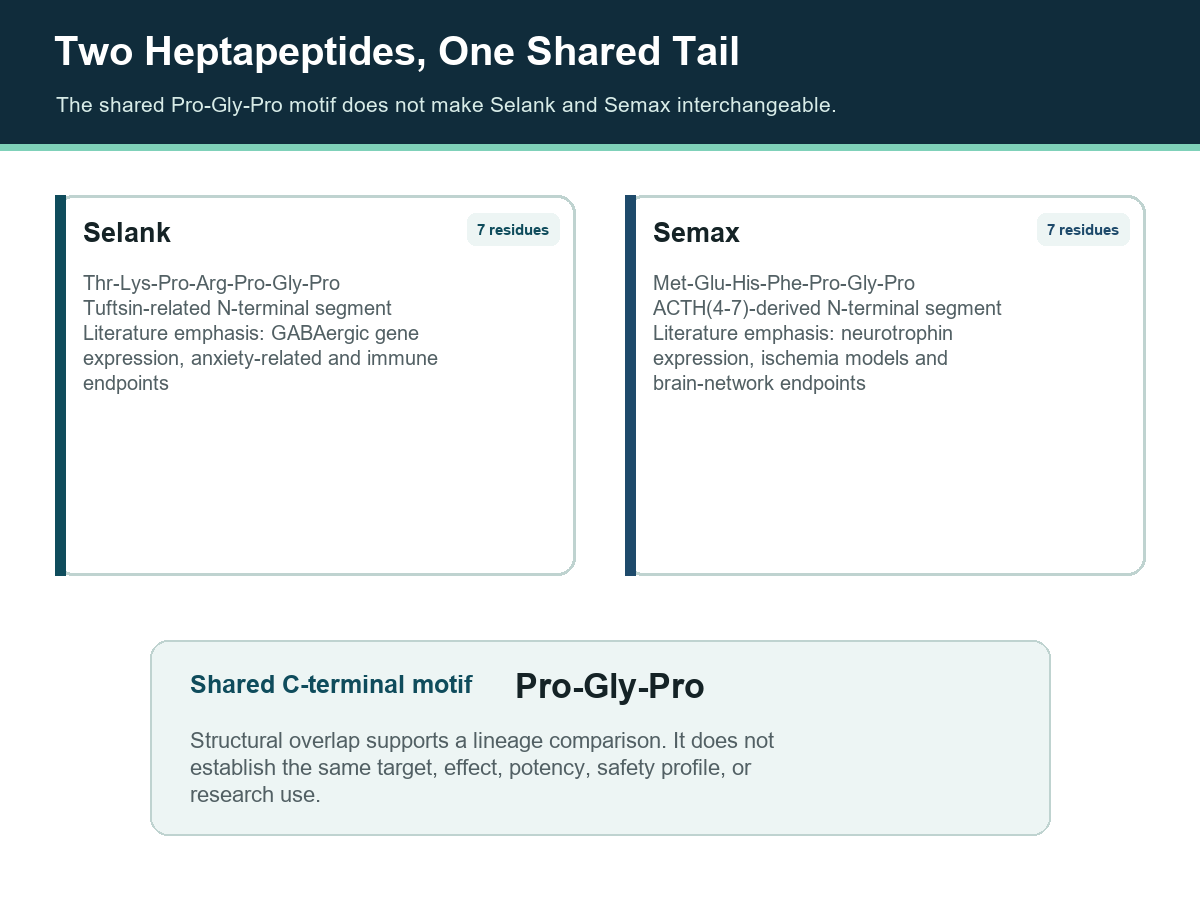
The shared Pro-Gly-Pro tail is sometimes used to collapse the two compounds into a single “nootropic peptide” category. That shortcut loses the main scientific distinction. Structural relatedness can justify a comparison, but it does not prove a shared receptor, potency, pharmacokinetic profile, safety profile, or effect.
Selank vs Semax: Quick Comparison
| Dimension | Selank | Semax | Interpretation boundary |
|---|---|---|---|
| Sequence lineage | Tuftsin-related Thr-Lys-Pro-Arg + Pro-Gly-Pro | ACTH(4-7) Met-Glu-His-Phe + Pro-Gly-Pro | Lineage does not prove equivalent activity. |
| Primary mechanistic literature | GABAergic gene expression, monoamine and immune-signaling observations | BDNF/NGF expression, neurotrophin-receptor signaling and proteomic observations | Mechanism depends on model, tissue, timing, and endpoint. |
| Common experimental systems | Neuronal cells, rodents, limited human reports | Glial cells, rodent brain and ischemia models, limited human reports | Preclinical findings do not establish a human effect. |
| Direct comparison | A 2020 resting-state fMRI study assessed both in 52 healthy participants. | One imaging study does not establish clinical equivalence or superiority. | |
| Not established here | General human efficacy, comprehensive safety, a dose, a protocol, or which compound is “better.” | Those questions require fit-for-purpose controlled evidence. | |
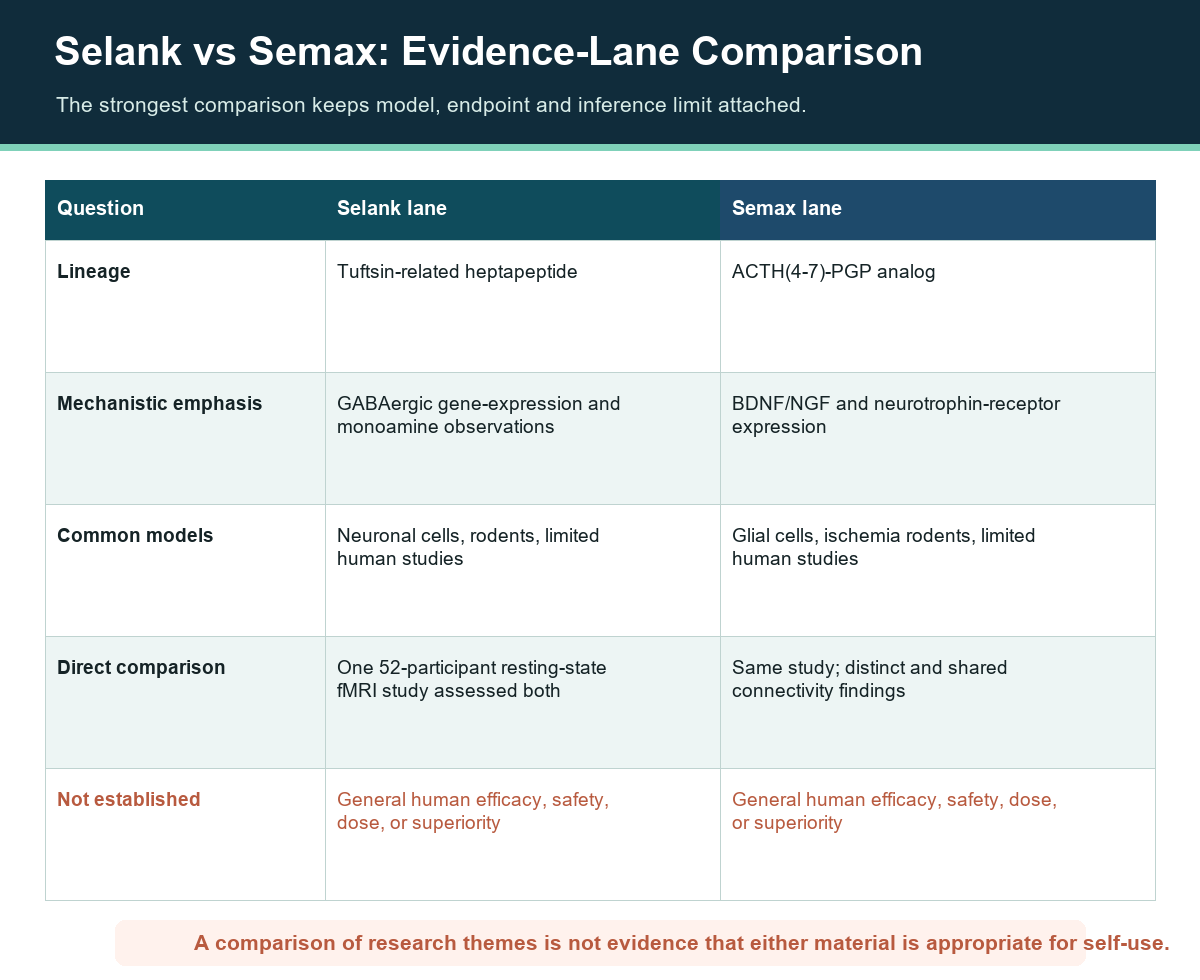
In practical evidence terms, Selank and Semax answer different laboratory questions. Selank is the more direct fit when the research question concerns the tuftsin-related sequence, GABAergic transcriptional responses, or selected immune-gene endpoints. Semax is the more direct fit when the question concerns the ACTH(4-7)-PGP sequence, neurotrophin transcription, or a defined ischemia model. That is a study-design distinction, not a consumer recommendation.
What Does the Selank Evidence Show?
GABAergic gene-expression findings
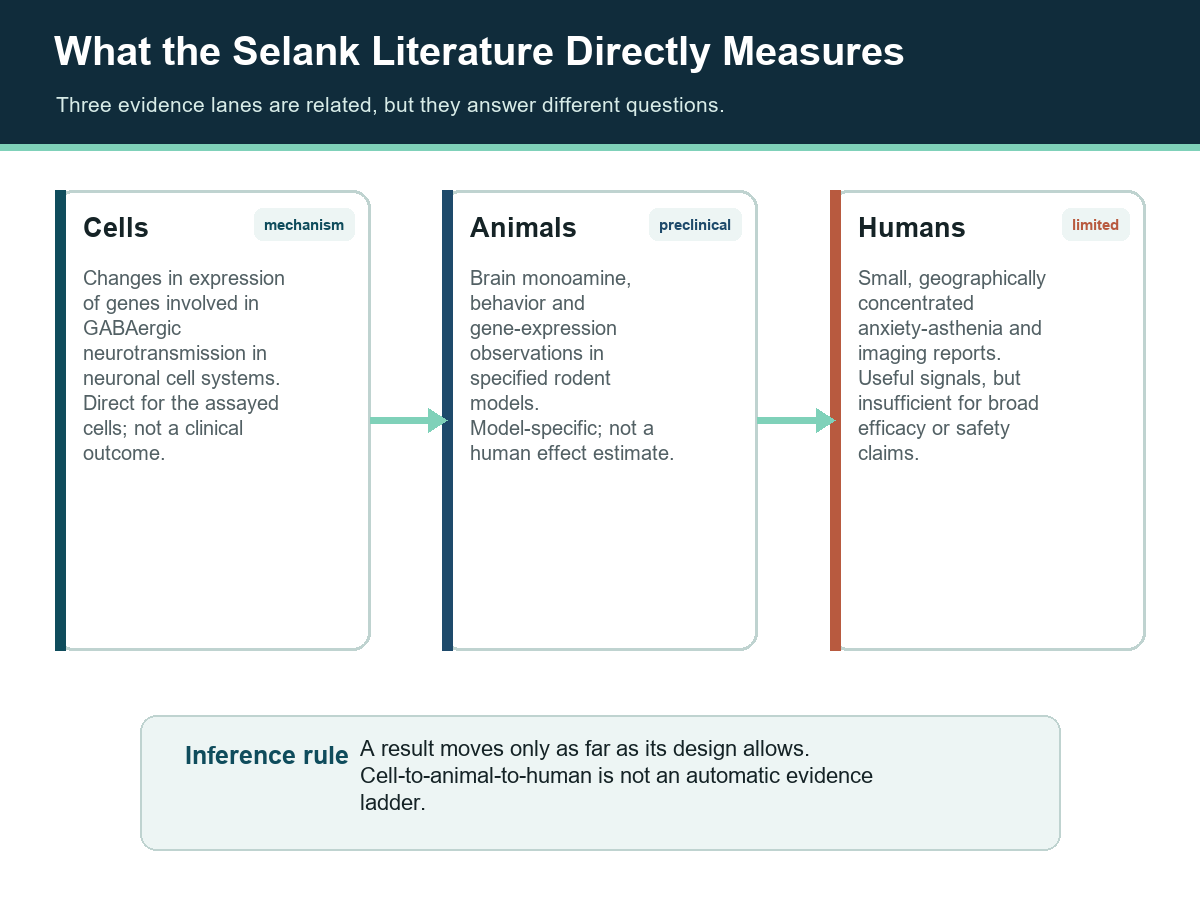
Volkova et al. (2016) profiled an 84-gene neurotransmission panel in rat frontal cortex after a single 300 µg/kg dose of Selank or GABA, and reported changed expression in 45 of those genes at 1 hour and in 22 genes at 3 hours. Filatova et al. (2017) ran an 84-gene panel in human IMR-32 neuroblastoma cells and found no messenger-RNA change under Selank alone; the paper reports no quantitative result for Selank monotherapy, and its positive findings concern GABA and olanzapine co-treatment. Together, these studies support GABAergic transcription as a plausible Selank research lane in rat cortex and a cell line. They do not establish a single receptor-level mechanism or a clinical anxiety outcome.
Monoamine and behavioral models
Semenova et al. (2009) compared Selank with its parent tuftsin in 87 Wistar rats depleted of serotonin by p-chlorophenylalanine (320 mg/kg i.p., four days earlier): Selank raised brain-stem 5-HT metabolism 30 minutes after injection, while tuftsin left the brain stem unchanged and lowered metabolism in the neocortex. Sarkisova et al. (2008) reported a dose-split rodent behavioural result: repeated 1000–2000 µg/kg doses countered depression-like behaviour in WAG/Rij rats, single 100 and 300 µg/kg doses shortened forced-swim immobility in BALB/c mice, and 600 and 900 µg/kg doses did not. These are useful for separating Selank from its parent tuftsin sequence, but they remain model-specific and do not yield a human effect size.
Immune signaling and human reports
The tuftsin-related lineage also appears in immune-gene research. Kolomin et al. (2011) reported that a single Selank dose changed chemokine, cytokine, and receptor-gene expression in mouse spleen at 6 hours and 24 hours, and that the Gly-Pro fragment reproduced most of those messenger-RNA changes. Uchakina et al. (2008) reported that Selank at 100 nM (10⁻⁷ M) completely suppressed interleukin-6 gene expression in cultured peripheral-blood cells from patients with depression but not from healthy controls, while raising IL-6 concentration in those same patient cultures (p < 0.05); over 14 days of dosing in patients with generalized anxiety disorder or neurasthenia, serum Th1/Th2 cytokine balance shifted. These studies support an immunomodulatory research question; they do not support an “immune booster” claim.
Zozulia et al. (2008) reported a randomized comparison in 62 patients with generalized anxiety disorder or neurasthenia: Selank (n=30) against the benzodiazepine medazepam (n=32), scored on Hamilton, Zung, and CGI scales alongside serum enkephalin activity. The anxiolytic effect of the two was similar, with additional antiasthenic and psychostimulant effects for Selank. The paper is part of the human Selank literature, but its language, setting, comparator, reporting conventions, and limited replication base constrain broad interpretation. It should not be read as a substitute for a modern, independently replicated safety-and-efficacy program.
What Does the Semax Evidence Show?
Neurotrophin expression
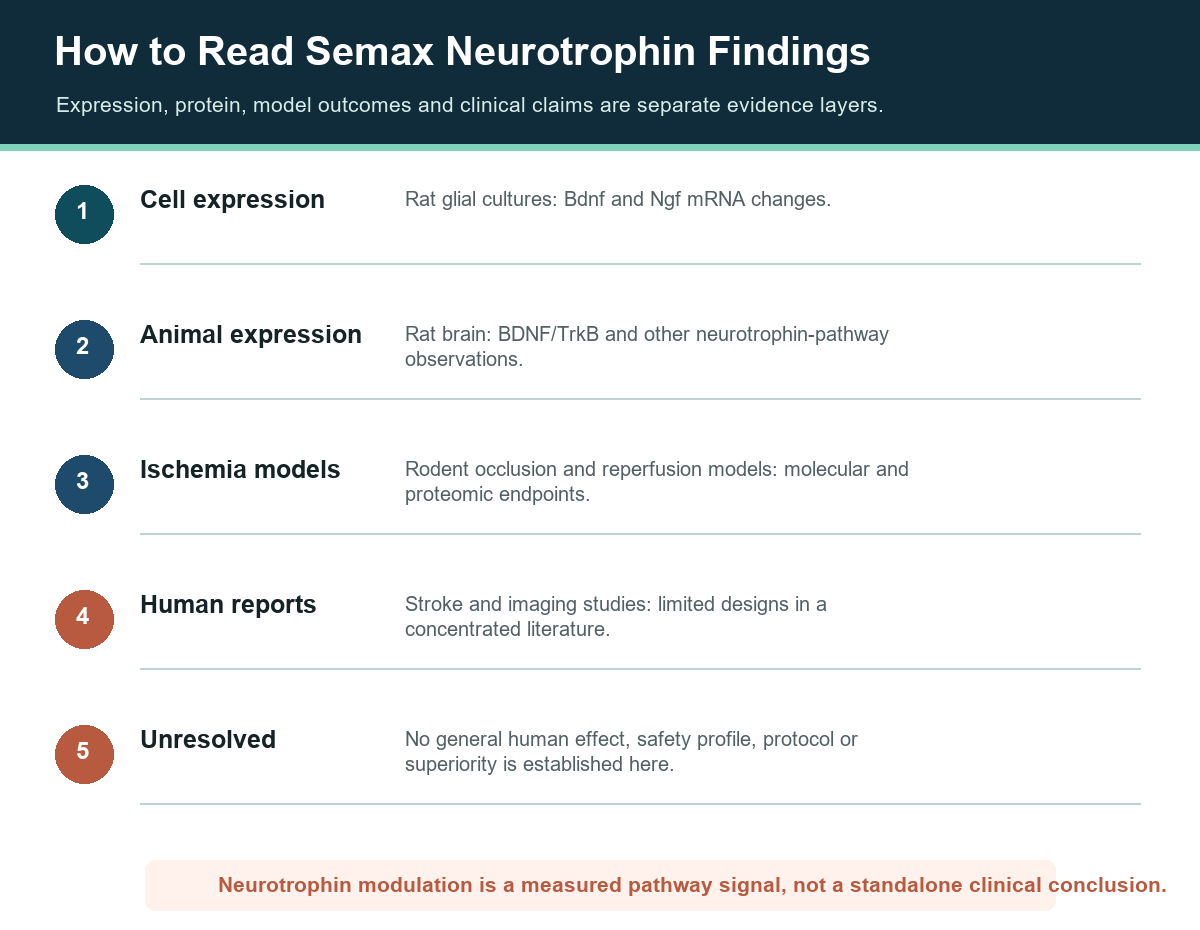
The most consistent Semax research theme is neurotrophin signaling. Shadrina et al. (2001) treated glial cells cultured from newborn-rat basal forebrain and found the largest response 30 minutes after Semax exposure: BDNF messenger RNA up eight-fold and NGF messenger RNA up five-fold against untreated control. Dolotov et al. (2006) reported calcium-dependent, reversible Semax binding in rat basal-forebrain membranes (dissociation constant 2.4 ± 1.0 nM) and a BDNF protein rise 3 hours after intranasal 50 and 250 µg/kg doses, in the basal forebrain but not the cerebellum. A separate 2006 rat hippocampus study measured a maximal 1.4-fold rise in BDNF protein and 1.6-fold rise in TrkB phosphorylation, with 3-fold and 2-fold rises in exon III Bdnf and TrkB messenger RNA, after a single 50 µg/kg dose.
Those readouts are model-specific. They do not justify the stronger statement that Semax “raises BDNF” generally in every tissue, species, or person.
Ischemia and proteomic models
Dmitrieva et al. (2010) examined Semax and Pro-Gly-Pro after permanent middle cerebral artery occlusion in rats: Semax raised cortical Bdnf, TrkC, and TrkA transcription 3 hours after occlusion, Nt-3 and Ngf at 24 hours, and Ngf again at 72 hours, and the authors read its effect as selective for ischemic cortex while the Pro-Gly-Pro effect was largely non-specific. Sudarkina et al. (2021) profiled brain protein expression 24 hours after transient middle cerebral artery occlusion in rats and reported more active CREB in subcortical structures, less MMP-9 and c-Fos in adjacent frontoparietal cortex, and less active JNK in both tissues. Those papers are direct evidence for their specified animal models and endpoints, not for a research vial’s clinical effect.
Dopamine and brain-network studies
Eremin et al. (2004) gave Sprague-Dawley rats D-amphetamine 5 mg/kg and found that Semax given 20 minutes earlier produced a higher striatal extracellular dopamine peak (p < 0.05) and a deeper fall in DHPAA (p < 0.01) than the stimulant alone; in C57BL/6 mice, D-amphetamine 2 mg/kg raised locomotor activity to 182% of baseline, and Semax 0.6 mg/kg given with it raised it to 261%. That is a perturbation study, not evidence of a general cognitive benefit. Human resting-state imaging studies, discussed below, add a network-level observation but still do not establish a clinical outcome.
Has Selank Been Compared Directly With Semax?
Yes, but the direct comparison record is narrow. Panikratova et al. (2020) assessed resting-state functional connectivity in 52 healthy participants, focusing on predefined regions that included the amygdala and dorsolateral prefrontal cortex. The authors reported shared and compound-specific connectivity observations involving the right amygdala and right temporal regions.
The study matters because it placed both peptides in one design rather than comparing separate papers after the fact. Its endpoint was short-term functional connectivity, however. It did not establish long-term clinical benefit, comparative safety, a dose-response relationship, or that one compound is better for a particular person or condition.
Comparison rule: “Selank is for anxiety and Semax is for cognition” is an oversimplified consumer shorthand. The literature has overlapping CNS endpoints, different model systems, and limited direct head-to-head evidence. A scientifically defensible comparison names the molecule, model, endpoint, timing, and study design.
How Strong Is the Human Evidence?
The human evidence is limited relative to the volume of online claims. Selank has small anxiety-asthenia reports and the direct imaging study. Semax has cerebrovascular and rehabilitation reports. Gusev et al. (2005) examined patients across stages of cerebrovascular insufficiency (n=187) and described stabilization and a reduced risk of stroke and transient ischemic attack; the published abstract reports no quantitative endpoint for the size of that effect. Gusev et al. (2018) studied 110 patients after ischemic stroke (mean age 58.0 ± 9.7 years) in early (89 ± 9 days) and late (214 ± 22 days) rehabilitation groups, each split by whether Semax was given as two 10-day courses of 6000 mcg/day separated by 20 days; they reported higher plasma BDNF and faster Barthel-index improvement in the Semax subgroups. Neither report by itself establishes a broadly transferable effect.
Three limits matter. First, much of the clinical literature is geographically and institutionally concentrated. Second, several reports are difficult to evaluate against current standards because methods and reporting are brief or available primarily in Russian. Third, independent replication and comprehensive adverse-event characterization remain insufficient for the sweeping claims common in commercial summaries.
Research and regulatory context. A research-product listing is not evidence that a product is an approved medicine. A clinical study or publication does not establish marketing authorization. Read the Selank and Semax findings in relation to the specific populations, formulations and outcomes studied; do not treat them as approval or dosing guidance for the research materials listed here.
| Question | Best available lane in this guide | What remains unresolved |
|---|---|---|
| Are the molecules distinct? | Yes. Their sequences and N-terminal lineages differ. | Sequence alone does not predict all functional differences. |
| Are there mechanistic signals? | Yes, across specified cell and animal systems. | No universal mechanism or cross-model potency comparison. |
| Are there human observations? | Yes, in limited anxiety, cerebrovascular, and imaging reports. | General efficacy, comprehensive safety, external validity, and independent replication. |
| Is one superior? | No fit-for-purpose superiority record was identified in the selected source set. | Comparative clinical outcomes and safety. |
Additional Reported Findings
Four further primary reports sit outside the lanes above. Each row keeps compound, model, species, endpoint, and result attached to its own source, so nothing migrates between the two peptides.
| Compound | Model and species | Endpoint | Reported result | Source |
|---|---|---|---|---|
| Semax | Male Wistar rats, intranasal 50 µg/kg, 1 hour | Ngf, Bdnf expression (qPCR) | Both up in hippocampus; Bdnf up in brainstem and cerebellum; Ngf down in frontal cortex | PMID 17353092 |
| Selank | Influenza A/Aichi 2/68 (H3N2), cell culture and mice | Viral reproduction, survival, cytokine genes | Reproduction fully suppressed when added 24 hours pre-inoculation; IFN-alpha induced, IL-4, IL-10, TNF-alpha unchanged | PMID 19882898 |
| Semax | SH-SY5Y and RBE4 cell lines, in vitro | Cu(II) binding, MTT viability | 4N-coordinated complex predominant above pH 5; copper-induced cytotoxicity reduced, though the abstract reports no quantitative result for its size | PMID 25310602 |
| Semax | White rats, neonatal fluvoxamine days 1–14, Semax days 15–28, tested at 1 and 2 months | Anxiety-like behaviour, maze learning, brain monoamines | All three normalized relative to fluvoxamine-only animals | PMID 33418449 |
What Can Analytical Documentation Verify?
A scientific paper and a current product record answer different questions. Published studies can support a claim about the material and model the authors tested. A current certificate of analysis can support lot-specific identity and purity fields when the methods, expected values, chromatogram, mass spectrum, batch identifier, and test date are available.
HPLC purity testing estimates chromatographic composition under a stated method; it does not prove sequence identity or biological activity by itself. Mass spectrometry can support mass identity but does not independently prove purity. The Apex COA-reading guide explains how to keep those claims separate.
Researchers evaluating current materials can review the Selank product record, the Semax product record, and the lot-specific COA archive. Those commercial records are not evidence of human efficacy, safety, or suitability for bodily use.
Frequently Asked Questions
What is the main difference between Selank and Semax?
Selank is a tuftsin-related heptapeptide studied mainly in GABAergic, anxiety-related, and immune-signaling models. Semax is an ACTH(4-7)-PGP heptapeptide studied mainly in neurotrophin, ischemia, and brain-network models. The distinction describes their research lineages; it is not a recommendation for use.
Are Selank and Semax the same peptide?
No. They share the C-terminal Pro-Gly-Pro motif, but their first four residues differ. Selank is Thr-Lys-Pro-Arg-Pro-Gly-Pro; Semax is Met-Glu-His-Phe-Pro-Gly-Pro.
Does Selank act on GABA receptors?
Selank studies report GABAergic gene-expression and related signaling observations. The evidence does not establish one universal receptor-level mechanism in every tissue or a general clinical outcome.
Does Semax increase BDNF?
Several cell and rodent studies report Bdnf messenger-RNA, BDNF protein, or TrkB-related changes under specific conditions. That supports a model-specific neurotrophin research lane, not a universal claim that Semax increases BDNF in every organism or person.
Have Selank and Semax been compared head to head?
A 2020 resting-state fMRI study assessed both in 52 healthy participants and reported shared and distinct connectivity findings. Its imaging endpoint does not establish comparative clinical efficacy, safety, or superiority.
Are there human studies?
Yes, but the record is limited and concentrated. It includes anxiety-asthenia reports for Selank, cerebrovascular and rehabilitation reports for Semax, and imaging studies. This guide does not treat that evidence as sufficient for a general human efficacy, safety, dose, or protocol claim.
References
- Vyunova et al. (2018). Peptide-based anxiolytics: molecular aspects of Selank biological activity. PMID 30255741.
- Volkova et al. (2016). Selank and genes involved in GABAergic neurotransmission. PMID 26924987.
- Filatova et al. (2017). GABA, Selank, and olanzapine in IMR-32 cells. PMID 28293190.
- Semenova et al. (2009). Selank, tuftsin, and serotonin metabolism in rat brain. PMID 19803361.
- Sarkisova et al. (2008). Selank in selected rodent behavioral models. PMID 18661785.
- Kolomin et al. (2011). Chemokine, cytokine, and receptor-gene expression after Selank and fragments. PMID 21786679.
- Uchakina et al. (2008). Selank immunological endpoints in anxiety-asthenic disorders. PMID 18577961.
- Zozulia et al. (2008). Selank report in generalized anxiety disorder and neurasthenia. PMID 18454096.
- Shadrina et al. (2001). Semax and neurotrophin messenger RNA in rat glial cultures. PMID 11457573.
- Dolotov et al. (2006). Semax binding and BDNF protein in rat basal forebrain. PMID 16635254.
- Dolotov et al. (2006). Semax, BDNF, and TrkB expression in rat hippocampus. PMID 16996037.
- Dmitrieva et al. (2010). Semax, Pro-Gly-Pro, and neurotrophin transcription after rat cerebral ischemia. PMID 19633950.
- Sudarkina et al. (2021). Semax proteomics in rat cerebral ischemia-reperfusion. PMID 34201112.
- Eremin et al. (2004). Semax and stimulant-linked dopamine/locomotor endpoints in rodents. PMID 15188751.
- Panikratova et al. (2020). Functional-connectivity study of Selank and Semax. PMID 32342318.
- Gusev et al. (2005). Semax report in cerebrovascular insufficiency. PMID 15792140.
- Gusev et al. (2018). Semax, BDNF, and rehabilitation endpoints after ischemic stroke. PMID 29798983.
Research Use Disclaimer
This article is educational research context, not medical advice. Apex Laboratory materials are sold strictly for in-vitro and preclinical research use. They are not for human or veterinary use, are not intended to diagnose, treat, cure, or prevent disease, and are not represented as pharmaceutical products.