Certificate of analysis · Apex Laboratory
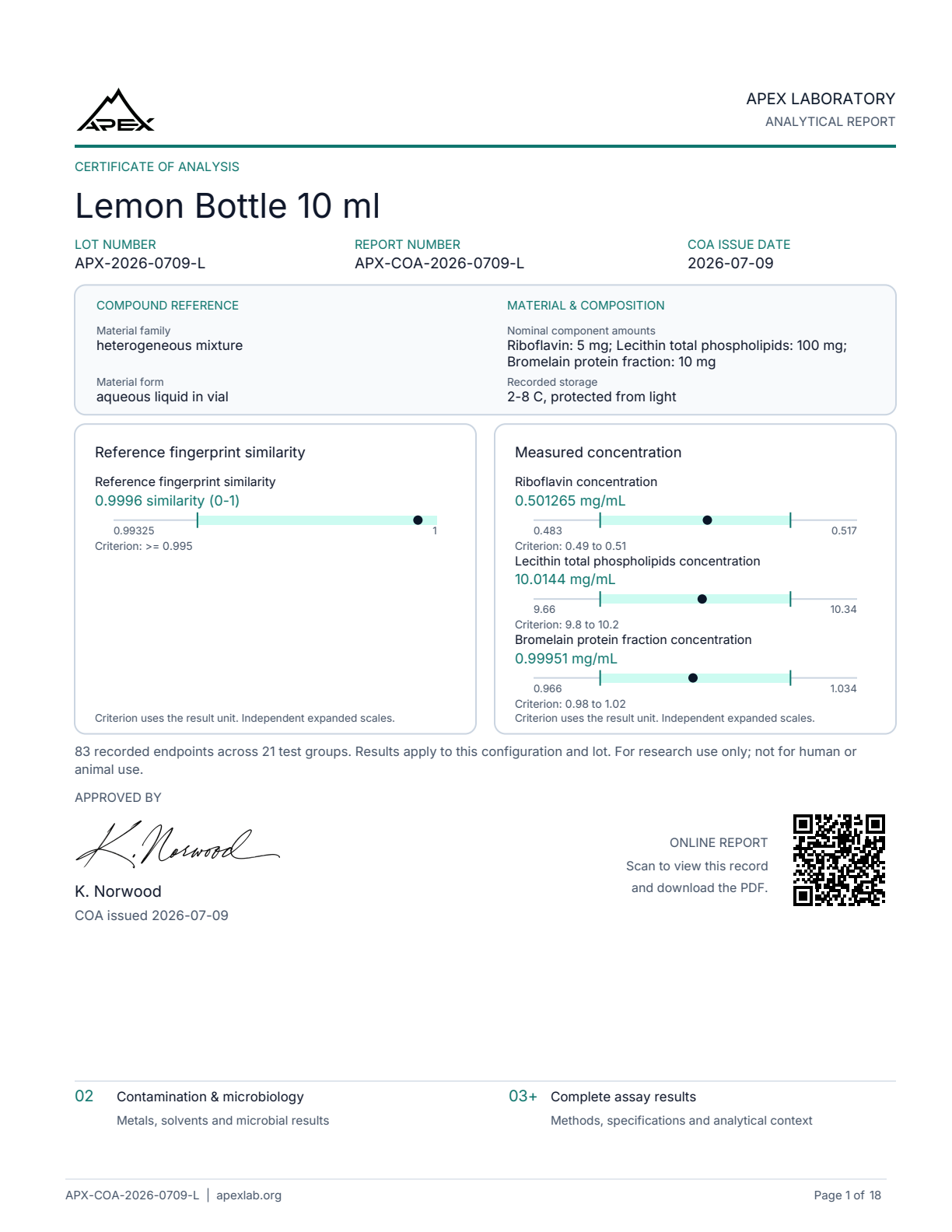
Lemon Bottle 10 ml
APX-2026-0709-L
View Lemon Bottle 10 ml product
For laboratory research use only. The issue date identifies this certificate; it is not a testing date.
 Preview report pages
 Analytical record
Results & specifications
T01Identity and structure
| Test / endpoint | Result | Acceptance criterion | Method |
|---|---|---|---|
| Orthogonal identity against specified reference | Conforms to the assigned reference; see identity basisPASS | Conforms to the specified acceptance criterion | M-T01-DEFAULT |
Supporting analytical detail for Orthogonal identity against specified reference
| |||
| Orthogonal fingerprint similarityspectrum/peptide-map comparison; score is not proof of stereochemistry | 0.9994 similarity (0-1)PASS | >= 0.995similarity (0-1) | M-T01-DEFAULT |
Supporting analytical detail for Orthogonal fingerprint similarity
| |||
| Riboflavin component-specific HRMS mass error[M+H]+; exact ion definition independent of whole-blend identity. Reference formula C17H20N4O6. | 0.01007 ppmPASS | -5 to 5ppm | M-T01-BLEND-SELECTIVE-HRMS |
Supporting analytical detail for Riboflavin component-specific HRMS mass error
| |||
T02Chromatographic purity
| Test / endpoint | Result | Acceptance criterion | Method |
|---|---|---|---|
| Multipeak fingerprint similarity to defined referenceFingerprint similarity, not chemical purity percentage | 0.9996 similarity (0-1)PASS | >= 0.995similarity (0-1) | M-T02-DEFAULT |
Supporting analytical detail for Multipeak fingerprint similarity to defined reference
| |||
T05Related substances and degradants
| Test / endpoint | Result | Acceptance criterion | Method |
|---|---|---|---|
| New unexplained chromatographic signal outside defined fingerprintAggregate non-reference signal; not mass fraction or component purity | 0.035 % total fingerprint responsePASS | <= 0.1% total fingerprint response | M-T05-DEFAULT |
Supporting analytical detail for New unexplained chromatographic signal outside defined fingerprint
| |||
T03Active content and assay
| Test / endpoint | Result | Acceptance criterion | Method |
|---|---|---|---|
| Riboflavin active contentAssigned component material basis; excludes vehicle/excipient/water; salt basis explicitly in identity specification | 5.01265 mg/vialPASS | 4.9 to 5.1mg/vial | M-T03-DEFAULT |
Supporting analytical detail for Riboflavin active content
| |||
| Riboflavin label claim assayIndependent calibrated amount / nominal amount x 100; not chromatographic area purity | 100.253 % label claimPASS | 98 to 102% label claim | M-T03-DEFAULT |
Supporting analytical detail for Riboflavin label claim assay
| |||
| Riboflavin concentrationAmount per nominal 10 mL fill | 0.501265 mg/mLPASS | 0.49 to 0.51mg/mL | M-T03-DEFAULT |
Supporting analytical detail for Riboflavin concentration
| |||
| Lecithin total phospholipids active contentAssigned component material basis; excludes vehicle/excipient/water; salt basis explicitly in identity specification | 100.144 mg/vialPASS | 98 to 102mg/vial | M-T03-DEFAULT |
Supporting analytical detail for Lecithin total phospholipids active content
| |||
| Lecithin total phospholipids label claim assayIndependent calibrated amount / nominal amount x 100; not chromatographic area purity | 100.144 % label claimPASS | 98 to 102% label claim | M-T03-DEFAULT |
Supporting analytical detail for Lecithin total phospholipids label claim assay
| |||
| Lecithin total phospholipids concentrationAmount per nominal 10 mL fill | 10.0144 mg/mLPASS | 9.8 to 10.2mg/mL | M-T03-DEFAULT |
Supporting analytical detail for Lecithin total phospholipids concentration
| |||
| Bromelain protein fraction active contentAssigned component material basis; excludes vehicle/excipient/water; salt basis explicitly in identity specification | 9.9951 mg/vialPASS | 9.8 to 10.2mg/vial | M-T03-DEFAULT |
Supporting analytical detail for Bromelain protein fraction active content
| |||
| Bromelain protein fraction label claim assayIndependent calibrated amount / nominal amount x 100; not chromatographic area purity | 99.951 % label claimPASS | 98 to 102% label claim | M-T03-DEFAULT |
Supporting analytical detail for Bromelain protein fraction label claim assay
| |||
| Bromelain protein fraction concentrationAmount per nominal 10 mL fill | 0.99951 mg/mLPASS | 0.98 to 1.02mg/mL | M-T03-DEFAULT |
Supporting analytical detail for Bromelain protein fraction concentration
| |||
T04Blend composition
| Test / endpoint | Result | Acceptance criterion | Method |
|---|---|---|---|
| Riboflavin component identity | Conforms to specified component identityPASS | Conforms to the specified acceptance criterion | M-T04-DEFAULT |
Supporting analytical detail for Riboflavin component identity
| |||
| Riboflavin component contentSame independent component assay as T03, not a second independent test | 5.01265 mg/vialPASS | 4.9 to 5.1mg/vial | M-T04-DEFAULT |
Supporting analytical detail for Riboflavin component content
| |||
| Lecithin total phospholipids component identity | Conforms to specified component identityPASS | Conforms to the specified acceptance criterion | M-T04-DEFAULT |
Supporting analytical detail for Lecithin total phospholipids component identity
| |||
| Lecithin total phospholipids component contentSame independent component assay as T03, not a second independent test | 100.144 mg/vialPASS | 98 to 102mg/vial | M-T04-DEFAULT |
Supporting analytical detail for Lecithin total phospholipids component content
| |||
| Bromelain protein fraction component identity | Conforms to specified component identityPASS | Conforms to the specified acceptance criterion | M-T04-DEFAULT |
Supporting analytical detail for Bromelain protein fraction component identity
| |||
| Bromelain protein fraction component contentSame independent component assay as T03, not a second independent test | 9.9951 mg/vialPASS | 9.8 to 10.2mg/vial | M-T04-DEFAULT |
Supporting analytical detail for Bromelain protein fraction component content
| |||
| Riboflavin isolated component identity definitionRiboflavin with native D-ribityl side-chain stereochemistry; not riboflavin phosphate/FMN. Light-protected LC-DAD retention and absorbance fingerprint; resolve lumichrome, lumiflavin and other degradation products. | Conforms to the stated component referencePASS | Conforms to the specified acceptance criterion | M-T04-BLEND-SELECTIVE-IDENTITY |
Supporting analytical detail for Riboflavin isolated component identity definition
| |||
| Riboflavin total-content extraction suitability | 99.85 % recoveryPASS | 98 to 102% recovery | M-T04-RIBOFLAVIN-EXTRACTION |
Supporting analytical detail for Riboflavin total-content extraction suitability
| |||
T15Unit uniformity
| Test / endpoint | Result | Acceptance criterion | Method |
|---|---|---|---|
| Riboflavin individual-unit meanspecified sample/form only | 100.253 % label claimPASS | 98 to 102% label claim | M-T15-DEFAULT |
Supporting analytical detail for Riboflavin individual-unit mean
| |||
| Riboflavin individual-unit RSDPrecision criterion for the listed specification, independently of AV | 0.3515 %PASS | <= 2% | M-T15-DEFAULT |
Supporting analytical detail for Riboflavin individual-unit RSD
| |||
| Lecithin total phospholipids individual-unit meanspecified sample/form only | 100.144 % label claimPASS | 98 to 102% label claim | M-T15-DEFAULT |
Supporting analytical detail for Lecithin total phospholipids individual-unit mean
| |||
| Lecithin total phospholipids individual-unit RSDPrecision criterion for the listed specification, independently of AV | 0.3519 %PASS | <= 2% | M-T15-DEFAULT |
Supporting analytical detail for Lecithin total phospholipids individual-unit RSD
| |||
| Bromelain protein fraction individual-unit meanspecified sample/form only | 99.951 % label claimPASS | 98 to 102% label claim | M-T15-DEFAULT |
Supporting analytical detail for Bromelain protein fraction individual-unit mean
| |||
| Bromelain protein fraction individual-unit RSDPrecision criterion for the listed specification, independently of AV | 0.3526 %PASS | <= 2% | M-T15-DEFAULT |
Supporting analytical detail for Bromelain protein fraction individual-unit RSD
| |||
| Mean extractable volumefill specification; no injection volume recommendation | 10 mL/containerPASS | 9.9 to 10.2mL/container | M-T15-DEFAULT |
Supporting analytical detail for Mean extractable volume
| |||
T06Water content
| Test / endpoint | Result | Acceptance criterion | Method |
|---|---|---|---|
| Applicability decisionspecified sample/form only | Not applicable — Water is the formulation vehicle; residual-moisture percentage would misdescribe an aqueous formulation. Vehicle quantity is specified separately.N/A — justified | Not applicable — Water is the formulation vehicle; residual-moisture percentage would misdescribe an aqueous formulation. Vehicle quantity is specified separately. | M-T06-DEFAULT |
Supporting analytical detail for Applicability decision
| |||
T07Counterions and associated species
| Test / endpoint | Result | Acceptance criterion | Method |
|---|---|---|---|
| Applicability decisionspecified sample/form only | Not applicable — No fixed counterion salt is assigned in this formulation; vehicle ions and intentional metal complexes are treated by their component specifications.N/A — justified | Not applicable — No fixed counterion salt is assigned in this formulation; vehicle ions and intentional metal complexes are treated by their component specifications. | M-T07-DEFAULT |
Supporting analytical detail for Applicability decision
| |||
T08Residual solvents
| Test / endpoint | Result | Acceptance criterion | Method |
|---|---|---|---|
| MethanolMaterial-based limit. Liquid numerical limits are listed specification and not ICH Option1 mass ppm. | 19.31 ug/mL formulationPASS | <= 3000ug/mL formulation | M-T08-DEFAULT |
Supporting analytical detail for Methanol
| |||
| AcetonitrileMaterial-based limit. Liquid numerical limits are listed specification and not ICH Option1 mass ppm. | 8.18 ug/mL formulationPASS | <= 410ug/mL formulation | M-T08-DEFAULT |
Supporting analytical detail for Acetonitrile
| |||
| DichloromethaneMaterial-based limit. Liquid numerical limits are listed specification and not ICH Option1 mass ppm. | 3.398 ug/mL formulationPASS | <= 600ug/mL formulation | M-T08-DEFAULT |
Supporting analytical detail for Dichloromethane
| |||
| N, N-dimethylformamideMaterial-based limit. Liquid numerical limits are listed specification and not ICH Option1 mass ppm. | 4.496 ug/mL formulationPASS | <= 880ug/mL formulation | M-T08-DEFAULT |
Supporting analytical detail for N, N-dimethylformamide
| |||
| EthanolMaterial-based limit. Liquid numerical limits are listed specification and not ICH Option1 mass ppm. | 40.022 ug/mL formulationPASS | <= 5000ug/mL formulation | M-T08-DEFAULT |
Supporting analytical detail for Ethanol
| |||
| AcetoneMaterial-based limit. Liquid numerical limits are listed specification and not ICH Option1 mass ppm. | 11.64 ug/mL formulationPASS | <= 5000ug/mL formulation | M-T08-DEFAULT |
Supporting analytical detail for Acetone
| |||
| Ethyl acetateMaterial-based limit. Liquid numerical limits are listed specification and not ICH Option1 mass ppm. | 9.78 ug/mL formulationPASS | <= 5000ug/mL formulation | M-T08-DEFAULT |
Supporting analytical detail for Ethyl acetate
| |||
| TolueneMaterial-based limit. Liquid numerical limits are listed specification and not ICH Option1 mass ppm. | 1.895 ug/mL formulationPASS | <= 890ug/mL formulation | M-T08-DEFAULT |
Supporting analytical detail for Toluene
| |||
| n-HexaneMaterial-based limit. Liquid numerical limits are listed specification and not ICH Option1 mass ppm. | 1.025 ug/mL formulationPASS | <= 290ug/mL formulation | M-T08-DEFAULT |
Supporting analytical detail for n-Hexane
| |||
| BenzeneMaterial-based limit. Liquid numerical limits are listed specification and not ICH Option1 mass ppm. | 0.083 ug/mL formulationPASS | <= 2ug/mL formulation | M-T08-DEFAULT |
Supporting analytical detail for Benzene
| |||
T09Elemental impurities
| Test / endpoint | Result | Acceptance criterion | Method |
|---|---|---|---|
| LeadTotal element; no speciation. material-based criterion, not a dose/route-derived safety limit. | 0.0112 ug/mL formulationPASS | <= 0.5ug/mL formulation | M-T09-DEFAULT |
Supporting analytical detail for Lead
| |||
| CadmiumTotal element; no speciation. material-based criterion, not a dose/route-derived safety limit. | 0.008 ug/mL formulationPASS | <= 0.2ug/mL formulation | M-T09-DEFAULT |
Supporting analytical detail for Cadmium
| |||
| ArsenicTotal element; no speciation. material-based criterion, not a dose/route-derived safety limit. | 0.0187 ug/mL formulationPASS | <= 0.5ug/mL formulation | M-T09-DEFAULT |
Supporting analytical detail for Arsenic
| |||
| MercuryTotal element; no speciation. material-based criterion, not a dose/route-derived safety limit. | 0.006 ug/mL formulationPASS | <= 0.1ug/mL formulation | M-T09-DEFAULT |
Supporting analytical detail for Mercury
| |||
| CobaltTotal element; no speciation. material-based criterion, not a dose/route-derived safety limit. | 0.0229 ug/mL formulationPASS | <= 1ug/mL formulation | M-T09-DEFAULT |
Supporting analytical detail for Cobalt
| |||
| VanadiumTotal element; no speciation. material-based criterion, not a dose/route-derived safety limit. | 0.0228 ug/mL formulationPASS | <= 1ug/mL formulation | M-T09-DEFAULT |
Supporting analytical detail for Vanadium
| |||
| NickelTotal element; no speciation. material-based criterion, not a dose/route-derived safety limit. | 0.0347 ug/mL formulationPASS | <= 2ug/mL formulation | M-T09-DEFAULT |
Supporting analytical detail for Nickel
| |||
| PalladiumTotal element; no speciation. material-based criterion, not a dose/route-derived safety limit. | 0.0101 ug/mL formulationPASS | <= 1ug/mL formulation | M-T09-DEFAULT |
Supporting analytical detail for Palladium
| |||
| PlatinumTotal element; no speciation. material-based criterion, not a dose/route-derived safety limit. | 0.0092 ug/mL formulationPASS | <= 1ug/mL formulation | M-T09-DEFAULT |
Supporting analytical detail for Platinum
| |||
| RhodiumTotal element; no speciation. material-based criterion, not a dose/route-derived safety limit. | 0.0063 ug/mL formulationPASS | <= 1ug/mL formulation | M-T09-DEFAULT |
Supporting analytical detail for Rhodium
| |||
| RutheniumTotal element; no speciation. material-based criterion, not a dose/route-derived safety limit. | 0.009 ug/mL formulationPASS | <= 1ug/mL formulation | M-T09-DEFAULT |
Supporting analytical detail for Ruthenium
| |||
| IridiumTotal element; no speciation. material-based criterion, not a dose/route-derived safety limit. | 0.0065 ug/mL formulationPASS | <= 1ug/mL formulation | M-T09-DEFAULT |
Supporting analytical detail for Iridium
| |||
T13pH and analytical solution
| Test / endpoint | Result | Acceptance criterion | Method |
|---|---|---|---|
| pH of native liquidAs supplied,25.0C; buffer-solution compatibility is not the pH of dry material | 5.49 pHPASS | 4.8 to 6.2pH | M-T13-DEFAULT |
Supporting analytical detail for pH of native liquid
| |||
T14Excipients and preservatives
| Test / endpoint | Result | Acceptance criterion | Method |
|---|---|---|---|
| Vehicle and preservative compositionExplicit formulation choice, not a statement about actual catalog formulation | Water q.s. declared volume; no added preservativePASS | Conforms to the specified acceptance criterion | M-T14-DEFAULT |
Supporting analytical detail for Vehicle and preservative composition
| |||
T21Appearance and physical inspection
| Test / endpoint | Result | Acceptance criterion | Method |
|---|---|---|---|
| AppearanceThree containers under diffuse white illumination | yellow opalescent dispersion; uniform dispersionPASS | Conforms to the specified acceptance criterion | M-T21-DEFAULT |
Supporting analytical detail for Appearance
| |||
| Visible foreign matterVisual observation only; subvisible particles reported separately | None observed in 3 inspected unitsPASS | Conforms to the specified acceptance criterion | M-T21-DEFAULT |
Supporting analytical detail for Visible foreign matter
| |||
T10Sterility test
| Test / endpoint | Result | Acceptance criterion | Method |
|---|---|---|---|
| Sterility: FTMFTM30-35C; tested units only; growth-promotion/suitability controls conform | No growth at 14 days in all 20 unitsPASS | Conforms to the specified acceptance criterion | M-T10-DEFAULT |
Supporting analytical detail for Sterility: FTM
| |||
| Sterility: SCDMSCDM20-25C; tested units only; no sterility assurance level assigned | No growth at 14 days in all 20 unitsPASS | Conforms to the specified acceptance criterion | M-T10-DEFAULT |
Supporting analytical detail for Sterility: SCDM
| |||
T11Bacterial endotoxins
| Test / endpoint | Result | Acceptance criterion | Method |
|---|---|---|---|
| Bacterial endotoxinsSample reporting limit after1:5 dilution; threshold is and not based on administration route/dose | <0.025 EU/mLPASS | <= 0.1EU/mL | M-T11-DEFAULT |
Supporting analytical detail for Bacterial endotoxins
| |||
T12Microbial enumeration
| Test / endpoint | Result | Acceptance criterion | Method |
|---|---|---|---|
| TAMCZero colonies observed from1g or1 mL equivalent filter; report <1, not exact absence | <1 CFU/mLPASS | <= 100CFU/mL | M-T12-DEFAULT |
Supporting analytical detail for TAMC
| |||
| TYMCZero colonies observed from1g or1 mL equivalent filter; report <1, not exact absence | <1 CFU/mLPASS | <= 10CFU/mL | M-T12-DEFAULT |
Supporting analytical detail for TYMC
| |||
| Escherichia coliSpecified-organism enrichment in explicit1g/1 mL scope; not a universal pharmacopeial panel | Not detected in 1 mLPASS | Conforms to the specified acceptance criterion | M-T12-DEFAULT |
Supporting analytical detail for Escherichia coli
| |||
| Staphylococcus aureusSpecified-organism enrichment in explicit1g/1 mL scope; not a universal pharmacopeial panel | Not detected in 1 mLPASS | Conforms to the specified acceptance criterion | M-T12-DEFAULT |
Supporting analytical detail for Staphylococcus aureus
| |||
| Pseudomonas aeruginosaSpecified-organism enrichment in explicit1g/1 mL scope; not a universal pharmacopeial panel | Not detected in 1 mLPASS | Conforms to the specified acceptance criterion | M-T12-DEFAULT |
Supporting analytical detail for Pseudomonas aeruginosa
| |||
| Salmonella speciesSpecified-organism enrichment in explicit1g/1 mL scope; not a universal pharmacopeial panel | Not detected in 1 mLPASS | Conforms to the specified acceptance criterion | M-T12-DEFAULT |
Supporting analytical detail for Salmonella species
| |||
| Candida albicansSpecified-organism enrichment in explicit1g/1 mL scope; not a universal pharmacopeial panel | Not detected in 1 mLPASS | Conforms to the specified acceptance criterion | M-T12-DEFAULT |
Supporting analytical detail for Candida albicans
| |||
T17Protein and conjugate characterization
| Test / endpoint | Result | Acceptance criterion | Method |
|---|---|---|---|
| Size-exclusion main defined populationIsolated bromelain protein fraction only; excludes lecithin and riboflavin | 99.91 % SEC responsePASS | 99.7 to 100% SEC response | M-T17-DEFAULT |
Supporting analytical detail for Size-exclusion main defined population
| |||
| High molecular weight aggregate fractionspecified sample/form only | 0.045 % SEC responsePASS | <= 0.1% SEC response | M-T17-DEFAULT |
Supporting analytical detail for High molecular weight aggregate fraction
| |||
| Low molecular weight non-reference fractionspecified sample/form only | 0.045 % SEC responsePASS | <= 0.1% SEC response | M-T17-DEFAULT |
Supporting analytical detail for Low molecular weight non-reference fraction
| |||
| Orthogonal construct/fingerprint mappingIdentity Reference defines construct, termini, and mixture caveats; no raw mass spectrum or gel image exists | Conforms to explicit reference specificationPASS | Conforms to the specified acceptance criterion | M-T17-DEFAULT |
Supporting analytical detail for Orthogonal construct/fingerprint mapping
| |||
| Lecithin Phosphatidylcholine class fractionClass-specific mass-calibrated LC-CAD with independent LC-MS class identification. These are intended constituents, not three impurities. Heterogeneous acyl species remain within each class. | 80.03 % w/w designated phospholipid fractionPASS | 78 to 82% w/w designated phospholipid fraction | M-T17-LIPID-CLASS-LC-CAD |
Supporting analytical detail for Lecithin Phosphatidylcholine class fraction
| |||
| Lecithin Phosphatidylethanolamine class fractionClass-specific mass-calibrated LC-CAD with independent LC-MS class identification. These are intended constituents, not three impurities. Heterogeneous acyl species remain within each class. | 14.98 % w/w designated phospholipid fractionPASS | 13.5 to 16.5% w/w designated phospholipid fraction | M-T17-LIPID-CLASS-LC-CAD |
Supporting analytical detail for Lecithin Phosphatidylethanolamine class fraction
| |||
| Lecithin Phosphatidylinositol class fractionClass-specific mass-calibrated LC-CAD with independent LC-MS class identification. These are intended constituents, not three impurities. Heterogeneous acyl species remain within each class. | 4.99 % w/w designated phospholipid fractionPASS | 4.5 to 5.5% w/w designated phospholipid fraction | M-T17-LIPID-CLASS-LC-CAD |
Supporting analytical detail for Lecithin Phosphatidylinositol class fraction
| |||
T18Process impurities
| Test / endpoint | Result | Acceptance criterion | Method |
|---|---|---|---|
| Residual source-process protein impuritiespineapple-derived bromelain/plant lecithin process; source-specific assay. For hydrolysates, intact source proteins outside the target digest are measured by selective separation; intended peptides are not HCP impurities. | 2.1 ng/mg assigned target materialPASS | <= 100ng/mg assigned target material | M-T18-DEFAULT |
Supporting analytical detail for Residual source-process protein impurities
| |||
| Residual source DNASource-specific qPCR in process; extraction recovery demonstrated only | 0.012 ng/vialPASS | <= 1ng/vial | M-T18-DEFAULT |
Supporting analytical detail for Residual source DNA
| |||
T16Biological activity
| Test / endpoint | Result | Acceptance criterion | Method |
|---|---|---|---|
| Bromelain caseinolytic specific activity1 casein U = 1 micromol tyrosine-equivalent TCA-soluble product released per minute at 37.0C, pH7.00,1.00%w/v casein,50mM sodium phosphate and5mM L-cysteine; tyrosine-calibrated Folin color response after precipitation. Method-defined equivalent units, not GDU. Use a separate native aqueous enzyme preparation; do not expose it to lipid or riboflavin extraction solvents. Dilute the native protein preparation1:10; add0.100 mL to a2.000 mL reaction. Sample at 0,1,2,3,4,5min and quench in equal-volume10%w/v TCA. After removal of precipitate, use a matrix-blank-corrected tyrosine calibration expressed as micromol equivalents per original reaction. Reference and sample matrices matched. | 2.00009 casein U/mg bromelain proteinRecorded numeric value: 2.000095PASS | 1.9 to 2.1casein U/mg bromelain protein | M-T16-BROMELAIN-INITIAL-RATE |
Supporting analytical detail for Bromelain caseinolytic specific activity
| |||
| Bromelain caseinolytic activity per vialSpecific activity x independently measured bromelain protein mg/vial. Target20 caseinU/vial from 10 mg x2caseinU/mg; not GDU. | 19.9912 casein U/vialRecorded numeric value: 19.991151PASS | 19 to 21casein U/vial | M-T16-BROMELAIN-INITIAL-RATE |
Supporting analytical detail for Bromelain caseinolytic activity per vial
| |||
| Bromelain caseinolytic activity concentrationRelative to the specified reference response; activity units and mass units are evaluated separately. Method validation is not asserted by this report. | 1.99911 casein U/mL formulationRecorded numeric value: 1.999115PASS | 1.9 to 2.1casein U/mL formulation | M-T16-BROMELAIN-INITIAL-RATE |
Supporting analytical detail for Bromelain caseinolytic activity concentration
| |||
| Bromelain matrix-spike activity recoveryActivity-added reference matched for casein, pH, thiol activation and color matrix; separate from total-protein spike recovery. | 100.8 % activity recoveryPASS | 90 to 110% activity recovery | M-T16-BROMELAIN-INITIAL-RATE |
Supporting analytical detail for Bromelain matrix-spike activity recovery
| |||
T19Particles and container closure
| Test / endpoint | Result | Acceptance criterion | Method |
|---|---|---|---|
| Container closure and visible package conditionNonsterile capsule bottle or intentional dispersion; light-obscuration particulate numbers inappropriate for these matrices | No damage; closure and seal conform in 10 packagesPASS | Conforms to the specified acceptance criterion | M-T19-DEFAULT |
Supporting analytical detail for Container closure and visible package condition
| |||
T20Stability observations
| Test / endpoint | Result | Acceptance criterion | Method |
|---|---|---|---|
| Reported 6 month assay retentionReported change relative to the initial assay. This report does not assign a retest date or shelf life. | 99.91 % of initial assayPASS | 98 to 102% of initial assay | M-T20-DEFAULT |
Supporting analytical detail for Reported 6 month assay retention
| |||
| Dating dispositionReported change relative to the initial assay. This report does not assign a retest date or shelf life. | 6 month review point; actual expiry/retest not assignedPASS | Conforms to the specified acceptance criterion | M-T20-DEFAULT |
Supporting analytical detail for Dating disposition
| |||
Method references
How the results are documented
- M-T01-DEFAULT
- Orthogonal chemical/structural identityLC-HRMS/MS plus sequence/connectivity-sensitive reference comparison
- M-T02-DEFAULT
- Chromatographic purityRP-UPLC DAD; SEC for protein size species; HILIC/CAD for nonchromophoric analytes
- M-T05-DEFAULT
- Related substancesStability-indicating LC integration; orthogonal size/charge separation for biologics
- M-T03-DEFAULT
- Calibrated material contentIndependent quantitative LC/CAD, protein assay or bioactivity calibration for IU
- M-T04-DEFAULT
- Component-resolved blend assaySeparate calibrated selective assay for every declared component
- M-T15-DEFAULT
- Individual-unit uniformityTen separate unit preparations and fill measurements
- M-T06-DEFAULT
- WaterCoulometric Karl Fischer
- M-T07-DEFAULT
- Counterion compositionIon chromatography and stoichiometric accounting
- M-T08-DEFAULT
- Residual solvent panelheadspace GC-MS
- M-T09-DEFAULT
- Elemental impurity panelICP-MS
- M-T13-DEFAULT
- pH and solution stateCalibrated potentiometry
- M-T14-DEFAULT
- Excipients/preservativesComponent-specific quantitative LC/CAD or formulation identity
- M-T21-DEFAULT
- AppearanceControlled visual examination
- M-T10-DEFAULT
- Sterility observations in two media with matrix-specific preparationMembrane filtration/rinsing or neutralized direct inoculation for Lemon dispersion
- M-T11-DEFAULT
- Bacterial endotoxinsRecombinant factor C fluorometric assay
- M-T12-DEFAULT
- Microbial enumeration/organismsMembrane filtration enumeration and enrichment
- M-T17-DEFAULT
- Protein/conjugate characterizationSEC-MALS, CE-SDS, peptide mapping, glycan/PEG profiling
- M-T18-DEFAULT
- Biological process impurity panelHost/process-specific ELISA and qPCR
- M-T01-BLEND-SELECTIVE-HRMS
- Component-specific exact-ion identity for the declared blendComponent-selective LC-HRMS with independently defined molecular ions
- M-T04-BLEND-SELECTIVE-IDENTITY
- Identity definition for each selectively assayed blend componentComponent-selective reference comparison with orthogonal identity controls
- M-T04-RIBOFLAVIN-EXTRACTION
- Riboflavin total-content extraction suitability in Lemon dispersionComponent-selective quantitative extraction and matrix-spike recovery
- M-T17-LIPID-CLASS-LC-CAD
- Lecithin phospholipid-class mass-fraction fingerprintClass-calibrated LC-CAD with independent LC-MS class identification
- M-T16-BROMELAIN-INITIAL-RATE
- Bromelain caseinolytic initial-rate activity and matrix recoveryTime-course casein hydrolysis with TCA separation and tyrosine-calibrated Folin detection
- M-T19-DEFAULT
- Particles and package integrityLight obscuration plus vacuum decay
- M-T20-DEFAULT
- Stability observationTime-zero/1/3/6-month trend
Apex Laboratory issues this certificate. Results apply to the stated configuration and lot. Browse all certificates.