Certificate of analysis · Apex Laboratory

SLU-PP-332 Caps (100pcs)

APX-2026-0708-S

COA issue date
Report ID
APX-COA-2026-0708-S
Issuing laboratory
Apex Laboratory
Configuration
SLU-PP-332 Caps (100pcs)
Authorized by
K. Norwood
Documented endpoints
63 across 21 test groups

View SLU-PP-332 Caps (100pcs) product

For laboratory research use only. The issue date identifies this certificate; it is not a testing date.
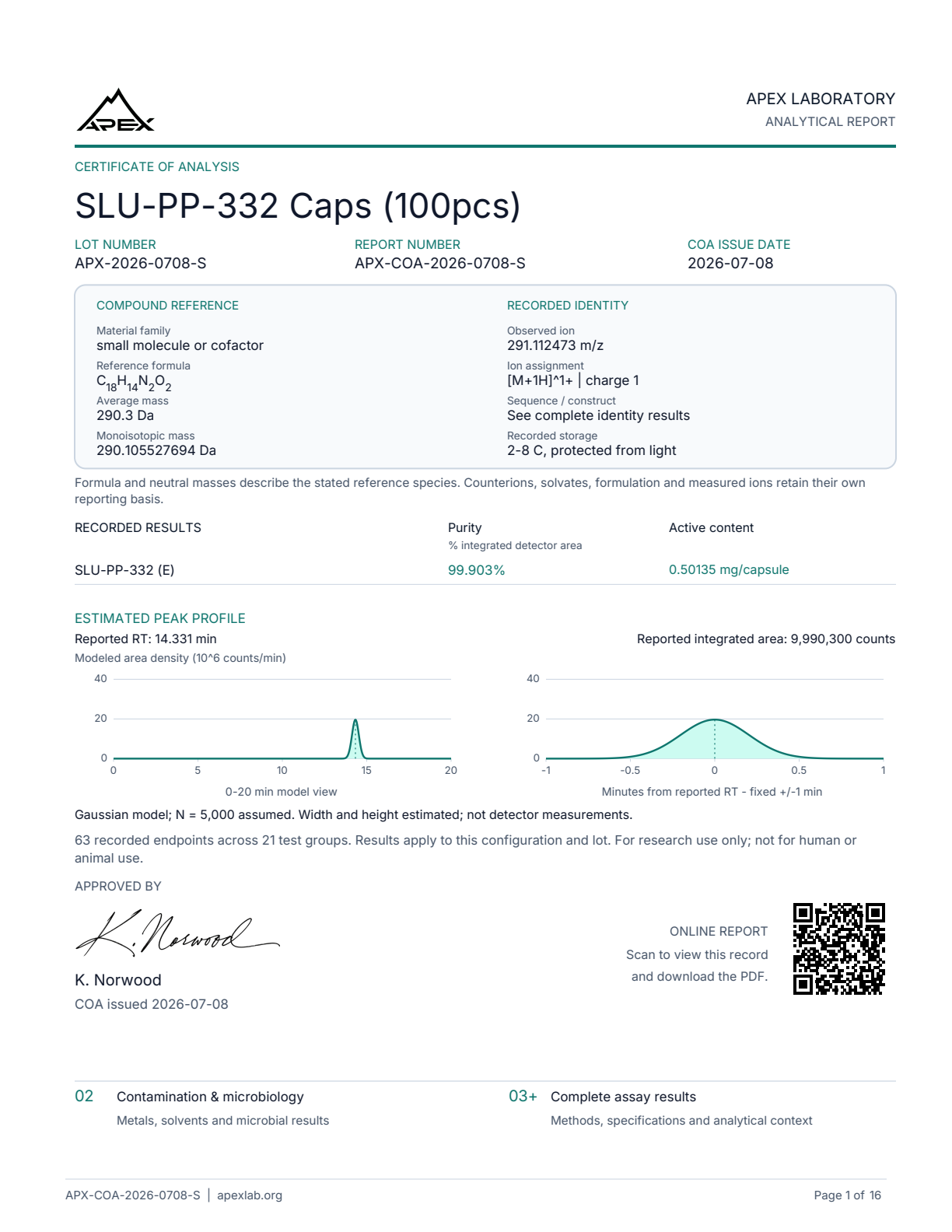
First-page preview of the SLU-PP-332 Caps (100pcs) certificate of analysisPreview report pages

Analytical record

Results & specifications

Download result tables

T01Identity and structure

Test / endpointResultAcceptance criterionMethod
Orthogonal identity against specified referenceSLU-PP-332: (E)-4-hydroxy-N-prime-(naphthalen-2-ylmethylene)benzohydrazide; free neutral compound, no intentional salt, E hydrazone configuration. Capsule configuration:0.500 mg active per capsule; microcrystalline cellulose q.s. to200.000 mg net fill;60.000 mg HPMC shell;100capsules per bottle. dry neutral active; shell is excluded from fill-weight and parent-content calculations.Conforms to the assigned reference; see identity basisPASSConforms to the specified acceptance criterionM-T01-DEFAULT
Supporting analytical detail for Orthogonal identity against specified reference
Sample units
3 capsules
Analytical replicates
2
identified structure or sequence
SLU-PP-332: (E)-4-hydroxy-N-prime-(naphthalen-2-ylmethylene)benzohydrazide; free neutral compound, no intentional salt, E hydrazone configuration. Capsule configuration:0.500 mg active per capsule; microcrystalline cellulose q.s. to200.000 mg net fill;60.000 mg HPMC shell;100capsules per bottle. dry neutral active; shell is excluded from fill-weight and parent-content calculations.
neutral average mass
290.3 Da or explicit reason
neutral monoisotopic mass
290.105527694 DaReference, not measured neutral mass
observed mz
291.112473 m/z
charge state
1 integer
adduct
[M+1H]^1+
mass tolerance
+/-5 ppm for an explicitly defined monoisotopic ion; not 5 Da.Method and sample context; reference facts are in Identity Reference.
reduced deglycosylated or intact
Intact specified parent for defined compounds; glycoproteins and PEG retain the specified population heterogeneity. No single exact intact glycoprotein mass is invented.Method and sample context; reference facts are in Identity Reference.
stereochemistry method
Component-specific chiral amino acid analysis or orthogonal structure comparison, where applicable; HRMS cannot distinguish stereoisomers.Method and sample context; reference facts are in Identity Reference.
identity standard traceability
RS-2721; internal standard, not a purchased certified reference material
Orthogonal fingerprint similarityspectrum/peptide-map comparison; score is not proof of stereochemistry0.9994 similarity (0-1)PASS>= 0.995similarity (0-1)M-T01-DEFAULT
Supporting analytical detail for Orthogonal fingerprint similarity
Sample units
3 capsules
Analytical replicates
2
SLU-PP-332 (E) HRMS ion mass error[M+1H]^1+; reference monoisotopic M=290.105527694 Da; molecule excludes associated salt/solvate-1.1376 ppmPASS-5 to 5ppmM-T01-DEFAULT
Supporting analytical detail for SLU-PP-332 (E) HRMS ion mass error
Sample units
3 capsules
Analytical replicates
2
SLU-PP-332 1H diagnostic NMR maximum shift deviationSelected primary-paper E-compound reference peaks; observed shifts. Match is corroborative, not independent proof of E geometry.0.004 ppmPASS<= 0.05ppmM-T01-SLU-NMR
Supporting analytical detail for SLU-PP-332 1H diagnostic NMR maximum shift deviation
Sample units
3 capsules
Analytical replicates
2
SLU-PP-332 13C diagnostic NMR maximum shift deviationSelected primary-paper E-compound reference peaks; observed shifts. Match is corroborative, not independent proof of E geometry.0.015 ppmPASS<= 0.2ppmM-T01-SLU-NMR
Supporting analytical detail for SLU-PP-332 13C diagnostic NMR maximum shift deviation
Sample units
3 capsules
Analytical replicates
2
SLU-PP-332 E/Z reference challenge resolution2*(11.10-10.20)/(.24+.24); E identity established by reference coanalysis and primary-paper NMR comparison3.75 RsPASS>= 1.5RsM-T01-SLU-E-Z
Supporting analytical detail for SLU-PP-332 E/Z reference challenge resolution
Sample units
3 capsules
Analytical replicates
2

T02Chromatographic purity

Test / endpointResultAcceptance criterionMethod
SLU-PP-332 (E) chromatographic puritySingle analyte method scope; intended blend co-components and excipients excluded by analyte-specific selectivity, not denominator manipulation99.903 % integrated detector areaPASS99.7 to 100% integrated detector areaM-T02-RP-UPLC-DAD
Supporting analytical detail for SLU-PP-332 (E) chromatographic purity
Sample units
3 capsules
Analytical replicates
2
gradient or separation conditions
Analyte-specific starting method in Method Profiles; retention time is anchored to the same component across sizes, with a small run shift.Method and sample context; reference facts are in Identity Reference.
detector and wavelength
Peptides: DAD at 214 nm. Proteins: SEC with UV detection at 280 nm. Nonchromophoric analytes: CAD, with detector-area reporting explicitly distinguished from mass fraction.Method and sample context; reference facts are in Identity Reference.
main peak retention time
14.331 min
integration threshold
Reporting threshold: 0.010%; LOQ: 0.005%; LOD: 0.002%, for the single-analyte method.Method and sample context; reference facts are in Identity Reference.
main peak area
9990300 counts
total integrated area
10000000 counts
unresolved or excluded peaks
Only specified co-components/vehicle/excipients excluded using selective methods; unknown U1/U2/U3 remain in analyte-method denominator.Method and sample context; reference facts are in Identity Reference.

T05Related substances and degradants

Test / endpointResultAcceptance criterionMethod
SLU-PP-332 (E) Unknown U1Same analyte-specific chromatogram as T02; response factor assumed 1.00 for unknowns; area only0.049 % integrated detector areaPASS<= 0.1% integrated detector areaM-T05-DEFAULT
Supporting analytical detail for SLU-PP-332 (E) Unknown U1
Limit of detection
0.002 % integrated detector area
Limit of quantitation
0.005 % integrated detector area
Sample units
3 capsules
Analytical replicates
2
impurity identity status
U1, U2 and U3 are unassigned peaks. Chemically named degradants appear only in specific orthogonal records when justified.Method and sample context; reference facts are in Identity Reference.
reporting threshold
0.010% integrated analyte-specific detector responseMethod and sample context; reference facts are in Identity Reference.
relative response factor
1.00 assumed only for area reporting; not sufficient for impurity mass-fraction reportingMethod and sample context; reference facts are in Identity Reference.
degradation or process origin if known
Unknown peak origin; peak position does not establish oxidation, deamidation or a synthesis byproduct.Method and sample context; reference facts are in Identity Reference.
SLU-PP-332 (E) Unknown U2Same analyte-specific chromatogram as T02; response factor assumed 1.00 for unknowns; area only0.029 % integrated detector areaPASS<= 0.1% integrated detector areaM-T05-DEFAULT
Supporting analytical detail for SLU-PP-332 (E) Unknown U2
Limit of detection
0.002 % integrated detector area
Limit of quantitation
0.005 % integrated detector area
Sample units
3 capsules
Analytical replicates
2
SLU-PP-332 (E) Unknown U3Same analyte-specific chromatogram as T02; response factor assumed 1.00 for unknowns; area only0.019 % integrated detector areaPASS<= 0.1% integrated detector areaM-T05-DEFAULT
Supporting analytical detail for SLU-PP-332 (E) Unknown U3
Limit of detection
0.002 % integrated detector area
Limit of quantitation
0.005 % integrated detector area
Sample units
3 capsules
Analytical replicates
2
SLU-PP-332 (E) total related peaksSum of U1+U2+U3; purity plus related areas = 100%0.097 % integrated detector areaPASS<= 0.3% integrated detector areaM-T05-DEFAULT
Supporting analytical detail for SLU-PP-332 (E) total related peaks
Sample units
3 capsules
Analytical replicates
2
SLU-PP-332 resolved Z hydrazoneOrthogonal E/Z-selective method; do not add these percentages again to the independent generic impurity chromatogram0.025 % response-corrected isomer areaPASS<= 0.1% response-corrected isomer areaM-T05-SLU-E-Z
Supporting analytical detail for SLU-PP-332 resolved Z hydrazone
Sample units
3 capsules
Analytical replicates
2

T03Active content and assay

Test / endpointResultAcceptance criterionMethod
SLU-PP-332 (E) active contentAssigned component material basis; excludes vehicle/excipient/water; salt basis explicitly in identity specification0.50135 mg/capsulePASS0.49 to 0.51mg/capsuleM-T03-DEFAULT
Supporting analytical detail for SLU-PP-332 (E) active content
Sample units
3 capsules
Analytical replicates
2
quantitative reference standard
RS-2721; independent component standards for blends; not a real purchased CRMMethod and sample context; reference facts are in Identity Reference.
standard assigned content
99.90% mass content for the chemical reference. An IU reference uses assigned activity; it is never described as 99.90% IU purity.Method and sample context; reference facts are in Identity Reference.
sample preparation volume
1 mL
dilution factor
5 fold
water correction
Water excluded by calibration to active-equivalent standard; moisture separately measured. No area-purity times gross-fill calculation.Method and sample context; reference facts are in Identity Reference.
counterion correction
Parent-equivalent content unless explicit iodide/choline chloride salt or GHK complex basis. Counterion/metal composition separately quantified.Method and sample context; reference facts are in Identity Reference.
gross fill mass
200.000000 mg total net fill, including moisture and excipientMethod and sample context; reference facts are in Identity Reference.
active material basis
mg per capsule or vial on the explicitly specified material basis; IU on the assigned biological-activity basis. Package count and package total are reported separately.Method and sample context; reference facts are in Identity Reference.
SLU-PP-332 (E) label claim assayIndependent calibrated amount / nominal amount x 100; not chromatographic area purity100.27 % label claimPASS98 to 102% label claimM-T03-DEFAULT
Supporting analytical detail for SLU-PP-332 (E) label claim assay
Sample units
3 capsules
Analytical replicates
2

T15Unit uniformity

Test / endpointResultAcceptance criterionMethod
SLU-PP-332 (E) individual-unit meanspecified sample/form only100.27 % label claimPASS98 to 102% label claimM-T15-DEFAULT
Supporting analytical detail for SLU-PP-332 (E) individual-unit mean
Sample units
10 capsules
Analytical replicates
1
individual fill mass
200.000000 mg nominal wet fill; capsule shell excludedMethod and sample context; reference facts are in Identity Reference.
physical unit count
100 Explicit context; see valueMethod and sample context; reference facts are in Identity Reference.
unit statistical summary
Mean, sample SD, RSD, M, k and AV are calculated from 10 individual observations; AV for a multidose liquid is descriptive only.Method and sample context; reference facts are in Identity Reference.
sampling plan
10 independent units per configuration, with component assays from the same units; separate from the three-unit composite assay.Method and sample context; reference facts are in Identity Reference.
SLU-PP-332 (E) acceptance value (n=10)AV=abs(M-mean)+2.4 sample SD; target 100%; M=mean within 98.5-101.50.8458 % label claimPASS<= 15% label claimM-T15-DEFAULT
Supporting analytical detail for SLU-PP-332 (E) acceptance value (n=10)
Sample units
10 capsules
Analytical replicates
1
SLU-PP-332 (E) individual-unit RSDPrecision criterion for the listed specification, independently of AV0.3515 %PASS<= 2%M-T15-DEFAULT
Supporting analytical detail for SLU-PP-332 (E) individual-unit RSD
Sample units
10 capsules
Analytical replicates
1
Physical capsule countthree-bottle count inspection100 capsules/bottlePASS100 to 100capsules/bottleM-T15-DEFAULT
Supporting analytical detail for Physical capsule count
Sample units
3 capsules
Analytical replicates
1

T04Blend composition

Test / endpointResultAcceptance criterionMethod
Applicability decisionspecified sample/form onlyNot applicable — One declared active or a water/preservative reagent. Preservative is separately quantified under T14; there is no multi-active blend ratio.N/A — justifiedNot applicable — One declared active or a water/preservative reagent. Preservative is separately quantified under T14; there is no multi-active blend ratio.M-T04-DEFAULT
Supporting analytical detail for Applicability decision
Sample units
0 capsules
Analytical replicates
0
component structure reference
Not applicable — One declared active or a water/preservative reagent. Preservative is separately quantified under T14; there is no multi-active blend ratio.Outside the defined test scope.
component label amount
Not applicable — One declared active or a water/preservative reagent. Preservative is separately quantified under T14; there is no multi-active blend ratio.Outside the defined test scope.
component measured amount
Not applicable — One declared active or a water/preservative reagent. Preservative is separately quantified under T14; there is no multi-active blend ratio.Outside the defined test scope.
component quantitative standard
Not applicable — One declared active or a water/preservative reagent. Preservative is separately quantified under T14; there is no multi-active blend ratio.Outside the defined test scope.
component response factor
Not applicable — One declared active or a water/preservative reagent. Preservative is separately quantified under T14; there is no multi-active blend ratio.Outside the defined test scope.
coelution assessment
Not applicable — One declared active or a water/preservative reagent. Preservative is separately quantified under T14; there is no multi-active blend ratio.Outside the defined test scope.
component ratio basis
Not applicable — One declared active or a water/preservative reagent. Preservative is separately quantified under T14; there is no multi-active blend ratio.Outside the defined test scope.

T06Water content

Test / endpointResultAcceptance criterionMethod
Residual waterWater as percentage of total net formulation, not peptide area purity0.723 % w/w finished fillPASS<= 2% w/w finished fillM-T06-KF
Supporting analytical detail for Residual water
Sample units
3 capsules
Analytical replicates
2
sample handling
Sealed vial transferred to a dry vessel; blank corrected. Pool 0.1000 g of net formulation where needed.Method and sample context; reference facts are in Identity Reference.
dry basis correction
1.007282653585422 factorFor mass-fraction reporting only; independent active assay is not blindly multiplied by this factor.

T07Counterions and associated species

Test / endpointResultAcceptance criterionMethod
Applicability decisionspecified sample/form onlyNot applicable — No fixed counterion salt is assigned in this formulation; vehicle ions and intentional metal complexes are treated by their component specifications.N/A — justifiedNot applicable — No fixed counterion salt is assigned in this formulation; vehicle ions and intentional metal complexes are treated by their component specifications.M-T07-DEFAULT
Supporting analytical detail for Applicability decision
Sample units
0 capsules
Analytical replicates
0
counterion identity
Not applicable — No fixed counterion salt is assigned in this formulation; vehicle ions and intentional metal complexes are treated by their component specifications.Outside the defined test scope.
counterion molar ratio
Not applicable — No fixed counterion salt is assigned in this formulation; vehicle ions and intentional metal complexes are treated by their component specifications.Outside the defined test scope.
salt or solvate specification
Not applicable — No fixed counterion salt is assigned in this formulation; vehicle ions and intentional metal complexes are treated by their component specifications.Outside the defined test scope.

T08Residual solvents

Test / endpointResultAcceptance criterionMethod
MethanolMaterial-based limit. Liquid numerical limits are listed specification and not ICH Option1 mass ppm.21.088 ug/g finished fillPASS<= 3000ug/g finished fillM-T08-DEFAULT
Supporting analytical detail for Methanol
Limit of detection
1 ug/g finished fill
Limit of quantitation
3 ug/g finished fill
Sample units
3 capsules
Analytical replicates
2
solvent identity
Methanol, acetonitrile, dichloromethane, DMF, ethanol, acetone, ethyl acetate, toluene, n-hexane and benzene.Method and sample context; reference facts are in Identity Reference.
sample preparation
0.1000 g of dry formulation or 1.000 mL of liquid, prepared to a final extract volume of 10.00 mL; headspace equilibration at 80 C for 30 min.Method and sample context; reference facts are in Identity Reference.
panel scope
Explicit ten-solvent teaching panel; additional process solvents require a process-specific risk assessment.Method and sample context; reference facts are in Identity Reference.
AcetonitrileMaterial-based limit. Liquid numerical limits are listed specification and not ICH Option1 mass ppm.7.927 ug/g finished fillPASS<= 410ug/g finished fillM-T08-DEFAULT
Supporting analytical detail for Acetonitrile
Limit of detection
0.3 ug/g finished fill
Limit of quantitation
1 ug/g finished fill
Sample units
3 capsules
Analytical replicates
2
DichloromethaneMaterial-based limit. Liquid numerical limits are listed specification and not ICH Option1 mass ppm.3.257 ug/g finished fillPASS<= 600ug/g finished fillM-T08-DEFAULT
Supporting analytical detail for Dichloromethane
Limit of detection
0.2 ug/g finished fill
Limit of quantitation
0.6 ug/g finished fill
Sample units
3 capsules
Analytical replicates
2
N, N-dimethylformamideMaterial-based limit. Liquid numerical limits are listed specification and not ICH Option1 mass ppm.4.02 ug/g finished fillPASS<= 880ug/g finished fillM-T08-DEFAULT
Supporting analytical detail for N, N-dimethylformamide
Limit of detection
0.5 ug/g finished fill
Limit of quantitation
1.5 ug/g finished fill
Sample units
3 capsules
Analytical replicates
2
EthanolMaterial-based limit. Liquid numerical limits are listed specification and not ICH Option1 mass ppm.40.388 ug/g finished fillPASS<= 5000ug/g finished fillM-T08-DEFAULT
Supporting analytical detail for Ethanol
Limit of detection
1 ug/g finished fill
Limit of quantitation
3 ug/g finished fill
Sample units
3 capsules
Analytical replicates
2
AcetoneMaterial-based limit. Liquid numerical limits are listed specification and not ICH Option1 mass ppm.11.413 ug/g finished fillPASS<= 5000ug/g finished fillM-T08-DEFAULT
Supporting analytical detail for Acetone
Limit of detection
0.5 ug/g finished fill
Limit of quantitation
1.5 ug/g finished fill
Sample units
3 capsules
Analytical replicates
2
Ethyl acetateMaterial-based limit. Liquid numerical limits are listed specification and not ICH Option1 mass ppm.9.871 ug/g finished fillPASS<= 5000ug/g finished fillM-T08-DEFAULT
Supporting analytical detail for Ethyl acetate
Limit of detection
0.5 ug/g finished fill
Limit of quantitation
1.5 ug/g finished fill
Sample units
3 capsules
Analytical replicates
2
TolueneMaterial-based limit. Liquid numerical limits are listed specification and not ICH Option1 mass ppm.1.705 ug/g finished fillPASS<= 890ug/g finished fillM-T08-DEFAULT
Supporting analytical detail for Toluene
Limit of detection
0.1 ug/g finished fill
Limit of quantitation
0.3 ug/g finished fill
Sample units
3 capsules
Analytical replicates
2
n-HexaneMaterial-based limit. Liquid numerical limits are listed specification and not ICH Option1 mass ppm.1.002 ug/g finished fillPASS<= 290ug/g finished fillM-T08-DEFAULT
Supporting analytical detail for n-Hexane
Limit of detection
0.1 ug/g finished fill
Limit of quantitation
0.3 ug/g finished fill
Sample units
3 capsules
Analytical replicates
2
BenzeneMaterial-based limit. Liquid numerical limits are listed specification and not ICH Option1 mass ppm.0.086 ug/g finished fillPASS<= 2ug/g finished fillM-T08-DEFAULT
Supporting analytical detail for Benzene
Limit of detection
0.01 ug/g finished fill
Limit of quantitation
0.03 ug/g finished fill
Sample units
3 capsules
Analytical replicates
2

T09Elemental impurities

Test / endpointResultAcceptance criterionMethod
LeadTotal element; no speciation. material-based criterion, not a dose/route-derived safety limit.0.0113 ug/g finished fillPASS<= 0.5ug/g finished fillM-T09-DEFAULT
Supporting analytical detail for Lead
Limit of detection
0.0005 ug/g finished fill
Limit of quantitation
0.002 ug/g finished fill
Sample units
3 capsules
Analytical replicates
2
element identity
Pb, Cd, As, Hg, Co, V, Ni, Pd, Pt, Rh, Ru and Ir. Intentional cobalt is excluded from the trace-total limit for B12 and MIC.Method and sample context; reference facts are in Identity Reference.
element speciation
Total elements by ICP-MS; free or non-cobalamin cobalt and unbound copper require separate speciation endpoints.Method and sample context; reference facts are in Identity Reference.
digestion method
Microwave digestion with HNO3/H2O2; 0.1000 g or 1.000 mL of sample prepared to a final volume of 10.00 mL.Method and sample context; reference facts are in Identity Reference.
full element panel
The explicit panel is listed in Results; this does not claim that every element in the periodic table was tested.Method and sample context; reference facts are in Identity Reference.
CadmiumTotal element; no speciation. material-based criterion, not a dose/route-derived safety limit.0.008 ug/g finished fillPASS<= 0.2ug/g finished fillM-T09-DEFAULT
Supporting analytical detail for Cadmium
Limit of detection
0.0005 ug/g finished fill
Limit of quantitation
0.002 ug/g finished fill
Sample units
3 capsules
Analytical replicates
2
ArsenicTotal element; no speciation. material-based criterion, not a dose/route-derived safety limit.0.0164 ug/g finished fillPASS<= 0.5ug/g finished fillM-T09-DEFAULT
Supporting analytical detail for Arsenic
Limit of detection
0.0005 ug/g finished fill
Limit of quantitation
0.002 ug/g finished fill
Sample units
3 capsules
Analytical replicates
2
MercuryTotal element; no speciation. material-based criterion, not a dose/route-derived safety limit.0.0057 ug/g finished fillPASS<= 0.1ug/g finished fillM-T09-DEFAULT
Supporting analytical detail for Mercury
Limit of detection
0.0005 ug/g finished fill
Limit of quantitation
0.002 ug/g finished fill
Sample units
3 capsules
Analytical replicates
2
CobaltTotal element; no speciation. material-based criterion, not a dose/route-derived safety limit.0.0216 ug/g finished fillPASS<= 1ug/g finished fillM-T09-DEFAULT
Supporting analytical detail for Cobalt
Limit of detection
0.0005 ug/g finished fill
Limit of quantitation
0.002 ug/g finished fill
Sample units
3 capsules
Analytical replicates
2
VanadiumTotal element; no speciation. material-based criterion, not a dose/route-derived safety limit.0.0252 ug/g finished fillPASS<= 1ug/g finished fillM-T09-DEFAULT
Supporting analytical detail for Vanadium
Limit of detection
0.0005 ug/g finished fill
Limit of quantitation
0.002 ug/g finished fill
Sample units
3 capsules
Analytical replicates
2
NickelTotal element; no speciation. material-based criterion, not a dose/route-derived safety limit.0.0336 ug/g finished fillPASS<= 2ug/g finished fillM-T09-DEFAULT
Supporting analytical detail for Nickel
Limit of detection
0.0005 ug/g finished fill
Limit of quantitation
0.002 ug/g finished fill
Sample units
3 capsules
Analytical replicates
2
PalladiumTotal element; no speciation. material-based criterion, not a dose/route-derived safety limit.0.0107 ug/g finished fillPASS<= 1ug/g finished fillM-T09-DEFAULT
Supporting analytical detail for Palladium
Limit of detection
0.0005 ug/g finished fill
Limit of quantitation
0.002 ug/g finished fill
Sample units
3 capsules
Analytical replicates
2
PlatinumTotal element; no speciation. material-based criterion, not a dose/route-derived safety limit.0.0093 ug/g finished fillPASS<= 1ug/g finished fillM-T09-DEFAULT
Supporting analytical detail for Platinum
Limit of detection
0.0005 ug/g finished fill
Limit of quantitation
0.002 ug/g finished fill
Sample units
3 capsules
Analytical replicates
2
RhodiumTotal element; no speciation. material-based criterion, not a dose/route-derived safety limit.0.0076 ug/g finished fillPASS<= 1ug/g finished fillM-T09-DEFAULT
Supporting analytical detail for Rhodium
Limit of detection
0.0005 ug/g finished fill
Limit of quantitation
0.002 ug/g finished fill
Sample units
3 capsules
Analytical replicates
2
RutheniumTotal element; no speciation. material-based criterion, not a dose/route-derived safety limit.0.0096 ug/g finished fillPASS<= 1ug/g finished fillM-T09-DEFAULT
Supporting analytical detail for Ruthenium
Limit of detection
0.0005 ug/g finished fill
Limit of quantitation
0.002 ug/g finished fill
Sample units
3 capsules
Analytical replicates
2
IridiumTotal element; no speciation. material-based criterion, not a dose/route-derived safety limit.0.0062 ug/g finished fillPASS<= 1ug/g finished fillM-T09-DEFAULT
Supporting analytical detail for Iridium
Limit of detection
0.0005 ug/g finished fill
Limit of quantitation
0.002 ug/g finished fill
Sample units
3 capsules
Analytical replicates
2

T13pH and analytical solution

Test / endpointResultAcceptance criterionMethod
Applicability decisionspecified sample/form onlyNot applicable — No validated aqueous solution pH specification for this capsule/poorly aqueous-soluble material. Extraction conditions for identity/assay are separately specified; no pH value is invented for dry powder.N/A — justifiedNot applicable — No validated aqueous solution pH specification for this capsule/poorly aqueous-soluble material. Extraction conditions for identity/assay are separately specified; no pH value is invented for dry powder.M-T13-DEFAULT
Supporting analytical detail for Applicability decision
Sample units
0 capsules
Analytical replicates
0
measurement temperature
Not applicable — No validated aqueous solution pH specification for this capsule/poorly aqueous-soluble material. Extraction conditions for identity/assay are separately specified; no pH value is invented for dry powder.Outside the defined test scope.
as supplied or prepared solution
Not applicable — No validated aqueous solution pH specification for this capsule/poorly aqueous-soluble material. Extraction conditions for identity/assay are separately specified; no pH value is invented for dry powder.Outside the defined test scope.
test solution concentration
Not applicable — No validated aqueous solution pH specification for this capsule/poorly aqueous-soluble material. Extraction conditions for identity/assay are separately specified; no pH value is invented for dry powder.Outside the defined test scope.
solvent or vehicle
Not applicable — No validated aqueous solution pH specification for this capsule/poorly aqueous-soluble material. Extraction conditions for identity/assay are separately specified; no pH value is invented for dry powder.Outside the defined test scope.
instrument calibration
Not applicable — No validated aqueous solution pH specification for this capsule/poorly aqueous-soluble material. Extraction conditions for identity/assay are separately specified; no pH value is invented for dry powder.Outside the defined test scope.

T14Excipients and preservatives

Test / endpointResultAcceptance criterionMethod
Microcrystalline cellulose contentSeparate excipient-specific assay; not label active198.212 mg/capsuleRecorded numeric value: 198.21244PASS188.151 to 207.957Lower limit: 188.1513Upper limit: 207.9567mg/capsuleM-T14-DEFAULT
Supporting analytical detail for Microcrystalline cellulose content
Sample units
3 capsules
Analytical replicates
2
excipient or preservative identity
Benzyl alcohol at 0.90% w/v for bacteriostatic water; 5 mg trehalose per dry vial; MCC q.s. to a 200 mg moist net fill plus a 60 mg HPMC shell for capsules; water q.s. for other liquids.Method and sample context; reference facts are in Identity Reference.
concentration basis
Explicit mg/unit or mg/mL; w/v means grams per 100 mL.Method and sample context; reference facts are in Identity Reference.
quantitative reference standard
Separate excipient or preservative standard; the active-component standard is not interchangeable.Method and sample context; reference facts are in Identity Reference.

T21Appearance and physical inspection

Test / endpointResultAcceptance criterionMethod
AppearanceThree containers under diffuse white illuminationwhite to off-white; uniform intact capsulePASSConforms to the specified acceptance criterionM-T21-DEFAULT
Supporting analytical detail for Appearance
Sample units
3 capsules
Analytical replicates
2
received material form
capsule
observed color
white to off-white
observed clarity
Clear where an aqueous molecular solution is specified. Lemon Bottle is an intentional yellow opalescent dispersion. Clarity is not applicable to dry material.Method and sample context; reference facts are in Identity Reference.
visible foreign material
None observed in three inspected units.Method and sample context; reference facts are in Identity Reference.
Visible foreign matterVisual observation only; subvisible particles reported separatelyNone observed in 3 inspected unitsPASSConforms to the specified acceptance criterionM-T21-DEFAULT
Supporting analytical detail for Visible foreign matter
Sample units
3 capsules
Analytical replicates
2

T10Sterility test

Test / endpointResultAcceptance criterionMethod
Applicability decisionspecified sample/form onlyNot applicable — capsules are nonsterile solids. Microbial limits are appropriate; reporting a passing sterility test would imply an unassigned sterile product specification.N/A — justifiedNot applicable — capsules are nonsterile solids. Microbial limits are appropriate; reporting a passing sterility test would imply an unassigned sterile product specification.M-T10-DEFAULT
Supporting analytical detail for Applicability decision
Sample units
0 capsules
Analytical replicates
0
method and edition
Not applicable — capsules are nonsterile solids. Microbial limits are appropriate; reporting a passing sterility test would imply an unassigned sterile product specification.Outside the defined test scope.
media identifiers
Not applicable — capsules are nonsterile solids. Microbial limits are appropriate; reporting a passing sterility test would imply an unassigned sterile product specification.Outside the defined test scope.
sample amount per medium
Not applicable — capsules are nonsterile solids. Microbial limits are appropriate; reporting a passing sterility test would imply an unassigned sterile product specification.Outside the defined test scope.
units per medium
Not applicable — capsules are nonsterile solids. Microbial limits are appropriate; reporting a passing sterility test would imply an unassigned sterile product specification.Outside the defined test scope.
incubation duration
Not applicable — capsules are nonsterile solids. Microbial limits are appropriate; reporting a passing sterility test would imply an unassigned sterile product specification.Outside the defined test scope.
incubation temperature
Not applicable — capsules are nonsterile solids. Microbial limits are appropriate; reporting a passing sterility test would imply an unassigned sterile product specification.Outside the defined test scope.
growth promotion control
Not applicable — capsules are nonsterile solids. Microbial limits are appropriate; reporting a passing sterility test would imply an unassigned sterile product specification.Outside the defined test scope.
negative control
Not applicable — capsules are nonsterile solids. Microbial limits are appropriate; reporting a passing sterility test would imply an unassigned sterile product specification.Outside the defined test scope.
product suitability
Not applicable — capsules are nonsterile solids. Microbial limits are appropriate; reporting a passing sterility test would imply an unassigned sterile product specification.Outside the defined test scope.
neutralization or membrane filtration
Not applicable — capsules are nonsterile solids. Microbial limits are appropriate; reporting a passing sterility test would imply an unassigned sterile product specification.Outside the defined test scope.
observed growth by medium
Not applicable — capsules are nonsterile solids. Microbial limits are appropriate; reporting a passing sterility test would imply an unassigned sterile product specification.Outside the defined test scope.
sampling plan and scope
Not applicable — capsules are nonsterile solids. Microbial limits are appropriate; reporting a passing sterility test would imply an unassigned sterile product specification.Outside the defined test scope.

T11Bacterial endotoxins

Test / endpointResultAcceptance criterionMethod
Applicability decisionspecified sample/form onlyNot applicable — No endotoxin-controlled intended use or specification is assigned to the nonsterile capsule . Microbial counts cannot be substituted for endotoxin testing.N/A — justifiedNot applicable — No endotoxin-controlled intended use or specification is assigned to the nonsterile capsule scenario. Microbial counts cannot be substituted for endotoxin testing.M-T11-DEFAULT
Supporting analytical detail for Applicability decision
Sample units
0 capsules
Analytical replicates
0
assay reagent and technique
Not applicable — No endotoxin-controlled intended use or specification is assigned to the nonsterile capsule scenario. Microbial counts cannot be substituted for endotoxin testing.Outside the defined test scope.
reagent lot
Not applicable — No endotoxin-controlled intended use or specification is assigned to the nonsterile capsule scenario. Microbial counts cannot be substituted for endotoxin testing.Outside the defined test scope.
assay sensitivity
Not applicable — No endotoxin-controlled intended use or specification is assigned to the nonsterile capsule scenario. Microbial counts cannot be substituted for endotoxin testing.Outside the defined test scope.
sample extraction
Not applicable — No endotoxin-controlled intended use or specification is assigned to the nonsterile capsule scenario. Microbial counts cannot be substituted for endotoxin testing.Outside the defined test scope.
dilution factor
Not applicable — No endotoxin-controlled intended use or specification is assigned to the nonsterile capsule scenario. Microbial counts cannot be substituted for endotoxin testing.Outside the defined test scope.
maximum valid dilution if used
Not applicable — No endotoxin-controlled intended use or specification is assigned to the nonsterile capsule scenario. Microbial counts cannot be substituted for endotoxin testing.Outside the defined test scope.
positive product control recovery
Not applicable — No endotoxin-controlled intended use or specification is assigned to the nonsterile capsule scenario. Microbial counts cannot be substituted for endotoxin testing.Outside the defined test scope.
interference or inhibition assessment
Not applicable — No endotoxin-controlled intended use or specification is assigned to the nonsterile capsule scenario. Microbial counts cannot be substituted for endotoxin testing.Outside the defined test scope.
standard endotoxin reference
Not applicable — No endotoxin-controlled intended use or specification is assigned to the nonsterile capsule scenario. Microbial counts cannot be substituted for endotoxin testing.Outside the defined test scope.
unit conversion basis
Not applicable — No endotoxin-controlled intended use or specification is assigned to the nonsterile capsule scenario. Microbial counts cannot be substituted for endotoxin testing.Outside the defined test scope.

T12Microbial enumeration

Test / endpointResultAcceptance criterionMethod
TAMCZero colonies observed from1g or1 mL equivalent filter; report <1, not exact absence<1 CFU/g finished fillPASS<= 100CFU/g finished fillM-T12-DEFAULT
Supporting analytical detail for TAMC
Limit of detection
1 CFU/g finished fill
Limit of quantitation
1 CFU/g finished fill
Sample units
3 capsules
Analytical replicates
2
TAMC individual count
0 and 0 colonies from separate filters representing 1 g or 1 mL each; report <1 CFU/g or <1 CFU/mL.Method and sample context; reference facts are in Identity Reference.
TYMC individual count
0 and 0 colonies from separate filters representing 1 g or 1 mL each; report <1 CFU/g or <1 CFU/mL.Method and sample context; reference facts are in Identity Reference.
specified organism identity
E. coli, S. aureus, P. aeruginosa, Salmonella species and C. albicans.Method and sample context; reference facts are in Identity Reference.
organism presence absence
Not detected in 1 g or 1 mL per organism; positive and negative enrichment controls conform to the assigned reference.Method and sample context; reference facts are in Identity Reference.
sample amount tested
Separate 1 g or 1 mL equivalents for each enumeration filter and organism assay; pooled dry units are documented.Method and sample context; reference facts are in Identity Reference.
media and incubation
TAMC: SCD agar at 30-35 C for 5 days. TYMC: Sabouraud agar at 20-25 C for 7 days. Specified organisms use organism-specific enrichment and confirmation.Method and sample context; reference facts are in Identity Reference.
method suitability
spike recoveries: 96% and 97%; blank: 0 colonies.Method and sample context; reference facts are in Identity Reference.
neutralization
Matrix-specific dilution or neutralization; inhibitory benzyl alcohol or peptide activity requires demonstrated recovery.Method and sample context; reference facts are in Identity Reference.
enumeration limit
1 CFU/g for dry material or 1 CFU/mL for liquid, based on one equivalent sample unit filtered; no exact-zero burden is claimed.Method and sample context; reference facts are in Identity Reference.
TYMCZero colonies observed from1g or1 mL equivalent filter; report <1, not exact absence<1 CFU/g finished fillPASS<= 10CFU/g finished fillM-T12-DEFAULT
Supporting analytical detail for TYMC
Limit of detection
1 CFU/g finished fill
Limit of quantitation
1 CFU/g finished fill
Sample units
3 capsules
Analytical replicates
2
Escherichia coliSpecified-organism enrichment in explicit1g/1 mL scope; not a universal pharmacopeial panelNot detected in 1gPASSConforms to the specified acceptance criterionM-T12-DEFAULT
Supporting analytical detail for Escherichia coli
Sample units
1 capsules
Analytical replicates
1
Staphylococcus aureusSpecified-organism enrichment in explicit1g/1 mL scope; not a universal pharmacopeial panelNot detected in 1gPASSConforms to the specified acceptance criterionM-T12-DEFAULT
Supporting analytical detail for Staphylococcus aureus
Sample units
1 capsules
Analytical replicates
1
Pseudomonas aeruginosaSpecified-organism enrichment in explicit1g/1 mL scope; not a universal pharmacopeial panelNot detected in 1gPASSConforms to the specified acceptance criterionM-T12-DEFAULT
Supporting analytical detail for Pseudomonas aeruginosa
Sample units
1 capsules
Analytical replicates
1
Salmonella speciesSpecified-organism enrichment in explicit1g/1 mL scope; not a universal pharmacopeial panelNot detected in 1gPASSConforms to the specified acceptance criterionM-T12-DEFAULT
Supporting analytical detail for Salmonella species
Sample units
1 capsules
Analytical replicates
1
Candida albicansSpecified-organism enrichment in explicit1g/1 mL scope; not a universal pharmacopeial panelNot detected in 1gPASSConforms to the specified acceptance criterionM-T12-DEFAULT
Supporting analytical detail for Candida albicans
Sample units
1 capsules
Analytical replicates
1

T16Biological activity

Test / endpointResultAcceptance criterionMethod
Applicability decisionspecified sample/form onlyNot applicable — No qualified, reference-traceable potency endpoint is established for this selected identity. Identity/content data cannot justify an invented biological potency value; exploratory biological activity would require a separately defined assay.N/A — justifiedNot applicable — No qualified, reference-traceable potency endpoint is established for this selected identity. Identity/content data cannot justify an invented biological potency value; exploratory biological activity would require a separately defined assay.M-T16-DEFAULT
Supporting analytical detail for Applicability decision
Sample units
0 capsules
Analytical replicates
0
biological endpoint
Not applicable — No qualified, reference-traceable potency endpoint is established for this selected identity. Identity/content data cannot justify an invented biological potency value; exploratory biological activity would require a separately defined assay.Outside the defined test scope.
assay system
Not applicable — No qualified, reference-traceable potency endpoint is established for this selected identity. Identity/content data cannot justify an invented biological potency value; exploratory biological activity would require a separately defined assay.Outside the defined test scope.
reference standard and activity
Not applicable — No qualified, reference-traceable potency endpoint is established for this selected identity. Identity/content data cannot justify an invented biological potency value; exploratory biological activity would require a separately defined assay.Outside the defined test scope.
activity unit definition
Not applicable — No qualified, reference-traceable potency endpoint is established for this selected identity. Identity/content data cannot justify an invented biological potency value; exploratory biological activity would require a separately defined assay.Outside the defined test scope.
concentration response range
Not applicable — No qualified, reference-traceable potency endpoint is established for this selected identity. Identity/content data cannot justify an invented biological potency value; exploratory biological activity would require a separately defined assay.Outside the defined test scope.
curve fit
Not applicable — No qualified, reference-traceable potency endpoint is established for this selected identity. Identity/content data cannot justify an invented biological potency value; exploratory biological activity would require a separately defined assay.Outside the defined test scope.
controls
Not applicable — No qualified, reference-traceable potency endpoint is established for this selected identity. Identity/content data cannot justify an invented biological potency value; exploratory biological activity would require a separately defined assay.Outside the defined test scope.
biological replicates
Not applicable — No qualified, reference-traceable potency endpoint is established for this selected identity. Identity/content data cannot justify an invented biological potency value; exploratory biological activity would require a separately defined assay.Outside the defined test scope.
confidence interval
Not applicable — No qualified, reference-traceable potency endpoint is established for this selected identity. Identity/content data cannot justify an invented biological potency value; exploratory biological activity would require a separately defined assay.Outside the defined test scope.
mass activity relationship if validated
Not applicable — No qualified, reference-traceable potency endpoint is established for this selected identity. Identity/content data cannot justify an invented biological potency value; exploratory biological activity would require a separately defined assay.Outside the defined test scope.

T17Protein and conjugate characterization

Test / endpointResultAcceptance criterionMethod
Applicability decisionspecified sample/form onlyNot applicable — No recombinant protein, polymer conjugate or complex mixture for this material. Defined synthetic peptide identity is characterized under T01; GHK copper speciation, when relevant, is explicit.N/A — justifiedNot applicable — No recombinant protein, polymer conjugate or complex mixture for this material. Defined synthetic peptide identity is characterized under T01; GHK copper speciation, when relevant, is explicit.M-T17-DEFAULT
Supporting analytical detail for Applicability decision
Sample units
0 capsules
Analytical replicates
0
full construct sequence
Not applicable — No recombinant protein, polymer conjugate or complex mixture for this material. Defined synthetic peptide identity is characterized under T01; GHK copper speciation, when relevant, is explicit.Outside the defined test scope.
expression system
Not applicable — No recombinant protein, polymer conjugate or complex mixture for this material. Defined synthetic peptide identity is characterized under T01; GHK copper speciation, when relevant, is explicit.Outside the defined test scope.
PEG architecture and distribution
Not applicable — No recombinant protein, polymer conjugate or complex mixture for this material. Defined synthetic peptide identity is characterized under T01; GHK copper speciation, when relevant, is explicit.Outside the defined test scope.
PEG attachment site
Not applicable — No recombinant protein, polymer conjugate or complex mixture for this material. Defined synthetic peptide identity is characterized under T01; GHK copper speciation, when relevant, is explicit.Outside the defined test scope.
conjugated to free fraction
Not applicable — No recombinant protein, polymer conjugate or complex mixture for this material. Defined synthetic peptide identity is characterized under T01; GHK copper speciation, when relevant, is explicit.Outside the defined test scope.
glycosylation
Not applicable — No recombinant protein, polymer conjugate or complex mixture for this material. Defined synthetic peptide identity is characterized under T01; GHK copper speciation, when relevant, is explicit.Outside the defined test scope.
oligomer or chain state
Not applicable — No recombinant protein, polymer conjugate or complex mixture for this material. Defined synthetic peptide identity is characterized under T01; GHK copper speciation, when relevant, is explicit.Outside the defined test scope.
reduction or deglycosylation
Not applicable — No recombinant protein, polymer conjugate or complex mixture for this material. Defined synthetic peptide identity is characterized under T01; GHK copper speciation, when relevant, is explicit.Outside the defined test scope.
aggregate fraction
Not applicable — No recombinant protein, polymer conjugate or complex mixture for this material. Defined synthetic peptide identity is characterized under T01; GHK copper speciation, when relevant, is explicit.Outside the defined test scope.
gel conditions and markers
Not applicable — No recombinant protein, polymer conjugate or complex mixture for this material. Defined synthetic peptide identity is characterized under T01; GHK copper speciation, when relevant, is explicit.Outside the defined test scope.
identity antibody or mapping
Not applicable — No recombinant protein, polymer conjugate or complex mixture for this material. Defined synthetic peptide identity is characterized under T01; GHK copper speciation, when relevant, is explicit.Outside the defined test scope.
intact mass distribution
Not applicable — No recombinant protein, polymer conjugate or complex mixture for this material. Defined synthetic peptide identity is characterized under T01; GHK copper speciation, when relevant, is explicit.Outside the defined test scope.

T18Process impurities

Test / endpointResultAcceptance criterionMethod
Applicability decisionspecified sample/form onlyNot applicable — chemical synthesis without cell/tissue manufacturing inputs; HCP, host DNA and Protein A are not relevant. Chemical process impurities are covered under T05/T08/T09.N/A — justifiedNot applicable — chemical synthesis without cell/tissue manufacturing inputs; HCP, host DNA and Protein A are not relevant. Chemical process impurities are covered under T05/T08/T09.M-T18-DEFAULT
Supporting analytical detail for Applicability decision
Sample units
0 capsules
Analytical replicates
0
expression or tissue source
Not applicable — chemical synthesis without cell/tissue manufacturing inputs; HCP, host DNA and Protein A are not relevant. Chemical process impurities are covered under T05/T08/T09.Outside the defined test scope.
process impurity identity
Not applicable — chemical synthesis without cell/tissue manufacturing inputs; HCP, host DNA and Protein A are not relevant. Chemical process impurities are covered under T05/T08/T09.Outside the defined test scope.
HCP assay coverage
Not applicable — chemical synthesis without cell/tissue manufacturing inputs; HCP, host DNA and Protein A are not relevant. Chemical process impurities are covered under T05/T08/T09.Outside the defined test scope.
DNA extraction recovery
Not applicable — chemical synthesis without cell/tissue manufacturing inputs; HCP, host DNA and Protein A are not relevant. Chemical process impurities are covered under T05/T08/T09.Outside the defined test scope.
process stage
Not applicable — chemical synthesis without cell/tissue manufacturing inputs; HCP, host DNA and Protein A are not relevant. Chemical process impurities are covered under T05/T08/T09.Outside the defined test scope.
assay control scope
Not applicable — chemical synthesis without cell/tissue manufacturing inputs; HCP, host DNA and Protein A are not relevant. Chemical process impurities are covered under T05/T08/T09.Outside the defined test scope.

T19Particles and container closure

Test / endpointResultAcceptance criterionMethod
Container closure and visible package conditionNonsterile capsule bottle or intentional dispersion; light-obscuration particulate numbers inappropriate for these matricesNo damage; closure and seal conform in 10 packagesPASSConforms to the specified acceptance criterionM-T19-DEFAULT
Supporting analytical detail for Container closure and visible package condition
Sample units
10 capsules
Analytical replicates
1
container closure configuration
HPMC capsules in a sealed HDPE bottle.Method and sample context; reference facts are in Identity Reference.
particle size bin
>=10 um and >=25 um; not applicable to intentional dispersions or capsules.Method and sample context; reference facts are in Identity Reference.
inspection volume
1 mL analytical volume; normalization to the entire containerMethod and sample context; reference facts are in Identity Reference.
closure integrity method
Vacuum decay with a limit of 0.20 kPa over 60 s; capsule bottles use seal-condition inspection.Method and sample context; reference facts are in Identity Reference.
leakage detection limit
5 um artificial positive-leak control; not a universal maximum allowable leakage limit.Method and sample context; reference facts are in Identity Reference.
packaging sample count
10 Explicit context; see valueMethod and sample context; reference facts are in Identity Reference.

T20Stability observations

Test / endpointResultAcceptance criterionMethod
Reported 6 month assay retentionReported change relative to the initial assay. This report does not assign a retest date or shelf life.99.9102 % of initial assayPASS98 to 102% of initial assayM-T20-DEFAULT
Supporting analytical detail for Reported 6 month assay retention
Sample units
3 capsules
Analytical replicates
2
study protocol id
STAB-P2721-SIMPLEMethod and sample context; reference facts are in Identity Reference.
storage temperature
2-8 C, protected from lightMethod and sample context; reference facts are in Identity Reference.
humidity or light
Protected from light in a sealed container; no ICH humidity claim.Method and sample context; reference facts are in Identity Reference.
container configuration
Same container as the initial unit.Method and sample context; reference facts are in Identity Reference.
elapsed time
Reported months 0, 1, 3 and 6.Method and sample context; reference facts are in Identity Reference.
freeze thaw or excursion scope
Not modeled; no excursion or freeze-thaw claim is supported.Method and sample context; reference facts are in Identity Reference.
retest or expiry rationale
six-month review only; actual expiry or retest is not assigned without real stability data.Method and sample context; reference facts are in Identity Reference.
Reported 6 month minimum component puritySeparate endpoint; no shelf-life claim99.861 % integrated detector areaPASS99.7 to 100% integrated detector areaM-T20-DEFAULT
Supporting analytical detail for Reported 6 month minimum component purity
Sample units
3 capsules
Analytical replicates
2
Dating dispositionReported change relative to the initial assay. This report does not assign a retest date or shelf life.6 month review point; actual expiry/retest not assignedPASSConforms to the specified acceptance criterionM-T20-DEFAULT
Supporting analytical detail for Dating disposition
Sample units
3 capsules
Analytical replicates
2

Method references

How the results are documented

M-T01-DEFAULT
Orthogonal chemical/structural identityLC-HRMS/MS plus sequence/connectivity-sensitive reference comparison
M-T02-RP-UPLC-DAD
Component-specific reversed-phase chromatographic response purityRP-UPLC with diode-array detection
M-T05-DEFAULT
Related substancesStability-indicating LC integration; orthogonal size/charge separation for biologics
M-T03-DEFAULT
Calibrated material contentIndependent quantitative LC/CAD, protein assay or bioactivity calibration for IU
M-T15-DEFAULT
Individual-unit uniformityTen separate unit preparations and fill measurements
M-T04-DEFAULT
Component-resolved blend assaySeparate calibrated selective assay for every declared component
M-T06-KF
Residual formulation water on a defined mass basisCoulometric Karl Fischer with oven transfer
M-T07-DEFAULT
Counterion compositionIon chromatography and stoichiometric accounting
M-T08-DEFAULT
Residual solvent panelheadspace GC-MS
M-T09-DEFAULT
Elemental impurity panelICP-MS
M-T13-DEFAULT
pH and solution stateCalibrated potentiometry
M-T14-DEFAULT
Excipients/preservativesComponent-specific quantitative LC/CAD or formulation identity
M-T21-DEFAULT
AppearanceControlled visual examination
M-T10-DEFAULT
Sterility observations in two media with matrix-specific preparationMembrane filtration/rinsing or neutralized direct inoculation for Lemon dispersion
M-T11-DEFAULT
Bacterial endotoxinsRecombinant factor C fluorometric assay
M-T12-DEFAULT
Microbial enumeration/organismsMembrane filtration enumeration and enrichment
M-T16-DEFAULT
Functional biological activityReference-relative concentration-response assay
M-T17-DEFAULT
Protein/conjugate characterizationSEC-MALS, CE-SDS, peptide mapping, glycan/PEG profiling
M-T18-DEFAULT
Biological process impurity panelHost/process-specific ELISA and qPCR
M-T01-SLU-NMR
SLU-PP-332 diagnostic proton/carbon NMR identity comparisonReference-matched 1H and 13C solution NMR
M-T01-SLU-E-Z
SLU-PP-332 E/Z hydrazone reference discriminationCompound-specific isomer-resolving LC with qualified E/Z references
M-T05-SLU-E-Z
SLU-PP-332 resolved Z-hydrazone impurityE/Z-selective reference-calibrated LC impurity quantitation
M-T19-DEFAULT
Particles and package integrityLight obscuration plus vacuum decay
M-T20-DEFAULT
Stability observationTime-zero/1/3/6-month trend

Apex Laboratory issues this certificate. Results apply to the stated configuration and lot. Browse all certificates.