Certificate of analysis · Apex Laboratory

HMG 75iu

APX-2026-0408-H

COA issue date
Report ID
APX-COA-2026-0408-H
Issuing laboratory
Apex Laboratory
Configuration
HMG 75iu
Authorized by
K. Norwood
Documented endpoints
71 across 21 test groups

View HMG 75iu product

For laboratory research use only. The issue date identifies this certificate; it is not a testing date.
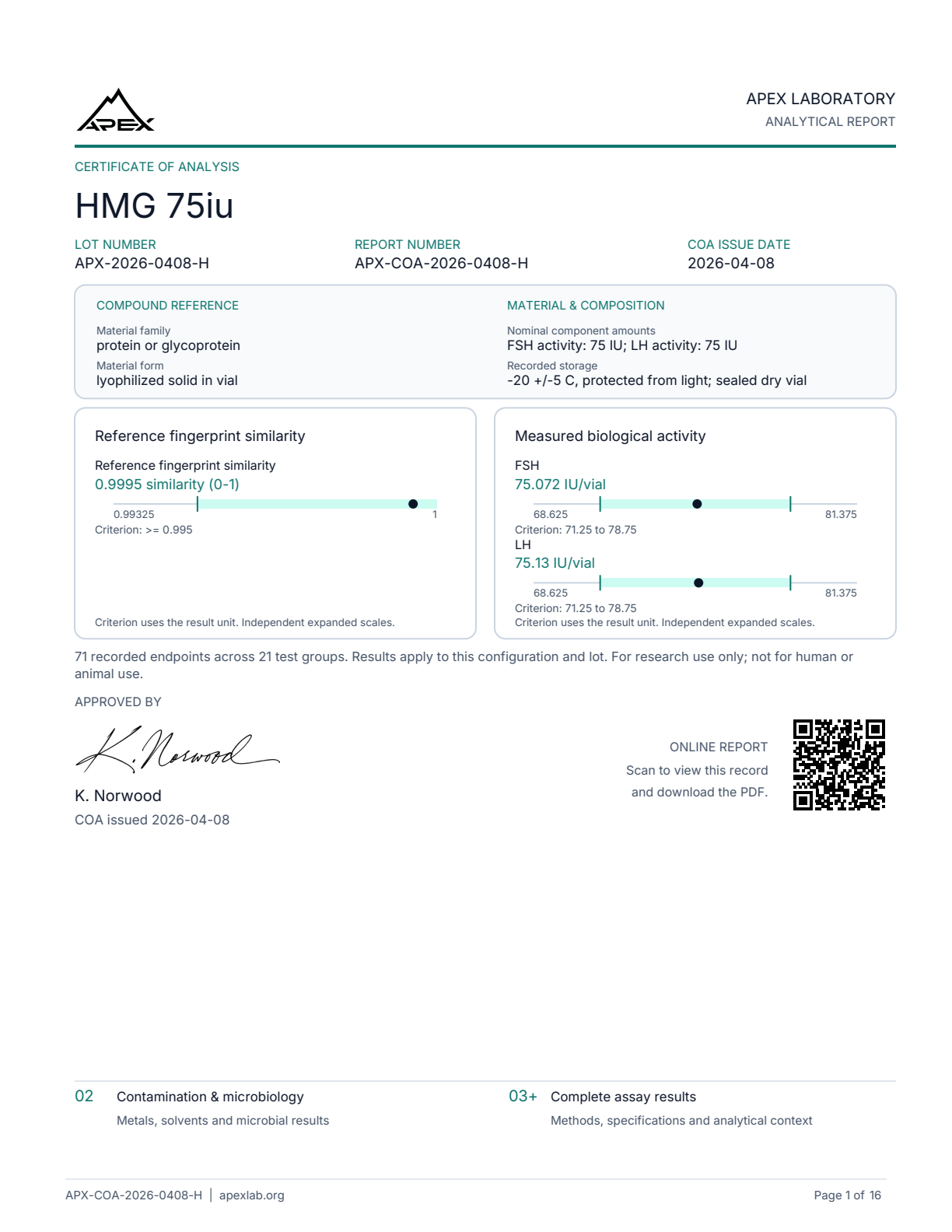
First-page preview of the HMG 75iu certificate of analysisPreview report pages

Analytical record

Results & specifications

Download result tables

T01Identity and structure

Test / endpointResultAcceptance criterionMethod
Orthogonal identity against specified referenceConforms to the assigned reference; see identity basisPASSConforms to the specified acceptance criterionM-T01-DEFAULT
Supporting analytical detail for Orthogonal identity against specified reference
Sample units
3 finished containers
Analytical replicates
2
neutral average mass
Not assigned: construct/distribution or no supported unique species
neutral monoisotopic mass
Not assigned — see component-specific HRMS records; a reference mass is not a measured neutral massMethod and sample context; reference facts are in Identity Reference.
observed mz
Not assigned — heterogeneous construct or no defined ion; orthogonal identity documented insteadMethod and sample context; reference facts are in Identity Reference.
mass tolerance
+/-5 ppm for an explicitly defined monoisotopic ion; not 5 Da.Method and sample context; reference facts are in Identity Reference.
reduced deglycosylated or intact
Intact specified parent for defined compounds; glycoproteins and PEG retain the specified population heterogeneity. No single exact intact glycoprotein mass is invented.Method and sample context; reference facts are in Identity Reference.
stereochemistry method
Component-specific chiral amino acid analysis or orthogonal structure comparison, where applicable; HRMS cannot distinguish stereoisomers.Method and sample context; reference facts are in Identity Reference.
identity standard traceability
RS-2630; internal standard, not a purchased certified reference material
Orthogonal fingerprint similarityspectrum/peptide-map comparison; score is not proof of stereochemistry0.9994 similarity (0-1)PASS>= 0.995similarity (0-1)M-T01-DEFAULT
Supporting analytical detail for Orthogonal fingerprint similarity
Sample units
3 finished containers
Analytical replicates
2

T02Chromatographic purity

Test / endpointResultAcceptance criterionMethod
Multipeak fingerprint similarity to defined referenceFingerprint similarity, not chemical purity percentage0.9995 similarity (0-1)PASS>= 0.995similarity (0-1)M-T02-DEFAULT
Supporting analytical detail for Multipeak fingerprint similarity to defined reference
Sample units
3 finished containers
Analytical replicates
2
gradient or separation conditions
Analyte-specific starting method in Method Profiles; retention time is anchored to the same component across sizes, with a small run shift.Method and sample context; reference facts are in Identity Reference.
detector and wavelength
Peptides: DAD at 214 nm. Proteins: SEC with UV detection at 280 nm. Nonchromophoric analytes: CAD, with detector-area reporting explicitly distinguished from mass fraction.Method and sample context; reference facts are in Identity Reference.
integration threshold
Reporting threshold: 0.010%; LOQ: 0.005%; LOD: 0.002%, for the single-analyte method.Method and sample context; reference facts are in Identity Reference.
unresolved or excluded peaks
Only specified co-components/vehicle/excipients excluded using selective methods; unknown U1/U2/U3 remain in analyte-method denominator.Method and sample context; reference facts are in Identity Reference.

T05Related substances and degradants

Test / endpointResultAcceptance criterionMethod
New unexplained chromatographic signal outside defined fingerprintAggregate non-reference signal; not mass fraction or component purity0.035 % total fingerprint responsePASS<= 0.1% total fingerprint responseM-T05-DEFAULT
Supporting analytical detail for New unexplained chromatographic signal outside defined fingerprint
Limit of detection
0.002 % total fingerprint response
Limit of quantitation
0.005 % total fingerprint response
Sample units
3 finished containers
Analytical replicates
2
impurity identity status
U1, U2 and U3 are unassigned peaks. Chemically named degradants appear only in specific orthogonal records when justified.Method and sample context; reference facts are in Identity Reference.
reporting threshold
0.010% integrated analyte-specific detector responseMethod and sample context; reference facts are in Identity Reference.
relative response factor
1.00 assumed only for area reporting; not sufficient for impurity mass-fraction reportingMethod and sample context; reference facts are in Identity Reference.
degradation or process origin if known
Unknown peak origin; peak position does not establish oxidation, deamidation or a synthesis byproduct.Method and sample context; reference facts are in Identity Reference.

T03Active content and assay

Test / endpointResultAcceptance criterionMethod
FSH activity per vialAssigned against a activity reference; IU is not converted to milligrams75.072 IU/vialPASS71.25 to 78.75IU/vialM-T03-BIOACTIVITY
Supporting analytical detail for FSH activity per vial
Sample units
3 finished containers
Analytical replicates
2
quantitative reference standard
RS-2630; independent component standards for blends; not a real purchased CRMMethod and sample context; reference facts are in Identity Reference.
standard assigned content
99.90% mass content for the chemical reference. An IU reference uses assigned activity; it is never described as 99.90% IU purity.Method and sample context; reference facts are in Identity Reference.
dilution factor
See analyte-specific factors; no arbitrary common dilution imposed on all strengthsMethod and sample context; reference facts are in Identity Reference.
water correction
Water excluded by calibration to active-equivalent standard; moisture separately measured. No area-purity times gross-fill calculation.Method and sample context; reference facts are in Identity Reference.
counterion correction
Parent-equivalent content unless explicit iodide/choline chloride salt or GHK complex basis. Counterion/metal composition separately quantified.Method and sample context; reference facts are in Identity Reference.
gross fill mass
No mass is inferred from IU or liquid volume; separate formulation fill quantity appliesMethod and sample context; reference facts are in Identity Reference.
active material basis
mg per capsule or vial on the explicitly specified material basis; IU on the assigned biological-activity basis. Package count and package total are reported separately.Method and sample context; reference facts are in Identity Reference.
LH activity per vialAssigned against a activity reference; IU is not converted to milligrams75.13 IU/vialPASS71.25 to 78.75IU/vialM-T03-BIOACTIVITY
Supporting analytical detail for LH activity per vial
Sample units
3 finished containers
Analytical replicates
2

T04Blend composition

Test / endpointResultAcceptance criterionMethod
FSH activity component identityConforms to specified component identityPASSConforms to the specified acceptance criterionM-T04-DEFAULT
Supporting analytical detail for FSH activity component identity
Sample units
3 finished containers
Analytical replicates
2
component label amount
FSH activity=75 IU; LH activity=75 IUMethod and sample context; reference facts are in Identity Reference.
component measured amount
FSH activity=75.072000 IU; LH activity=75.130000 IUMethod and sample context; reference facts are in Identity Reference.
component quantitative standard
Separate RS component standards; content and response are assigned independently for each component.Method and sample context; reference facts are in Identity Reference.
coelution assessment
Selective component extraction and separation are assumed verified in the placebo and spiked blend; a whole-blend peak is not used for every analyte.Method and sample context; reference facts are in Identity Reference.
component ratio basis
Mass ratio applies only to components labeled in mg. FSH and LH IU are separate bioactivity units and are not added to milligrams.Method and sample context; reference facts are in Identity Reference.
FSH activity component contentSame independent component assay as T03, not a second independent test75.072 IU/vialPASS71.25 to 78.75IU/vialM-T04-DEFAULT
Supporting analytical detail for FSH activity component content
Sample units
3 finished containers
Analytical replicates
2
LH activity component identityConforms to specified component identityPASSConforms to the specified acceptance criterionM-T04-DEFAULT
Supporting analytical detail for LH activity component identity
Sample units
3 finished containers
Analytical replicates
2
LH activity component contentSame independent component assay as T03, not a second independent test75.13 IU/vialPASS71.25 to 78.75IU/vialM-T04-DEFAULT
Supporting analytical detail for LH activity component content
Sample units
3 finished containers
Analytical replicates
2

T15Unit uniformity

Test / endpointResultAcceptance criterionMethod
FSH activity individual-unit meanspecified sample/form only100.096 % label claimPASS98 to 102% label claimM-T15-DEFAULT
Supporting analytical detail for FSH activity individual-unit mean
Sample units
10 finished containers
Analytical replicates
1
physical unit count
1 Explicit context; see valueMethod and sample context; reference facts are in Identity Reference.
unit statistical summary
Mean, sample SD, RSD, M, k and AV are calculated from 10 individual observations; AV for a multidose liquid is descriptive only.Method and sample context; reference facts are in Identity Reference.
sampling plan
10 independent units per configuration, with component assays from the same units; separate from the three-unit composite assay.Method and sample context; reference facts are in Identity Reference.
FSH activity acceptance value (n=10)AV=abs(M-mean)+2.4 sample SD; target 100%; M=mean within 98.5-101.50.8458 % label claimPASS<= 15% label claimM-T15-DEFAULT
Supporting analytical detail for FSH activity acceptance value (n=10)
Sample units
10 finished containers
Analytical replicates
1
FSH activity individual-unit RSDPrecision criterion for the listed specification, independently of AV0.3521 %PASS<= 2%M-T15-DEFAULT
Supporting analytical detail for FSH activity individual-unit RSD
Sample units
10 finished containers
Analytical replicates
1
LH activity individual-unit meanspecified sample/form only100.173 % label claimPASS98 to 102% label claimM-T15-DEFAULT
Supporting analytical detail for LH activity individual-unit mean
Sample units
10 finished containers
Analytical replicates
1
LH activity acceptance value (n=10)AV=abs(M-mean)+2.4 sample SD; target 100%; M=mean within 98.5-101.50.8458 % label claimPASS<= 15% label claimM-T15-DEFAULT
Supporting analytical detail for LH activity acceptance value (n=10)
Sample units
10 finished containers
Analytical replicates
1
LH activity individual-unit RSDPrecision criterion for the listed specification, independently of AV0.3518 %PASS<= 2%M-T15-DEFAULT
Supporting analytical detail for LH activity individual-unit RSD
Sample units
10 finished containers
Analytical replicates
1

T06Water content

Test / endpointResultAcceptance criterionMethod
Residual waterWater as percentage of total net formulation, not peptide area purity0.547 % w/w finished fillPASS<= 2% w/w finished fillM-T06-KF
Supporting analytical detail for Residual water
Sample units
3 finished containers
Analytical replicates
2
sample handling
Sealed vial transferred to a dry vessel; blank corrected. Pool 0.1000 g of net formulation where needed.Method and sample context; reference facts are in Identity Reference.
dry basis correction
1.005500085467507 factorFor mass-fraction reporting only; independent active assay is not blindly multiplied by this factor.

T07Counterions and associated species

Test / endpointResultAcceptance criterionMethod
Applicability decisionspecified sample/form onlyNot applicable — No fixed counterion salt is assigned in this formulation; vehicle ions and intentional metal complexes are treated by their component specifications.N/A — justifiedNot applicable — No fixed counterion salt is assigned in this formulation; vehicle ions and intentional metal complexes are treated by their component specifications.M-T07-DEFAULT
Supporting analytical detail for Applicability decision
Sample units
0 finished containers
Analytical replicates
0
counterion identity
Not applicable — No fixed counterion salt is assigned in this formulation; vehicle ions and intentional metal complexes are treated by their component specifications.Outside the defined test scope.
counterion molar ratio
Not applicable — No fixed counterion salt is assigned in this formulation; vehicle ions and intentional metal complexes are treated by their component specifications.Outside the defined test scope.
salt or solvate specification
Not applicable — No fixed counterion salt is assigned in this formulation; vehicle ions and intentional metal complexes are treated by their component specifications.Outside the defined test scope.

T08Residual solvents

Test / endpointResultAcceptance criterionMethod
MethanolMaterial-based limit. Liquid numerical limits are listed specification and not ICH Option1 mass ppm.20.085 ug/g finished fillPASS<= 3000ug/g finished fillM-T08-DEFAULT
Supporting analytical detail for Methanol
Limit of detection
1 ug/g finished fill
Limit of quantitation
3 ug/g finished fill
Sample units
3 finished containers
Analytical replicates
2
solvent identity
Methanol, acetonitrile, dichloromethane, DMF, ethanol, acetone, ethyl acetate, toluene, n-hexane and benzene.Method and sample context; reference facts are in Identity Reference.
sample preparation
0.1000 g of dry formulation or 1.000 mL of liquid, prepared to a final extract volume of 10.00 mL; headspace equilibration at 80 C for 30 min.Method and sample context; reference facts are in Identity Reference.
panel scope
Explicit ten-solvent teaching panel; additional process solvents require a process-specific risk assessment.Method and sample context; reference facts are in Identity Reference.
AcetonitrileMaterial-based limit. Liquid numerical limits are listed specification and not ICH Option1 mass ppm.8.75 ug/g finished fillPASS<= 410ug/g finished fillM-T08-DEFAULT
Supporting analytical detail for Acetonitrile
Limit of detection
0.3 ug/g finished fill
Limit of quantitation
1 ug/g finished fill
Sample units
3 finished containers
Analytical replicates
2
DichloromethaneMaterial-based limit. Liquid numerical limits are listed specification and not ICH Option1 mass ppm.3.366 ug/g finished fillPASS<= 600ug/g finished fillM-T08-DEFAULT
Supporting analytical detail for Dichloromethane
Limit of detection
0.2 ug/g finished fill
Limit of quantitation
0.6 ug/g finished fill
Sample units
3 finished containers
Analytical replicates
2
N, N-dimethylformamideMaterial-based limit. Liquid numerical limits are listed specification and not ICH Option1 mass ppm.4.209 ug/g finished fillPASS<= 880ug/g finished fillM-T08-DEFAULT
Supporting analytical detail for N, N-dimethylformamide
Limit of detection
0.5 ug/g finished fill
Limit of quantitation
1.5 ug/g finished fill
Sample units
3 finished containers
Analytical replicates
2
EthanolMaterial-based limit. Liquid numerical limits are listed specification and not ICH Option1 mass ppm.35.033 ug/g finished fillPASS<= 5000ug/g finished fillM-T08-DEFAULT
Supporting analytical detail for Ethanol
Limit of detection
1 ug/g finished fill
Limit of quantitation
3 ug/g finished fill
Sample units
3 finished containers
Analytical replicates
2
AcetoneMaterial-based limit. Liquid numerical limits are listed specification and not ICH Option1 mass ppm.12.922 ug/g finished fillPASS<= 5000ug/g finished fillM-T08-DEFAULT
Supporting analytical detail for Acetone
Limit of detection
0.5 ug/g finished fill
Limit of quantitation
1.5 ug/g finished fill
Sample units
3 finished containers
Analytical replicates
2
Ethyl acetateMaterial-based limit. Liquid numerical limits are listed specification and not ICH Option1 mass ppm.9.07 ug/g finished fillPASS<= 5000ug/g finished fillM-T08-DEFAULT
Supporting analytical detail for Ethyl acetate
Limit of detection
0.5 ug/g finished fill
Limit of quantitation
1.5 ug/g finished fill
Sample units
3 finished containers
Analytical replicates
2
TolueneMaterial-based limit. Liquid numerical limits are listed specification and not ICH Option1 mass ppm.1.621 ug/g finished fillPASS<= 890ug/g finished fillM-T08-DEFAULT
Supporting analytical detail for Toluene
Limit of detection
0.1 ug/g finished fill
Limit of quantitation
0.3 ug/g finished fill
Sample units
3 finished containers
Analytical replicates
2
n-HexaneMaterial-based limit. Liquid numerical limits are listed specification and not ICH Option1 mass ppm.1.159 ug/g finished fillPASS<= 290ug/g finished fillM-T08-DEFAULT
Supporting analytical detail for n-Hexane
Limit of detection
0.1 ug/g finished fill
Limit of quantitation
0.3 ug/g finished fill
Sample units
3 finished containers
Analytical replicates
2
BenzeneMaterial-based limit. Liquid numerical limits are listed specification and not ICH Option1 mass ppm.0.085 ug/g finished fillPASS<= 2ug/g finished fillM-T08-DEFAULT
Supporting analytical detail for Benzene
Limit of detection
0.01 ug/g finished fill
Limit of quantitation
0.03 ug/g finished fill
Sample units
3 finished containers
Analytical replicates
2

T09Elemental impurities

Test / endpointResultAcceptance criterionMethod
LeadTotal element; no speciation. material-based criterion, not a dose/route-derived safety limit.0.0113 ug/g finished fillPASS<= 0.5ug/g finished fillM-T09-DEFAULT
Supporting analytical detail for Lead
Limit of detection
0.0005 ug/g finished fill
Limit of quantitation
0.002 ug/g finished fill
Sample units
3 finished containers
Analytical replicates
2
element identity
Pb, Cd, As, Hg, Co, V, Ni, Pd, Pt, Rh, Ru and Ir. Intentional cobalt is excluded from the trace-total limit for B12 and MIC.Method and sample context; reference facts are in Identity Reference.
element speciation
Total elements by ICP-MS; free or non-cobalamin cobalt and unbound copper require separate speciation endpoints.Method and sample context; reference facts are in Identity Reference.
digestion method
Microwave digestion with HNO3/H2O2; 0.1000 g or 1.000 mL of sample prepared to a final volume of 10.00 mL.Method and sample context; reference facts are in Identity Reference.
full element panel
The explicit panel is listed in Results; this does not claim that every element in the periodic table was tested.Method and sample context; reference facts are in Identity Reference.
CadmiumTotal element; no speciation. material-based criterion, not a dose/route-derived safety limit.0.0074 ug/g finished fillPASS<= 0.2ug/g finished fillM-T09-DEFAULT
Supporting analytical detail for Cadmium
Limit of detection
0.0005 ug/g finished fill
Limit of quantitation
0.002 ug/g finished fill
Sample units
3 finished containers
Analytical replicates
2
ArsenicTotal element; no speciation. material-based criterion, not a dose/route-derived safety limit.0.0185 ug/g finished fillPASS<= 0.5ug/g finished fillM-T09-DEFAULT
Supporting analytical detail for Arsenic
Limit of detection
0.0005 ug/g finished fill
Limit of quantitation
0.002 ug/g finished fill
Sample units
3 finished containers
Analytical replicates
2
MercuryTotal element; no speciation. material-based criterion, not a dose/route-derived safety limit.0.0056 ug/g finished fillPASS<= 0.1ug/g finished fillM-T09-DEFAULT
Supporting analytical detail for Mercury
Limit of detection
0.0005 ug/g finished fill
Limit of quantitation
0.002 ug/g finished fill
Sample units
3 finished containers
Analytical replicates
2
CobaltTotal element; no speciation. material-based criterion, not a dose/route-derived safety limit.0.021 ug/g finished fillPASS<= 1ug/g finished fillM-T09-DEFAULT
Supporting analytical detail for Cobalt
Limit of detection
0.0005 ug/g finished fill
Limit of quantitation
0.002 ug/g finished fill
Sample units
3 finished containers
Analytical replicates
2
VanadiumTotal element; no speciation. material-based criterion, not a dose/route-derived safety limit.0.024 ug/g finished fillPASS<= 1ug/g finished fillM-T09-DEFAULT
Supporting analytical detail for Vanadium
Limit of detection
0.0005 ug/g finished fill
Limit of quantitation
0.002 ug/g finished fill
Sample units
3 finished containers
Analytical replicates
2
NickelTotal element; no speciation. material-based criterion, not a dose/route-derived safety limit.0.0382 ug/g finished fillPASS<= 2ug/g finished fillM-T09-DEFAULT
Supporting analytical detail for Nickel
Limit of detection
0.0005 ug/g finished fill
Limit of quantitation
0.002 ug/g finished fill
Sample units
3 finished containers
Analytical replicates
2
PalladiumTotal element; no speciation. material-based criterion, not a dose/route-derived safety limit.0.0103 ug/g finished fillPASS<= 1ug/g finished fillM-T09-DEFAULT
Supporting analytical detail for Palladium
Limit of detection
0.0005 ug/g finished fill
Limit of quantitation
0.002 ug/g finished fill
Sample units
3 finished containers
Analytical replicates
2
PlatinumTotal element; no speciation. material-based criterion, not a dose/route-derived safety limit.0.0091 ug/g finished fillPASS<= 1ug/g finished fillM-T09-DEFAULT
Supporting analytical detail for Platinum
Limit of detection
0.0005 ug/g finished fill
Limit of quantitation
0.002 ug/g finished fill
Sample units
3 finished containers
Analytical replicates
2
RhodiumTotal element; no speciation. material-based criterion, not a dose/route-derived safety limit.0.0071 ug/g finished fillPASS<= 1ug/g finished fillM-T09-DEFAULT
Supporting analytical detail for Rhodium
Limit of detection
0.0005 ug/g finished fill
Limit of quantitation
0.002 ug/g finished fill
Sample units
3 finished containers
Analytical replicates
2
RutheniumTotal element; no speciation. material-based criterion, not a dose/route-derived safety limit.0.0084 ug/g finished fillPASS<= 1ug/g finished fillM-T09-DEFAULT
Supporting analytical detail for Ruthenium
Limit of detection
0.0005 ug/g finished fill
Limit of quantitation
0.002 ug/g finished fill
Sample units
3 finished containers
Analytical replicates
2
IridiumTotal element; no speciation. material-based criterion, not a dose/route-derived safety limit.0.0056 ug/g finished fillPASS<= 1ug/g finished fillM-T09-DEFAULT
Supporting analytical detail for Iridium
Limit of detection
0.0005 ug/g finished fill
Limit of quantitation
0.002 ug/g finished fill
Sample units
3 finished containers
Analytical replicates
2

T13pH and analytical solution

Test / endpointResultAcceptance criterionMethod
pH of specified buffered analytical solution1.000 mg active/mL in 25mM acetate buffer, pH4.80,25.0C; buffer-solution compatibility is not the pH of dry material4.79 pHPASS4.1 to 5.5pHM-T13-DEFAULT
Supporting analytical detail for pH of specified buffered analytical solution
Sample units
3 finished containers
Analytical replicates
2
measurement temperature
25.0 C.Method and sample context; reference facts are in Identity Reference.
as supplied or prepared solution
Prepared buffered analytical solution; not the pH of dry powder.Method and sample context; reference facts are in Identity Reference.
test solution concentration
1.000 mg active/mL.Method and sample context; reference facts are in Identity Reference.
solvent or vehicle
10 mM MES at pH 6.0 for GHK-containing material; otherwise 25 mM acetate at pH 4.8.Method and sample context; reference facts are in Identity Reference.
instrument calibration
Three-point calibration at pH 4.01, 7.00 and 10.01; acetic acid uses pH 1.68, 4.01 and 7.00. calibration.Method and sample context; reference facts are in Identity Reference.

T14Excipients and preservatives

Test / endpointResultAcceptance criterionMethod
Trehalose excipientExplicit stabilizer amount; biological protein mass remains independent of IU5.004 mg/vialPASS4.75 to 5.25mg/vialM-T14-DEFAULT
Supporting analytical detail for Trehalose excipient
Sample units
3 finished containers
Analytical replicates
2
excipient or preservative identity
Benzyl alcohol at 0.90% w/v for bacteriostatic water; 5 mg trehalose per dry vial; MCC q.s. to a 200 mg moist net fill plus a 60 mg HPMC shell for capsules; water q.s. for other liquids.Method and sample context; reference facts are in Identity Reference.
concentration basis
Explicit mg/unit or mg/mL; w/v means grams per 100 mL.Method and sample context; reference facts are in Identity Reference.
quantitative reference standard
Separate excipient or preservative standard; the active-component standard is not interchangeable.Method and sample context; reference facts are in Identity Reference.

T21Appearance and physical inspection

Test / endpointResultAcceptance criterionMethod
AppearanceThree containers under diffuse white illuminationwhite to off-white; uniform lyophilized cakePASSConforms to the specified acceptance criterionM-T21-DEFAULT
Supporting analytical detail for Appearance
Sample units
3 finished containers
Analytical replicates
2
received material form
lyophilized solid in vial
observed color
white to off-white
observed clarity
Clear where an aqueous molecular solution is specified. Lemon Bottle is an intentional yellow opalescent dispersion. Clarity is not applicable to dry material.Method and sample context; reference facts are in Identity Reference.
visible foreign material
None observed in three inspected units.Method and sample context; reference facts are in Identity Reference.
Visible foreign matterVisual observation only; subvisible particles reported separatelyNone observed in 3 inspected unitsPASSConforms to the specified acceptance criterionM-T21-DEFAULT
Supporting analytical detail for Visible foreign matter
Sample units
3 finished containers
Analytical replicates
2

T10Sterility test

Test / endpointResultAcceptance criterionMethod
Sterility: FTMFTM30-35C; tested units only; growth-promotion/suitability controls conformNo growth at 14 days in all 20 unitsPASSConforms to the specified acceptance criterionM-T10-DEFAULT
Supporting analytical detail for Sterility: FTM
Sample units
20 finished containers
Analytical replicates
1
media identifiers
FTM-001 and SCDM-001.Method and sample context; reference facts are in Identity Reference.
sample amount per medium
Half of each prepared full unit per medium. The Lemon Bottle dispersion uses neutralized direct inoculation with matrix suitability.Method and sample context; reference facts are in Identity Reference.
units per medium
20 finished units contribute to each medium; sample units are not reused for destructive chemical testing.Method and sample context; reference facts are in Identity Reference.
incubation duration
14 days.Method and sample context; reference facts are in Identity Reference.
incubation temperature
FTM: 30-35 C; SCDM: 20-25 C.Method and sample context; reference facts are in Identity Reference.
growth promotion control
Reference challenges at <=100 CFU show growth; organism and medium suitability controls are documented as .Method and sample context; reference facts are in Identity Reference.
negative control
No growth in the medium and process negative controls over 14 days.Method and sample context; reference facts are in Identity Reference.
product suitability
Growth is recovered in the product-spiked method control. This is and is not inferred from a no-growth sample.Method and sample context; reference facts are in Identity Reference.
neutralization or membrane filtration
Membrane filtration and rinsing; the intentional colloidal dispersion uses neutralized direct inoculation.Method and sample context; reference facts are in Identity Reference.
observed growth by medium
No growth in FTM or SCDM on days 3, 7 and 14 for each of the 20 units.Method and sample context; reference facts are in Identity Reference.
sampling plan and scope
Selected units only; this is not a sterility assurance level or proof that all units in the lot are sterile.Method and sample context; reference facts are in Identity Reference.
Sterility: SCDMSCDM20-25C; tested units only; no sterility assurance level assignedNo growth at 14 days in all 20 unitsPASSConforms to the specified acceptance criterionM-T10-DEFAULT
Supporting analytical detail for Sterility: SCDM
Sample units
20 finished containers
Analytical replicates
1

T11Bacterial endotoxins

Test / endpointResultAcceptance criterionMethod
Bacterial endotoxinsSample reporting limit after1:5 dilution; threshold is and not based on administration route/dose<0.025 EU/vialPASS<= 0.1EU/vialM-T11-DEFAULT
Supporting analytical detail for Bacterial endotoxins
Limit of detection
0.01 EU/vial
Limit of quantitation
0.025 EU/vial
Sample units
3 finished containers
Analytical replicates
2
assay reagent and technique
Recombinant factor C fluorometric assay.Method and sample context; reference facts are in Identity Reference.
reagent lot
RFC-001Method and sample context; reference facts are in Identity Reference.
assay sensitivity
Assay LOQ: 0.005 EU/mL. After a 1:5 dilution, the reporting limit is 0.025 in the native unit: EU/mg, EU/mL or EU/vial.Method and sample context; reference facts are in Identity Reference.
sample extraction
1 mg active equivalent/mL for dry products labeled by mass; one vial/mL for IU-labeled products; native liquid for solutions.Method and sample context; reference facts are in Identity Reference.
dilution factor
5 Explicit context; see valueMethod and sample context; reference facts are in Identity Reference.
maximum valid dilution if used
20 Explicit context; see valueMethod and sample context; reference facts are in Identity Reference.
positive product control recovery
99.5%, 100.5% and 101.5%; acceptance range: 50-200%.Method and sample context; reference facts are in Identity Reference.
interference or inhibition assessment
The positive product control shows no inhibition or enhancement in the matrix; dilution is within the MVD.Method and sample context; reference facts are in Identity Reference.
standard endotoxin reference
RSE-001: activity-traceable standard.Method and sample context; reference facts are in Identity Reference.
unit conversion basis
Native result = assay concentration in EU/mL x 5 / native equivalent concentration. Censored values remain censored.Method and sample context; reference facts are in Identity Reference.

T12Microbial enumeration

Test / endpointResultAcceptance criterionMethod
TAMCZero colonies observed from1g or1 mL equivalent filter; report <1, not exact absence<1 CFU/g finished fillPASS<= 100CFU/g finished fillM-T12-DEFAULT
Supporting analytical detail for TAMC
Limit of detection
1 CFU/g finished fill
Limit of quantitation
1 CFU/g finished fill
Sample units
3 finished containers
Analytical replicates
2
TAMC individual count
0 and 0 colonies from separate filters representing 1 g or 1 mL each; report <1 CFU/g or <1 CFU/mL.Method and sample context; reference facts are in Identity Reference.
TYMC individual count
0 and 0 colonies from separate filters representing 1 g or 1 mL each; report <1 CFU/g or <1 CFU/mL.Method and sample context; reference facts are in Identity Reference.
specified organism identity
E. coli, S. aureus, P. aeruginosa, Salmonella species and C. albicans.Method and sample context; reference facts are in Identity Reference.
organism presence absence
Not detected in 1 g or 1 mL per organism; positive and negative enrichment controls conform to the assigned reference.Method and sample context; reference facts are in Identity Reference.
sample amount tested
Separate 1 g or 1 mL equivalents for each enumeration filter and organism assay; pooled dry units are documented.Method and sample context; reference facts are in Identity Reference.
media and incubation
TAMC: SCD agar at 30-35 C for 5 days. TYMC: Sabouraud agar at 20-25 C for 7 days. Specified organisms use organism-specific enrichment and confirmation.Method and sample context; reference facts are in Identity Reference.
method suitability
spike recoveries: 96% and 97%; blank: 0 colonies.Method and sample context; reference facts are in Identity Reference.
neutralization
Matrix-specific dilution or neutralization; inhibitory benzyl alcohol or peptide activity requires demonstrated recovery.Method and sample context; reference facts are in Identity Reference.
enumeration limit
1 CFU/g for dry material or 1 CFU/mL for liquid, based on one equivalent sample unit filtered; no exact-zero burden is claimed.Method and sample context; reference facts are in Identity Reference.
TYMCZero colonies observed from1g or1 mL equivalent filter; report <1, not exact absence<1 CFU/g finished fillPASS<= 10CFU/g finished fillM-T12-DEFAULT
Supporting analytical detail for TYMC
Limit of detection
1 CFU/g finished fill
Limit of quantitation
1 CFU/g finished fill
Sample units
3 finished containers
Analytical replicates
2
Escherichia coliSpecified-organism enrichment in explicit1g/1 mL scope; not a universal pharmacopeial panelNot detected in 1gPASSConforms to the specified acceptance criterionM-T12-DEFAULT
Supporting analytical detail for Escherichia coli
Sample units
1 finished containers
Analytical replicates
1
Staphylococcus aureusSpecified-organism enrichment in explicit1g/1 mL scope; not a universal pharmacopeial panelNot detected in 1gPASSConforms to the specified acceptance criterionM-T12-DEFAULT
Supporting analytical detail for Staphylococcus aureus
Sample units
1 finished containers
Analytical replicates
1
Pseudomonas aeruginosaSpecified-organism enrichment in explicit1g/1 mL scope; not a universal pharmacopeial panelNot detected in 1gPASSConforms to the specified acceptance criterionM-T12-DEFAULT
Supporting analytical detail for Pseudomonas aeruginosa
Sample units
1 finished containers
Analytical replicates
1
Salmonella speciesSpecified-organism enrichment in explicit1g/1 mL scope; not a universal pharmacopeial panelNot detected in 1gPASSConforms to the specified acceptance criterionM-T12-DEFAULT
Supporting analytical detail for Salmonella species
Sample units
1 finished containers
Analytical replicates
1
Candida albicansSpecified-organism enrichment in explicit1g/1 mL scope; not a universal pharmacopeial panelNot detected in 1gPASSConforms to the specified acceptance criterionM-T12-DEFAULT
Supporting analytical detail for Candida albicans
Sample units
1 finished containers
Analytical replicates
1

T16Biological activity

Test / endpointResultAcceptance criterionMethod
FSHR relative potencyRelative to the specified reference response; activity units and mass units are evaluated separately. Method validation is not asserted by this report.100.096 % reference response potencyPASS90 to 110% reference response potencyM-T16-DEFAULT
Supporting analytical detail for FSHR relative potency
Sample units
3 finished containers
Analytical replicates
2
biological endpoint
Separate FSHR and LHCGR cAMP bioactivity assaysMethod and sample context; reference facts are in Identity Reference.
assay system
Specified receptor-cell reporter or casein initial-rate assay for bromelain; see endpoint-specific raw data.Method and sample context; reference facts are in Identity Reference.
reference standard and activity
SIM activity standard with a 100% relative assignment. The gonadotropin reference carries the same nominal IU/vial as the label.Method and sample context; reference facts are in Identity Reference.
activity unit definition
Relative potency = reference EC50 / sample EC50 x 100. IU/vial = assigned reference IU x relative potency / 100, with equal nominal preparation factors.Method and sample context; reference facts are in Identity Reference.
concentration response range
0.01, 0.03, 0.1, 0.3, 1, 3, 10 and 30 times the normalized reference EC50; no absolute EC50 is invented.Method and sample context; reference facts are in Identity Reference.
curve fit
4PL: bottom 2, top 100, Hill slope 1 and run-specific EC50; three independent runs with duplicate wells.Method and sample context; reference facts are in Identity Reference.
controls
Reference, vehicle blank and assay window; curve parameters are declared.Method and sample context; reference facts are in Identity Reference.
biological replicates
3 Explicit context; see valueMethod and sample context; reference facts are in Identity Reference.
confidence interval
99.8748 to 100.4721
LHCGR relative potencyRelative to the specified reference response; activity units and mass units are evaluated separately. Method validation is not asserted by this report.100.173 % reference response potencyPASS90 to 110% reference response potencyM-T16-DEFAULT
Supporting analytical detail for LHCGR relative potency
Sample units
3 finished containers
Analytical replicates
2

T17Protein and conjugate characterization

Test / endpointResultAcceptance criterionMethod
Size-exclusion main defined populationSame primary SEC population result as T02 for proteins; orthogonal size separation for PEG/mixtures. Includes expected biological heterogeneity.99.91 % SEC responsePASS99.7 to 100% SEC responseM-T17-DEFAULT
Supporting analytical detail for Size-exclusion main defined population
Sample units
3 finished containers
Analytical replicates
2
PEG attachment site
The N-alpha amine at residue 1 for the specified PEG-MGF reference; not assumed for other materials.Method and sample context; reference facts are in Identity Reference.
conjugated to free fraction
Free core peptide and free PEG are quantified separately, where applicable; covalent attachment cannot be inferred from peptide-core mass.Method and sample context; reference facts are in Identity Reference.
glycosylation
The reference glycoform population is retained for glycoproteins; no universal exact glycan mass is assigned. E. coli-derived LR3 is nonglycosylated.Method and sample context; reference facts are in Identity Reference.
oligomer or chain state
Fc-linked homodimer for ACE-031 and dulaglutide; hCG heterodimer; LR3 single chain. See Identity Reference.Method and sample context; reference facts are in Identity Reference.
reduction or deglycosylation
A specialized orthogonal record is provided where applicable; reduction or deglycosylation is not implicitly performed.Method and sample context; reference facts are in Identity Reference.
aggregate fraction
See the T17 SEC population and HMW/LMW rows.Method and sample context; reference facts are in Identity Reference.
High molecular weight aggregate fractionspecified sample/form only0.045 % SEC responsePASS<= 0.1% SEC responseM-T17-DEFAULT
Supporting analytical detail for High molecular weight aggregate fraction
Sample units
3 finished containers
Analytical replicates
2
Low molecular weight non-reference fractionspecified sample/form only0.045 % SEC responsePASS<= 0.1% SEC responseM-T17-DEFAULT
Supporting analytical detail for Low molecular weight non-reference fraction
Sample units
3 finished containers
Analytical replicates
2
Orthogonal construct/fingerprint mappingIdentity Reference defines construct, termini, and mixture caveats; no raw mass spectrum or gel image existsConforms to explicit reference specificationPASSConforms to the specified acceptance criterionM-T17-DEFAULT
Supporting analytical detail for Orthogonal construct/fingerprint mapping
Sample units
3 finished containers
Analytical replicates
2
Released N-glycan composition-profile cosine similarityCosine similarity of complete response-corrected fraction vectors to explicit reference; no site/linkage assignment1 similarity0-1Recorded numeric value: 0.9999997294317454PASS0.995 to 1similarity0-1M-T17-GLYCAN-COMPOSITION-PROFILE
Supporting analytical detail for Released N-glycan composition-profile cosine similarity
Sample units
3 finished containers
Analytical replicates
2
hCG-fraction O-glycan composition-profile recoverySeparate35:65 mono-/disialylated Hex1HexNAc1 composition profile; independent of N-glycan table100 % assigned reference fractionsPASS98 to 102% assigned reference fractionsM-T17-HCG-O-GLYCAN-PROFILE
Supporting analytical detail for hCG-fraction O-glycan composition-profile recovery
Sample units
3 finished containers
Analytical replicates
2
Nonreducing CE-SDS intended chain-population fractionProtein-specific reference profile; hCG/HMG expected alpha/beta subunits are intended species, not degraded monomer99.85 % integrated CE-SDS areaPASS99.7 to 100% integrated CE-SDS areaM-T17-PROTEIN-CHAIN-PROFILE
Supporting analytical detail for Nonreducing CE-SDS intended chain-population fraction
Sample units
3 finished containers
Analytical replicates
2
Reducing CE-SDS intended chain-population fractionProtein-specific reference profile; hCG/HMG expected alpha/beta subunits are intended species, not degraded monomer99.85 % integrated CE-SDS areaPASS99.7 to 100% integrated CE-SDS areaM-T17-PROTEIN-CHAIN-PROFILE
Supporting analytical detail for Reducing CE-SDS intended chain-population fraction
Sample units
3 finished containers
Analytical replicates
2

T18Process impurities

Test / endpointResultAcceptance criterionMethod
Residual source-process protein impuritiesurinary-source gonadotropin process; source-specific assay. For hydrolysates, intact source proteins outside the target digest are measured by selective separation; intended peptides are not HCP impurities.2.1 ng/vialPASS<= 100ng/vialM-T18-DEFAULT
Supporting analytical detail for Residual source-process protein impurities
Limit of detection
0.2 ng/vial
Limit of quantitation
0.6 ng/vial
Sample units
3 finished containers
Analytical replicates
2
process impurity identity
Source-process protein and source DNA; Protein A only in the Fc-affinity scenario.Method and sample context; reference facts are in Identity Reference.
HCP assay coverage
source-specific coverage; intended hydrolysate proteins are not classified as HCP impurities.Method and sample context; reference facts are in Identity Reference.
DNA extraction recovery
spike recovery: 98.6%.Method and sample context; reference facts are in Identity Reference.
process stage
Process-residue test of the finished unit; not actual upstream process validation.Method and sample context; reference facts are in Identity Reference.
assay control scope
Source-specific positive control, extraction blank and matrix spike.Method and sample context; reference facts are in Identity Reference.
Residual source DNASource-specific qPCR in process; extraction recovery demonstrated only0.012 ng/vialPASS<= 1ng/vialM-T18-DEFAULT
Supporting analytical detail for Residual source DNA
Limit of detection
0.001 ng/vial
Limit of quantitation
0.003 ng/vial
Sample units
3 finished containers
Analytical replicates
2

T19Particles and container closure

Test / endpointResultAcceptance criterionMethod
Subvisible particles >= 10umAs-supplied liquid or entire dry vial dissolved to stated analytical volume; limits, no injectable compliance claim21 particles/containerPASS<= 6000particles/containerM-T19-DEFAULT
Supporting analytical detail for Subvisible particles >= 10um
Sample units
3 finished containers
Analytical replicates
1
container closure configuration
Type I borosilicate glass with a bromobutyl stopper and crimp seal; package.Method and sample context; reference facts are in Identity Reference.
particle size bin
>=10 um and >=25 um; not applicable to intentional dispersions or capsules.Method and sample context; reference facts are in Identity Reference.
inspection volume
1 mL analytical volume; normalization to the entire containerMethod and sample context; reference facts are in Identity Reference.
closure integrity method
Vacuum decay with a limit of 0.20 kPa over 60 s; capsule bottles use seal-condition inspection.Method and sample context; reference facts are in Identity Reference.
leakage detection limit
5 um artificial positive-leak control; not a universal maximum allowable leakage limit.Method and sample context; reference facts are in Identity Reference.
packaging sample count
10 Explicit context; see valueMethod and sample context; reference facts are in Identity Reference.
Subvisible particles >= 25umAs-supplied liquid or entire dry vial dissolved to stated analytical volume; limits, no injectable compliance claim2 particles/containerPASS<= 600particles/containerM-T19-DEFAULT
Supporting analytical detail for Subvisible particles >= 25um
Sample units
3 finished containers
Analytical replicates
1
Vacuum decay package integritymethod vacuum-decay threshold0.20kPa/60s;5um positive defect control. No universal leakage-to-sterility equivalence.10/10test closures conform; positive-leak controls detectedPASSConforms to the specified acceptance criterionM-T19-DEFAULT
Supporting analytical detail for Vacuum decay package integrity
Sample units
10 finished containers
Analytical replicates
1

T20Stability observations

Test / endpointResultAcceptance criterionMethod
Reported 6 month assay retentionReported change relative to the initial assay. This report does not assign a retest date or shelf life.99.9101 % of initial assayPASS98 to 102% of initial assayM-T20-DEFAULT
Supporting analytical detail for Reported 6 month assay retention
Sample units
3 finished containers
Analytical replicates
2
study protocol id
STAB-P2630-SIMPLEMethod and sample context; reference facts are in Identity Reference.
storage temperature
-20 +/-5 C, protected from light; sealed dry vialMethod and sample context; reference facts are in Identity Reference.
humidity or light
Protected from light in a sealed container; no ICH humidity claim.Method and sample context; reference facts are in Identity Reference.
container configuration
Same container as the initial unit.Method and sample context; reference facts are in Identity Reference.
elapsed time
Reported months 0, 1, 3 and 6.Method and sample context; reference facts are in Identity Reference.
freeze thaw or excursion scope
Not modeled; no excursion or freeze-thaw claim is supported.Method and sample context; reference facts are in Identity Reference.
retest or expiry rationale
six-month review only; actual expiry or retest is not assigned without real stability data.Method and sample context; reference facts are in Identity Reference.
Dating dispositionReported change relative to the initial assay. This report does not assign a retest date or shelf life.6 month review point; actual expiry/retest not assignedPASSConforms to the specified acceptance criterionM-T20-DEFAULT
Supporting analytical detail for Dating disposition
Sample units
3 finished containers
Analytical replicates
2

Method references

How the results are documented

M-T01-DEFAULT
Orthogonal chemical/structural identityLC-HRMS/MS plus sequence/connectivity-sensitive reference comparison
M-T02-DEFAULT
Chromatographic purityRP-UPLC DAD; SEC for protein size species; HILIC/CAD for nonchromophoric analytes
M-T05-DEFAULT
Related substancesStability-indicating LC integration; orthogonal size/charge separation for biologics
M-T03-BIOACTIVITY
Gonadotropin activity content against an IU-assigned referenceReceptor-specific relative biological-potency calibration and IU accounting
M-T04-DEFAULT
Component-resolved blend assaySeparate calibrated selective assay for every declared component
M-T15-DEFAULT
Individual-unit uniformityTen separate unit preparations and fill measurements
M-T06-KF
Residual formulation water on a defined mass basisCoulometric Karl Fischer with oven transfer
M-T07-DEFAULT
Counterion compositionIon chromatography and stoichiometric accounting
M-T08-DEFAULT
Residual solvent panelheadspace GC-MS
M-T09-DEFAULT
Elemental impurity panelICP-MS
M-T13-DEFAULT
pH and solution stateCalibrated potentiometry
M-T14-DEFAULT
Excipients/preservativesComponent-specific quantitative LC/CAD or formulation identity
M-T21-DEFAULT
AppearanceControlled visual examination
M-T10-DEFAULT
Sterility observations in two media with matrix-specific preparationMembrane filtration/rinsing or neutralized direct inoculation for Lemon dispersion
M-T11-DEFAULT
Bacterial endotoxinsRecombinant factor C fluorometric assay
M-T12-DEFAULT
Microbial enumeration/organismsMembrane filtration enumeration and enrichment
M-T16-DEFAULT
Functional biological activityReference-relative concentration-response assay
M-T17-DEFAULT
Protein/conjugate characterizationSEC-MALS, CE-SDS, peptide mapping, glycan/PEG profiling
M-T18-DEFAULT
Biological process impurity panelHost/process-specific ELISA and qPCR
M-T17-GLYCAN-COMPOSITION-PROFILE
Released N-glycan composition-profile comparisonPNGase-F release with composition-resolved, response-calibrated LC-MS
M-T17-HCG-O-GLYCAN-PROFILE
hCG beta-contributing O-glycan composition profileC-terminal hCG beta glycopeptide LC-MS/MS with desialylation controls
M-T17-PROTEIN-CHAIN-PROFILE
Reference-defined reduced/nonreducing protein-chain populationsCE-SDS with independent chain-reference migration and subunit identity comparison
M-T19-DEFAULT
Particles and package integrityLight obscuration plus vacuum decay
M-T20-DEFAULT
Stability observationTime-zero/1/3/6-month trend

Apex Laboratory issues this certificate. Results apply to the stated configuration and lot. Browse all certificates.