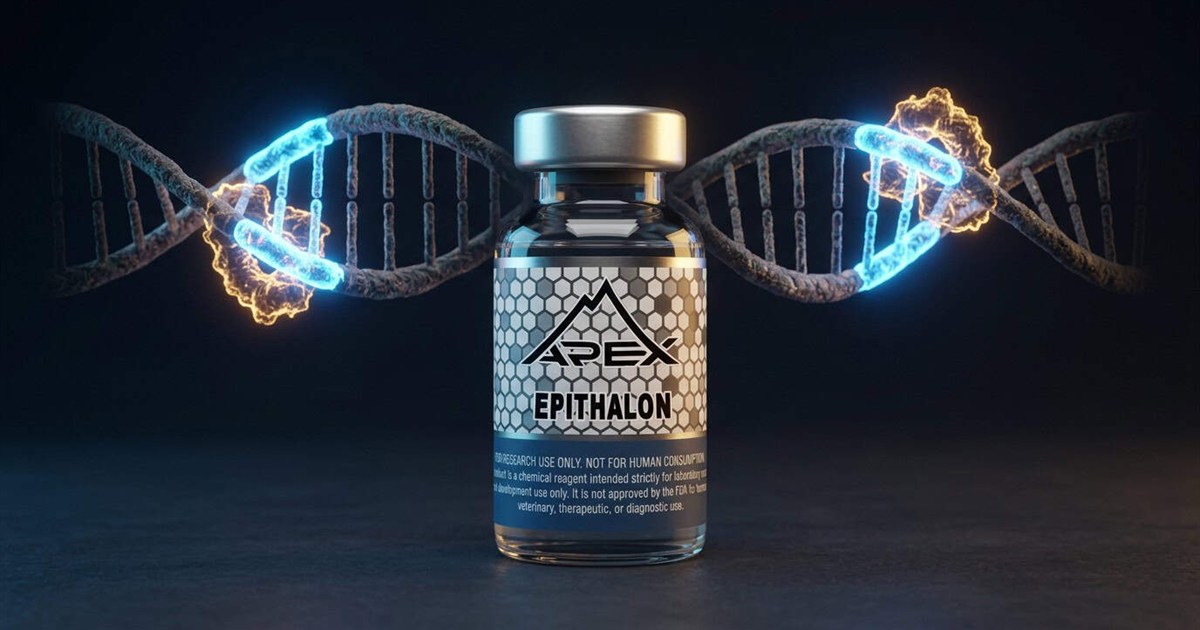
Epithalon explained · cells, people and longevity
Longer telomeres in a dish are a finding. A longer human life is a different question.
Epithalon, also spelled Epitalon, is a synthetic four-amino-acid peptide: Ala-Glu-Asp-Gly, or AEDG. It is studied for telomere maintenance, gene regulation and melatonin-related biology. Human reports exist, alongside a much larger experimental literature. They do not establish a reliable anti-aging treatment, a sleep medicine or a safe self-use regimen.
This guide follows the exact material and the measured outcome, including the positive results, the null findings and the studies often attributed to the wrong peptide.
What is Epithalon, and how is it different from Epithalamin?
Epithalon is the defined sequence alanine–glutamic acid–aspartic acid–glycine. Epithalamin is a mixture of peptides extracted from the pineal gland. Melatonin is a separate hormone. The similar names and shared pineal research history are a major source of confusion.
Four letters identify the peptide
The neutral reference has formula C14H22N4O9 and molecular weight approximately 390.35 g/mol. A salt form, counterion and peptide-content basis require separate documentation; the reference mass is not a measured property of every vial. PubChem reference species.
Where did the research come from?
The tetrapeptide was designed from the amino-acid composition of a pineal extract before a later analytical paper reported AEDG within a pineal peptide complex. The 2017 identification study supports that identity history. It does not show that AEDG alone accounts for every effect of the mixture.
Much of the early literature comes from the Khavinson research program and collaborators. That concentration matters when assessing replication, but it is not a reason to ignore later work from other laboratories. The 2025 overview is useful for finding the wider literature; individual experiments below provide the evidence for particular claims.
Does Epithalon lengthen telomeres?
Telomeres are repetitive DNA at chromosome ends. Telomerase is an enzyme involved in maintaining them; ALT, or alternative lengthening of telomeres, is a different maintenance pathway. Measuring longer telomeres does not by itself show better health, a younger biological age or a longer life.
The early experiments were in cultured cells
A 2003 report described telomerase expression, enzyme activity and telomere elongation after exposure. The 2004 follow-up reported that fetal lung fibroblasts continued dividing beyond the control culture’s limit: 44 rather than 34 passages at the reported observation point. These are laboratory cell-population results, not people followed through aging.
Different cell contexts, several separate measurements
Normal cell lines · three weeks
IBR.3 fibroblasts and HMEC epithelial cells
- Average telomere length, hTERT and enzyme activity measured
- The main text reports increases
- Corrected plots and labels require qualification
Breast cancer cell lines · four days
21NT and BT474
- Responses varied across tested concentrations
- hTERT expression and enzyme activity did not follow the same pattern
- The authors report ALT-related changes
The 2025 full text says a four-day exposure did not increase telomere length in normal IBR.3 cells and reports extension after a longer three-week exposure. The corrected figures need to be read alongside that account. Figure 1C is marked nonsignificant. Figure 1D is identified as HMEC in the caption but as IBR.3 on the plot. Those details prevent a clean claim that both normal cell lines uniformly responded.
The correction replaces Figures 1–3. Corrected Figure 2G also marks the HMEC hTERT comparison nonsignificant, and some enzyme-activity significance brackets compare samples with a strong positive control. The article’s narrative and its corrected plots therefore should not be collapsed into one effect size. We retain the reported study context and identify the uncertainty; we do not choose a replacement measurement. The qPCR telomere assay also measures an average across chromosome ends, not equal change at every end.
Human donor cells did not all respond in the same direction
That study included cells from five younger and six middle-aged men. Its mixed directions are a useful counterweight to the claim that AEDG always lengthens telomeres. The mitotic index also generally did not increase. A cell’s starting state and the measurement method matter.
What human studies actually exist?
“No human studies” is too broad. The better question is whether a study used AEDG, what it measured, and whether its design can support the benefit being claimed.
A retinal-disease report is not an anti-aging trial
The 2002 report describes patients with retinitis pigmentosa and a conventional-treatment comparison group. The full paper reports favorable visual-function and electrophysiology observations. It does not describe random allocation or blinding, and its broad “positive clinical effect” headline combines different outcomes. It cannot establish an effective treatment for general aging, sleep or a different eye disorder.
The paper also includes a separate Campbell-rat experiment. Human and rat findings should not be blended into one efficacy estimate. Original four-page report.
Biomarkers rather than demonstrated sleep benefit
A 2007 report discusses both Epithalamin and Epitalon in relation to older people and monkeys. Its abstract does not provide enough allocation and formulation detail to support a precise independent treatment estimate. Later human work is more explicit about AEDG and its measured endpoints.
Seventy-five participants, two different roles
Reference group
Women with an age-appropriate urinary melatonin-metabolite level.
Lower baseline metabolite level
This group was divided between AEDG and placebo.
Measured: urinary 6-sulfatoxymelatonin and blood-cell clock-gene expressionNot measured: sleep latency, awakenings or a clinical insomnia response
Over twenty days, the AEDG group had a reported 1.7-fold rise in the urinary metabolite, while the placebo group did not change. Blinding was not specified, the study was small and short, and the reported general-wellbeing assessment was not adequately defined. A melatonin-metabolite change is not a measured improvement in sleep.
The 2020 Russian-language record and related 2021 reports concern closely matching circadian work. They should not automatically be counted as independent replications or summed into a larger sample. The full 2021 gene paper examines peripheral immune cells, not direct activity in a living human pineal gland.
Does the melatonin evidence explain better sleep?
A plausible biological pathway is a starting point for testing, not a substitute for a sleep outcome. The animal findings themselves are not uniform.
| Experimental setting | What was observed | What remains unproven |
|---|---|---|
| Older female rhesus monkeys | 2001 study: evening melatonin and cortisol-rhythm changes. | A reliable sleep benefit in humans, or the same response in younger subjects. |
| Isolated rat pineal glands | 2003 study: no significant melatonin-secretion effect in young or old glands; no change to the isoproterenol-stimulated response. | A universal direct stimulation of pineal melatonin secretion. |
| Human circadian study | Urinary metabolite and blood-cell gene-expression changes over twenty days. | Shorter time to sleep, better sleep quality or effective treatment of insomnia. |
On narrow screens, focus or swipe the table to read the final column.
These models differ in species, starting state and experimental conditions. They can coexist without proving that one result is fraudulent or that every system must respond identically. They also do not establish a dependable onset or duration of benefit for a person.
Does Epithalon extend lifespan?
Some animal experiments report longer survival. The effect depends on the model and the endpoint, and a change in maximum lifespan should not be described as the same change in average lifespan.
An early positive result in Drosophila
The 2000 study reported an 11–16% increase in adult lifespan after exposure during development. That is an insect experiment, not evidence that starting treatment in an older human adds the same percentage to life expectancy.
Mean lifespan did not increase
In female Swiss-derived SHR mice, Epitalon did not change average lifespan, body weight or food intake. The paper reported longer survival in the last tenth of survivors and a higher maximum lifespan. Keeping the average-survival null alongside the late-survivor result changes the interpretation.
Context changed the survival result
The illumination study found no lifespan change under the standard day/night regimen, while selected survival measures improved under natural or constant illumination. That is evidence of context dependence, not a general lifespan guarantee.
Related HER-2/neu mouse reports describe favorable mammary-tumor endpoints and survival findings. They concern a tumor-prone model, not ordinary human aging. The repeated model and overlapping research program also mean that multiple papers are not automatically multiple independent replications. See tumor development, tumor size and gene expression and the survival report.
The long-term human studies used a different material
A 266-person report examined Thymalin and Epithalamin preparations. The 15-year follow-up involved Epithalamin alongside basic care in coronary patients. These papers cannot establish that purified AEDG extends human life. The extract name is an essential part of the evidence.
What about DNA binding, brain cells, skin and fertility?
The mechanistic literature offers testable ideas, but its evidence levels differ. A DNA-binding model proposes a peptide–DNA recognition mechanism; it does not demonstrate precise targeting of a human gene after administration. The mouse-heart microarray study measured changes in gene expression, which does not by itself identify the direct molecular target.
In human gingival mesenchymal stem cells, AEDG increased markers associated with neuronal differentiation. The accompanying histone-binding explanation included molecular modeling. Human-derived stem cells are not patients receiving a treatment for memory loss or dementia. A cell-differentiation review covers several peptides, and transporter docking calculations propose possible routes into cells; neither establishes human brain delivery or oral bioavailability.
Research has also moved into other laboratory systems. A 2025 ARPE-19 retinal-cell study reported improved scratch-wound closure and changes in oxidative-stress, EMT and fibrosis-related measurements under high-glucose conditions. It was not a trial in people with diabetic retinopathy. Mouse-oocyte aging experiments and a bovine embryo-production study address reproductive cells and laboratory development, not improved fertility in women.
A 2026 lymphoma paper connects cellular senescence and drug resistance through LCP2-related signaling. Its abstract describes patient-plasma biomarker analysis alongside resistant-cell and animal-model work involving Epitalon and Chaetocin. It does not report a clinical trial showing that Epithalon treats lymphoma, and it does not establish an effect on normal human aging.
Negative or context-dependent findings belong in this picture too. In a rat tissue-morphology experiment, Epithalon suppressed splenic blood-cell and lymphocyte formation under the studied conditions rather than simply “boosting immunity.” Broad claims of rejuvenation, better skin or immune enhancement go beyond these model-specific measurements.
What is known about side effects, cancer risk and FDA status?
There is not enough evidence to define a dependable long-term human safety profile. Limited adverse-event reporting is not proof that adverse effects do not occur. The 2026 FDA assessment highlights missing safety and pharmacokinetic information, especially for the proposed subcutaneous route. Different formulations and routes cannot be treated as interchangeable.
The cancer question deserves a direct answer: the available studies do not show that Epithalon causes cancer in people, and they also do not establish that it is cancer-safe. The 2025 authors’ report of breast-cancer-cell ALT changes is a reason to examine cell context carefully, with the figure limitations discussed above. Favorable tumor findings in selected mice do not cancel that uncertainty or prove protection in humans.
Epithalon is not an FDA-approved medicine. Its former orphan designation for retinitis pigmentosa is currently listed as withdrawn or revoked, without approval for the orphan indication. Orphan designation is not drug approval. Current FDA orphan record.
The FDA scientific briefing for the July 2026 compounding meeting evaluated insomnia and found the available effectiveness and safety evidence insufficient for that proposed use. That document is the agency staff assessment. A compounding discussion or advisory recommendation is a separate process from approval of a finished drug; this guide does not infer a final legal decision from the meeting agenda.
There is likewise no source-backed personal dose, cycle, onset or half-life established here. A culture experiment lasting four days or three weeks is not a treatment schedule, and a change in a laboratory biomarker does not supply one.
How should researchers evaluate an Epithalon material record?
Start with identity: AEDG, the stated form and the configuration. Then match the lot and the report. Chromatographic purity is a method-dependent peak-area measurement; peptide content and identity require their own evidence. Neither a name nor a high purity percentage establishes biological activity, sterility or a result for a later shipment.
The Epithalon product page shows the current commercial configurations. Use the applicable record in the Lab Verified library and the guide to reading a peptide COA to interpret what was measured. These documents answer material questions; they do not establish clinical benefit.
Frequently Asked Questions About Epithalon
What is Epithalon used for in research?
Epithalon, also spelled Epitalon, is the four-residue peptide AEDG. Researchers study telomere maintenance, gene regulation, melatonin-related measurements and experimental models of aging. Those research topics do not establish a medicine for aging or insomnia.
Does Epithalon lengthen telomeres?
Some cell experiments report longer telomeres after Epithalon exposure. Results depend on cell type, exposure and assay. A donor-lymphocyte study included increases, decreases and nonsignificant changes. These findings do not demonstrate telomere extension throughout a treated person or a longer human life.
Are there human studies of Epithalon?
Yes. The literature includes a retinal-disease report and small circadian or melatonin-related studies. Their designs and endpoints are limited. Human-derived cells are a separate evidence category, and long-term Epithalamin extract studies cannot be relabeled as trials of purified AEDG.
Does Epithalon improve sleep?
The clearest small human circadian study measured a urinary melatonin metabolite and blood-cell gene expression. It did not measure sleep outcomes. Changes in those biomarkers do not establish shorter time to sleep, fewer awakenings or effective treatment of insomnia.
Does Epithalon cause cancer?
The available research does not establish its human cancer risk. A 2025 cell study found alternative telomere-lengthening activity in breast cancer cell lines, while some older tumor-prone mouse studies reported favorable outcomes. Neither observation settles long-term cancer safety in people.
Is Epithalon the same as Epithalamin or melatonin?
No. Epithalon is the defined peptide Ala-Glu-Asp-Gly. Epithalamin is a pineal peptide extract containing multiple components. Melatonin is a different molecule and a hormone. Shared research themes do not make these materials interchangeable.
Does Epithalon make people look younger or live longer?
The studies reviewed here do not establish those benefits. Longer survival in selected animal experiments, additional divisions in cultured cells and changes in biomarkers are different outcomes from improved appearance, healthspan or survival in humans.
How quickly does Epithalon work, and what is its half-life?
A reliable human onset, duration of benefit and pharmacokinetic profile have not been established by the sources reviewed here. Four-day or three-week cell exposures and a twenty-day biomarker study describe experimental observation windows, not a personal treatment schedule.
Is Epithalon FDA approved?
Epithalon is not an FDA-approved medicine. Its former orphan designation for retinitis pigmentosa is listed as withdrawn or revoked, without approval for that indication. The separate 2026 compounding review does not turn a research reagent into an approved drug.
What does an Epithalon COA establish?
An applicable report describes the identified sample and the methods and results for that record. Match compound, configuration, lot and reporting basis. Chromatographic purity, peptide content and identity are different measurements; a report does not prove clinical efficacy, sterility or the result for a later shipment.
Continue Your Research
Research References
- Khavinson VK and colleagues. Effect of epitalon on the lifespan increase in Drosophila melanogaster. Mechanisms of ageing and development (2000). PMID 11087911
- Khavinson VK and colleagues. Immunohistochemical and morphometric analysis of effects of vilon and epithalon on functional morphology of radiosensitive organs. Bulletin of experimental biology and medicine (2001). PMID 11427924
- Goncharova ND and colleagues. Regulatory effect of Epithalon on production of melatonin and cortisol in old monkeys. Bulletin of experimental biology and medicine (2001). PMID 11550036
- Anisimov VN and colleagues. Inhibitory effect of the peptide epitalon on the development of spontaneous mammary tumors in HER-2/neu transgenic mice. International journal of cancer (2002). PMID 12209581
- Anisimov SV and colleagues. Studies of the effects of Vilon and Epithalon on gene expression in mouse heart using DNA-microarray technology. Bulletin of experimental biology and medicine (2002). PMID 12360356
- Anisimov VN and colleagues. Epithalon inhibits tumor growth and expression of HER-2/neu oncogene in breast tumors in transgenic mice characterized by accelerated aging. Bulletin of experimental biology and medicine (2002). PMID 12428286
- Anisimov VN and colleagues. Epithalon decelerates aging and suppresses development of breast adenocarcinomas in transgenic her-2/neu mice. Bulletin of experimental biology and medicine (2002). PMID 12459848
- Djeridane Y and colleagues. Effect of a synthetic pineal tetrapeptide (Ala-Glu-Asp-GLy) on melatonin secretion by the pineal gland of young and old rats. Journal of endocrinological investigation (2003). PMID 12809170
- Khavinson VKh and colleagues. Epithalon peptide induces telomerase activity and telomere elongation in human somatic cells. Bulletin of experimental biology and medicine (2003). PMID 12937682
- Khavinson VKh and colleagues. Peptide promotes overcoming of the division limit in human somatic cell. Bulletin of experimental biology and medicine (2004). PMID 15455129
- Khavinson V and colleagues. DNA double-helix binds regulatory peptides similarly to transcription factors. Neuro endocrinology letters (2005). PMID 15990728
- Vinogradova IA and colleagues. Effect of Ala-Glu-Asp-Gly peptide on life span and development of spontaneous tumors in female rats exposed to different illumination regimes. Bulletin of experimental biology and medicine (2007). PMID 18856211
- Khavinson VK and colleagues. Identification of Peptide AEDG in the Polypeptide Complex of the Pineal Gland. Bulletin of experimental biology and medicine (2017). PMID 29124531
- Khavinson V and colleagues. Peptide Regulation of Cell Differentiation. Stem cell reviews and reports (2020). PMID 31808038
- Khavinson V and colleagues. AEDG Peptide (Epitalon) Stimulates Gene Expression and Protein Synthesis during Neurogenesis: Possible Epigenetic Mechanism. Molecules (Basel, Switzerland) (2020). PMID 32019204
- Khavinson VK and colleagues. Feasibility of Transport of 26 Biologically Active Ultrashort Peptides via LAT and PEPT Family Transporters. Biomolecules (2023). PMID 36979488
- Araj SK and colleagues. Overview of Epitalon-Highly Bioactive Pineal Tetrapeptide with Promising Properties. International journal of molecular sciences (2025). PMID 40141333
- Al-Dulaimi S and colleagues. Epitalon increases telomere length in human cell lines through telomerase upregulation or ALT activity. Biogerontology (2025). PMID 40908429
- Khavinson V and colleagues. Pineal-regulating tetrapeptide epitalon improves eye retina condition in retinitis pigmentosa. Neuro endocrinology letters (2002). PMID 12195242
- Korkushko OV and colleagues. [Normalizing effect of the pineal gland peptides on the daily melatonin rhythm in old monkeys and elderly people]. Advances in gerontology = Uspekhi gerontologii (2007). PMID 17969590
- Khavinson VK and colleagues. Effect of Peptide AEDG on Telomere Length and Mitotic Index of PHA-Stimulated Human Blood Lymphocytes. Bulletin of experimental biology and medicine (2019). PMID 31761987
- Khavinson VKh and colleagues. Peptides of pineal gland and thymus prolong human life. Neuro endocrinology letters (2003). PMID 14523363
- Korkushko OV and colleagues. Peptide geroprotector from the pituitary gland inhibits rapid aging of elderly people: results of 15-year follow-up. Bulletin of experimental biology and medicine (2011). PMID 22451889
- Al-Dulaimi S and colleagues. Correction: Epitalon increases telomere length in human cell lines through telomerase upregulation or ALT activity. Biogerontology (2025). PMID 41240216
- Gatta M and colleagues. The Antioxidant Tetrapeptide Epitalon Enhances Delayed Wound Healing in an in Vitro Model of Diabetic Retinopathy. Stem cell reviews and reports (2025). PMID 40493162
- Ullah S and colleagues. Epitalon-activated telomerase enhance bovine oocyte maturation rate and post-thawed embryo development. Life sciences (2025). PMID 39788414
- Yue X and colleagues. Epitalon protects against post-ovulatory aging-related damage of mouse oocytes in vitro . Aging (2022). PMID 35413689
- Ivko OM and colleagues. [AEDG peptide regulates human circadian rhythms genes expression during pineal gland accelerated aging.]. Advances in gerontology = Uspekhi gerontologii (2020). PMID 33280326
- Anisimov VN and colleagues. Effect of Epitalon on biomarkers of aging, life span and spontaneous tumor incidence in female Swiss-derived SHR mice. Biogerontology (2003). PMID 14501183
- Zhang Y and colleagues. LCP2 mediates SUV39H1-driven cellular senescence-related chemoresistance in natural killer/T-cell lymphoma. Cell death & disease (2026). PMID 42209466
- FDA. Epitalon-related bulk drug substances: scientific assessment for the July 23–24, 2026 Pharmacy Compounding Advisory Committee meeting. Agency briefing document.
- Khavinson V, Linkova N, Ivko O. AEDG peptide and circadian-gene expression in human immune cells. World Heart Journal 13(1), 189–191 (2021). Primary full report.
Research Use Disclaimer
This educational guide discusses research evidence and its limits. Apex Laboratory materials are supplied for in-vitro laboratory research, not for human or veterinary use. Study descriptions do not authorize administration or establish a clinical treatment.