
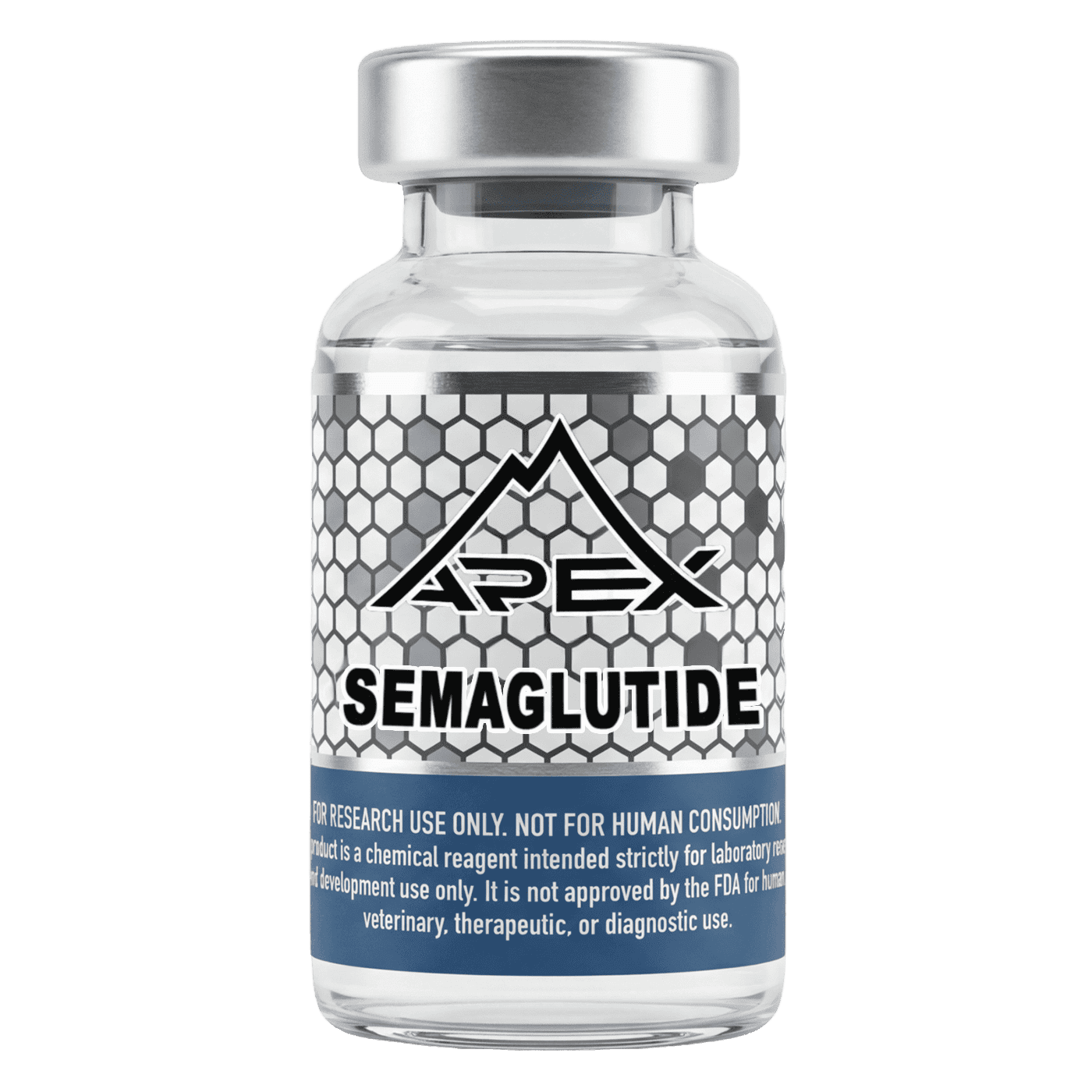
Certificate of Analysis — Semaglutide 20mg
GLP-1 receptor agonist – CAS 910463-68-2
Verified by Apex Laboratory in-house HPLC (purity by 220 nm peak area) and ESI mass spectrometry (mass identity confirmation). Data on this page describes the current shipping lot.
- Purity (HPLC, area %): 99.52%
- Mass found (ESI-MS): 4113.46 Da
- Mass expected: 4113.58 Da
- HPLC retention time: 16.5 min
- Batch ID: APX-2026-0305-S
- Test date: March 5, 2026
- Analyst: K. Norwood
View Semaglutide 20mg on the Lab Verified COA archive · Read the Semaglutide Research Guide
Semaglutide is a glp-1 receptor agonist supplied by Apex Laboratory as a high-purity research peptide intended strictly for in-vitro laboratory research and development applications.
Compound Overview
Semaglutide is a modified GLP-1 analog engineered with an albumin-binding fatty acid side chain that extends its half-life in research models. It binds and activates the GLP-1 receptor, which plays a central role in glucose homeostasis and appetite regulation pathways.
Within the incretin-mimetic class, semaglutide occupies the position of a selective single-axis GLP-1 receptor agonist: unlike dual- or triple-receptor research peptides that recruit GIP or glucagon receptors in parallel, semaglutide is engineered to engage only the glucagon-like peptide-1 receptor (GLP-1R), a class B G-protein-coupled receptor. This receptor selectivity makes the compound a frequently used reference ligand in laboratory work that needs to isolate GLP-1R-mediated signaling from the confounding contributions of other incretin receptors. On agonist binding, the GLP-1R couples predominantly to the stimulatory G-protein Gαs, driving adenylyl-cyclase activation and intracellular cAMP accumulation; cAMP-reporter and PKA-pathway assays in transfected cell lines are therefore the standard in-vitro readouts used to characterize semaglutide potency.
Semaglutide’s pharmacokinetic behavior in research models derives from three deliberate substitutions on the native GLP-1(7-37) backbone, sharing roughly 94% sequence homology with the endogenous peptide. An 2-aminoisobutyric acid (Aib) substitution at position 8 sterically shields the molecule from dipeptidyl peptidase-4 (DPP-4) cleavage, the principal route by which native GLP-1 is inactivated within minutes. A lysine-to-arginine swap at position 34 directs site-specific acylation to a single residue. Most distinctively, the lysine at position 26 carries a C-18 fatty diacid attached through a hydrophilic γGlu-2×OEG (AEEA) spacer arm; this lipid moiety promotes reversible non-covalent binding to serum albumin, which in turn slows renal clearance and underlies the extended half-life observed in protraction studies. The same hydrophobic side chain accounts for the relatively late HPLC retention time recorded for this compound and should be considered when designing reversed-phase chromatographic methods for purity confirmation.
Research Background & Published Literature
One of the most extensively studied peptides in modern metabolic research, Semaglutide has been the subject of the STEP, SUSTAIN, and PIONEER clinical trial programs. Published data spans applications in glycemic control, cardiovascular outcomes, and metabolic signaling. It remains a benchmark compound for GLP-1 receptor studies in laboratories worldwide.
Researchers interested in the published literature surrounding this compound can explore the following peer-reviewed resources for additional context on its mechanism of action, signaling pathways, and experimental applications in controlled laboratory settings:
- Wilding et al. (2021) — STEP 1 trial, NEJM
- Marso et al. (2016) — SUSTAIN-6 cardiovascular outcomes, NEJM
Semaglutide is among the most thoroughly documented GLP-1 receptor agonists in the peer-reviewed literature, and its publication record is useful to researchers as a comparative benchmark when characterizing newer incretin analogs. In contrast to triple-agonist peptides whose published evidence base is concentrated in recent obesity trials, semaglutide’s literature spans more than a decade and three distinct clinical programs — SUSTAIN (subcutaneous glycemic and cardiovascular endpoints), STEP (weight-management endpoints), and PIONEER (oral-formulation pharmacology) — giving it unusual breadth across glucose homeostasis, cardiovascular outcomes, and formulation science. This makes the compound a common positive control and reference standard in laboratory comparisons of receptor binding affinity, cAMP signaling potency, and metabolic-pathway activity.
A recurring theme in the broader mechanistic literature concerns signaling bias at the GLP-1 receptor. In the wider context of GLP-1R biased-agonism research, the relationship between G-protein (Gαs/cAMP) signaling and β-arrestin recruitment has become an active question, because β-arrestin engagement is classically linked to receptor internalization and desensitization (see Jones 2022, a general review of GLP-1 receptor biased agonism, PMID: 33880754). The medicinal-chemistry optimization that produced long-acting agonists such as semaglutide prioritized cAMP signaling potency and protraction; within receptor-pharmacology programs, selective single-axis GLP-1R ligands are commonly used as comparators against which more biased experimental analogs are evaluated in cell-based and rodent models, though the present source is a field-level review rather than a semaglutide-specific characterization. Researchers exploring this compound’s own published record may find the following peer-reviewed sources useful for context on its structure, signaling, and experimental applications in controlled laboratory settings:
- Wilding JPH et al. (2021) — Once-Weekly Semaglutide in Adults with Overweight or Obesity (STEP 1), N Engl J Med. PMID: 33567185
- Marso SP et al. (2016) — Semaglutide and Cardiovascular Outcomes in Patients with Type 2 Diabetes (SUSTAIN-6), N Engl J Med. PMID: 27633186
- Jones B (2022) — The therapeutic potential of GLP-1 receptor biased agonism (general review of GLP-1 receptor biased agonism), Br J Pharmacol. PMID: 33880754
- Semaglutide-specific receptor signaling and pharmacology — current PubMed literature: https://pubmed.ncbi.nlm.nih.gov/?term=semaglutide+GLP-1+receptor+signaling
Technical Specifications
- Product Name: Semaglutide
- Classification: GLP-1 Receptor Agonist
- Structural Description: 31-amino acid GLP-1 analog with a C-18 fatty diacid chain
- CAS Number: 910463-68-2
- Molecular Weight: 4113.58 g/mol
- Purity: ≥99% (verified by HPLC and Mass Spectrometry)
- Physical Form: Lyophilized (freeze-dried) powder
- Intended Use: In-vitro research use only — not for human consumption
Storage, Handling & Stability Guidelines
The albumin-binding side chain provides enhanced stability in lyophilized form. Store at -20°C long-term. Reconstituted Semaglutide should be refrigerated at 2–8°C and used within 28 days.
- Minimize time at ambient temperature during handling to preserve compound integrity.
- Avoid moisture exposure by resealing vials promptly after each withdrawal.
- Use appropriate personal protective equipment and follow your institution’s chemical safety protocols at all times.
- Label all aliquots with the compound name, concentration, date of reconstitution, and operator initials for complete traceability.
Quality Assurance & Analytical Verification
Apex Laboratory applies a dual-verification quality protocol to every batch before it enters inventory. Each lot undergoes High-Performance Liquid Chromatography (HPLC) to confirm chromatographic purity and Mass Spectrometry (MS) to verify molecular identity and molecular weight. This two-step analytical process ensures that the material you receive meets our ≥99% purity standard with confirmed molecular integrity. Certificates of Analysis documenting these results are available upon request for your internal quality records.
Frequently Asked Questions
What receptor does Semaglutide target?
Semaglutide selectively targets the GLP-1 (glucagon-like peptide-1) receptor. It features a C-18 fatty diacid modification that enables albumin binding, extending its research half-life compared to native GLP-1.
What is the molecular weight of Semaglutide?
Semaglutide has a molecular weight of approximately 4113.58 g/mol. It is a 31-amino acid modified analog of human GLP-1.
How does Semaglutide differ structurally from native GLP-1 in research terms?
Semaglutide is a modified analog of human GLP-1(7-37) sharing roughly 94% sequence homology with the native peptide. Three engineered changes distinguish it: an Aib substitution at position 8 (conferring resistance to DPP-4 cleavage), an Arg substitution at position 34 (directing site-specific acylation), and a C-18 fatty diacid attached to Lys26 via a hydrophilic gamma-Glu-2xOEG spacer (promoting albumin binding and extended half-life in research models). These features make it a useful reference ligand for GLP-1 receptor studies.
Why is Semaglutide considered a single-axis GLP-1 agonist compared with dual or triple agonists?
Semaglutide is engineered to selectively activate only the GLP-1 receptor, whereas dual agonists also recruit the GIP receptor and triple agonists add glucagon-receptor activity. This selectivity makes semaglutide a common comparator in laboratory work that needs to isolate GLP-1R-mediated cAMP signaling from contributions of other incretin receptors when characterizing newer multi-receptor research peptides.
What analytical considerations apply when verifying Semaglutide by HPLC?
The C-18 fatty diacid side chain makes the molecule comparatively hydrophobic, which produces a relatively late retention time on reversed-phase columns. Method development should account for this when selecting gradient conditions for purity confirmation. Apex Laboratory verifies each lot by in-house HPLC (purity by 220 nm peak area) and ESI mass spectrometry (mass-identity confirmation against the expected ~4113.58 Da); these data are summarized in the Certificate of Analysis for the current shipping lot.
Related Research Compounds
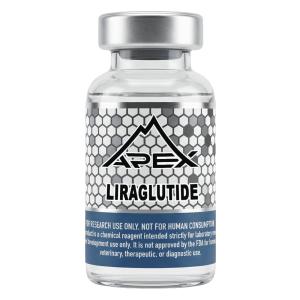
Researchers studying glp-1 receptor agonist pathways may also be interested in related compounds available from Apex Laboratory, including Tirzepatide, Retatrutide, Liraglutide. Explore our complete research catalog to browse all available peptides, reagents, and laboratory supplies, or visit our About page to learn more about our quality verification process.
Shipping, Packaging & Delivery
All orders placed before 2:00 PM Eastern Standard Time ship the same business day via tracked domestic carriers. Products are packaged in insulated, temperature-appropriate containers designed to preserve compound stability during transit. Upon delivery, transfer all materials to appropriate storage conditions immediately. For time-sensitive research protocols or special delivery requirements, contact our support team in advance to coordinate optimal shipping timing for your laboratory workflow.
Research Use Disclaimer
For in-vitro research use only. Not for human consumption. All products sold by Apex Laboratory are intended exclusively for qualified researchers, accredited laboratories, and educational institutions. Purchasers assume full responsibility for ensuring safe handling, proper storage, and compliance with all applicable federal, state, and local laws, regulations, and institutional policies governing the purchase and use of chemical research reagents.

Reviews
There are no reviews yet.